In recent days, tensions over the U.S. war in Iran have steadily mounted.
Polls have shown the campaign is widely unpopular. An entire flank of Trump’s MAGA base has criticized it as a clear departure from the “America First” mantra Trump has long espoused. Leaders within the Trump administration have pushed against claims it was about regime change, framing it instead as a necessary response to imminent threats.
Trump, meanwhile, has struck a decidedly defiant tone — offering few of the reassurances or rationalizations that past presidents have offered in the initial stages of war, and sounding more unbothered than embattled.
He has lamented American casualties but also seemed to shrug them off — along with additional deaths he expects to come and potential attacks on the U.S. homeland — as the simple cost of war, saying, “Some people will die.”
He has ignored concerns the war will turn into another unending Middle East quagmire, while openly flirting with taking over Cuba too.
Undermining his administration’s own messaging that the war is not about regime change, Trump wrote in a social media post Friday that there would be “no deal” with Iran without “UNCONDITIONAL SURRENDER” and new Iranian leadership “ACCEPTABLE” to him.
Sticking a thumb in the eye of his “America First” defectors, he said the U.S. and its allies are going to “work tirelessly” to make Iran “economically bigger, better, and stronger than ever before,” adding, “MAKE IRAN GREAT AGAIN (MIGA!)”
In the last week, Trump has instigated or been forced to navigate a stunning cascade of political threats. In addition to attacking Iran, he fired his Homeland Security secretary in charge of his signature immigration campaign, faced newly detailed allegations — which he denied — that he sexually assaulted a child alongside Jeffrey Epstein, saw his attorney general subpoenaed by fellow Republicans in Congress, and watched American jobs numbers drop as gas prices spiked.
And yet, Trump has also managed to avoid complex questions about those issues — the most pressing before his administration — and despite Democrats and some of his own supporters lashing out over them.
“I’ve seen a lot of Presidents fall short of their promises but I’ve never seen any President just doing the opposite of everything promised on purpose. Prices, Epstein, wars. Just absolutely racing to betray his voters,” Sen. Brian Schatz (D-Hawaii) wrote on X.
“This is Israel’s war, this is not the United States’ war. This war is not being waged on behalf of American national security objectives, to make the United States safer or richer,” said Tucker Carlson, one of Trump’s longtime allies.
Carlson said Trump committed U.S. forces to fighting in Iran for no other reason than because Israeli Prime Minister Benjamin Netanyahu “demanded it,” even though it “certainly wasn’t a good idea for the United States” and the Trump administration had “no real plan” for replacing the Iranian leadership it has now toppled.
The White House defended Trump’s actions across the board in statements to The Times on Friday.
On Iran, it said Trump “is courageously protecting the United States from the deadly threat posed by the rogue Iranian regime — and that is as America First as it gets.” On departing Homeland Security Secretary Kristi Noem and Atty. Gen. Pam Bondi, it said Trump “has assembled the most talented and competent cabinet in history,” and “continues to have faith in his Administration.”
On the economy, they said the Trump administration “is doing its part to unleash robust, private sector-led economic growth with tax cuts and deregulation,” and that Trump “has already initiated robust action” to control oil prices even amid the Iran war. And on the Epstein files, they said the latest claims unveiled “are completely baseless accusations, backed by zero credible evidence.”
Trump has also spoken out in defense of his handling of the various crises facing his administration — but not nearly with the sort of detail and solemnity that wartime presidents usually speak, experts said.
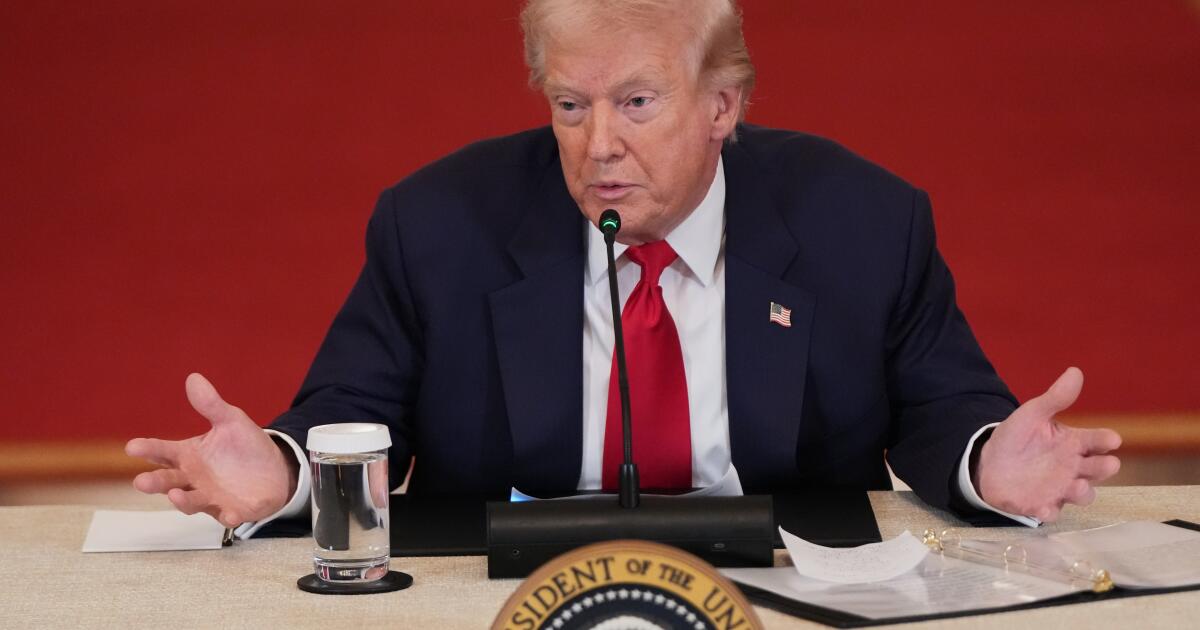
At his only public event on Friday — a nearly two-hour round-table with national leaders and sporting officials about college athletics — he ridiculed members of the media who asked about Iran and Noem.
“What a stupid question that is to be asking at this time,” he said, when asked about reports that Russia was helping Iran target and attack Americans there. “We’re talking about something else.”
When pressed as to why he was spending so much time talking about college sports when so much else is going on in the country and the world, Trump briefly talked about Iran — saying “people are very impressed by our military” and that the U.S. is now “more respected than we’ve ever been” — before concluding the event.
Jennifer Mercieca, a political historian and communications professor at Texas A&M and author of “Demagogue for President: The Rhetorical Genius of Donald Trump,” said she was surprised Trump didn’t make a stronger case for going to war in Iran during his recent State of the Union speech, and that he hasn’t been more aggressive about making the case for war since, including by using traditional language about bolstering American values around the world.
“In comparison to other presidents in a similar situation trying to lead a nation into war, that is surprising to me — and unusual,” she said.
Also unusual is the low public support for the war, Mercieca said, given that, since World War II, there has generally been high public approval for U.S. war efforts at their start.
Mercieca said she wonders if there is a correlation between Trump’s not providing a more vigorous rationale for the war and the low public approval for it — or perhaps between the low approval and the brash descriptions of the war as a merciless campaign of destruction and vengeance from others in the administration, such as Secretary of Defense Pete Hegseth.
She said Hegseth and others have shown a “lack of decorum, a lack of honor or dignity [in] their way of behaving, especially when we’re talking about warfare and human lives.”
Jack Rakove, a Stanford University professor emeritus of history and political science, said Trump’s posture is fitting with his character since he first entered politics and before, as he “can never take responsibility for anything that appears to be a mistake” and is “obsessed with the idea of appearing tough and tough-minded.”
Rakove said he does not believe, as some critics have suggested, that Trump launched the war in Iran specifically to distract from the Epstein files, which as of Thursday included newly released FBI descriptions of several interviews in which a woman accused Trump and Epstein of sexual assault in the 1980s when she was a child. Her accusations have not been verified.
But Rakove said he does wonder to what degree Trump is consciously pushing chaos in order to ensure that no one detrimental issue for him politically captures the public’s attention for too long.
Mercieca said Trump has always been “uniquely good at controlling the public conversation,” but that power has been tested recently by the Epstein files — which have held the public’s attention despite his repeatedly saying that “we should move on from that, that we should stop talking about it, that he’s been exonerated.”
She said Trump’s instinct in the current moment to push ahead aggressively despite waning support for his economic policies, his immigration policies and his war in Iran could be related to his desire to return people’s attention to his agenda, but is also in line with his long-held desire to go down in history — including by making big moves.
“I think he’s very much trying to leave his mark on the White House, I think he’s trying to leave his mark on the nation, I think he’s trying to leave his mark on the world, and I think war is a way that leaders have traditionally done that throughout history,” she said.