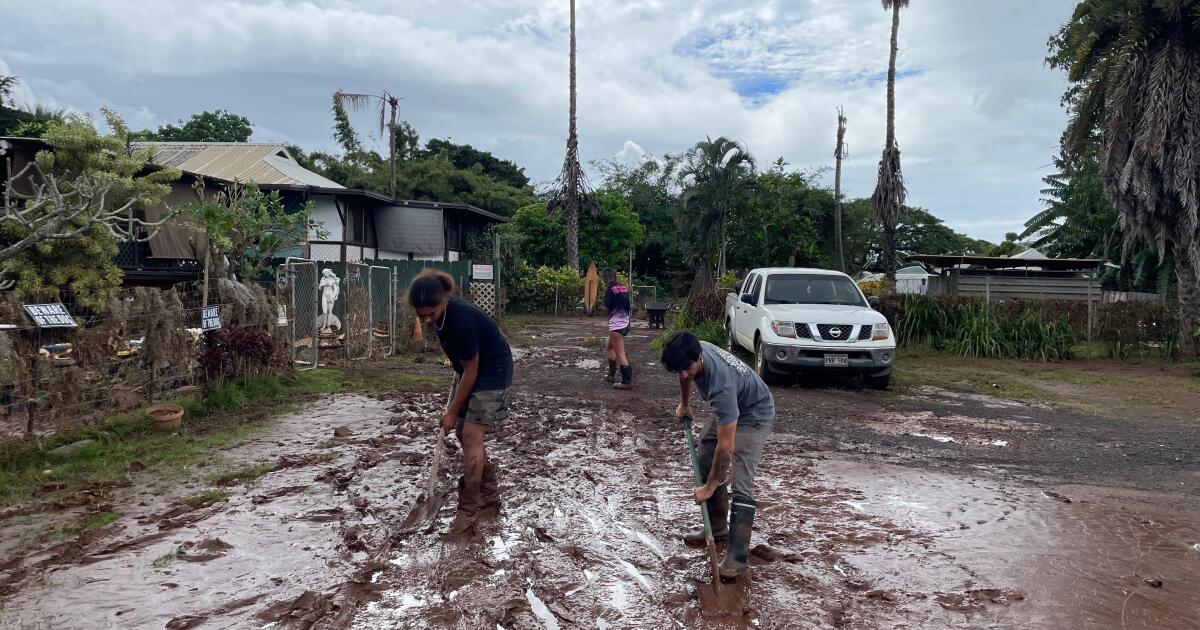
HONOLULU — Crews this week began evaluating damage from a surprise downpour that sent floodwaters raging through a neighborhood near downtown Honolulu — the latest bout in a series of storms and flooding that have pummeled the state over the past two weeks.
Residents along Oahu’s North Shore, famous for its big wave surfing, were cleaning up from the worst flooding to hit Hawaii in two decades when a storm Monday unleashed several inches of rain on the southern part of the island. Reddish-brown torrents gushed along roads in the Manoa Valley, a few miles east of downtown Honolulu, sweeping away parked cars and swamping much of the neighborhood.
Natalie Aczon had gone to the drugstore to pick up some medication for her mother on Monday. By the time she left the store some 15 minutes later, water was roaring down the street next to the shopping center.
“People came running out from Longs and one of the guys actually said, ‘That’s my white car.’ And it had elevated,” she said.
Michael McEwan and his wife Heather Nakahara returned to their home in Waialua on Oahu’s North Shore over the weekend to find their kitchen counters covered in red silt. Piled-up furniture blocked a hallway and a folding table they don’t own was lodged under a heavy sleeper sofa. There were two other mystery tables in their backyard.
The rushing water trapped the couple in a bedroom closet for eight hours with their two small terriers and three parrots until daybreak when McEwan was able to flag down firefighters driving down their road. The rescuers tied a rope to a tree next to their bedroom, which guided them through a narrow channel of flowing water.
They likely will have permanent reminders of the flooding in their house because of the red volcanic mud permeating everything.
“It’s full of iron, so it stains everything brownish-yellow,” McEwan said.
As the waters rose Friday, officials warned that the 120-year-old Wahiawa dam, north of Honolulu, was “at risk of imminent failure.” The dam has long been vulnerable, but worries eased as the water subsided.
The earthen structure was built in 1906 to increase sugar production for the Waialua Agricultural Co., which eventually became a subsidiary of Dole Food Co. It was reconstructed following a collapse in 1921.
The state has said Wahiawa dam has “high hazard potential” and a failure “will result in probable loss of human life.”
It has sent Dole four notices of deficiency about the dam since 2009, and five years ago it fined the company $20,000 for failing to address safety deficiencies on time, according to records.
Afterward, Dole proposed to donate the dam, reservoir and ditch system to the state in exchange for an agreement to repair the spillway to meet and maintain dam safety standards.
“The dam continues to operate as designed with no indications of damage,” Dole said in a statement.
The ferocity of the downpour even took National Weather Service meteorologists aback. They knew that lingering instability from a powerful winter storm system called a “Kona low” could yield more rain, but their models aren’t good at predicting how much moisture can remain in such systems, said forecaster Cole Evans.
“When you think it’s over it’s not quite over,” he said Tuesday.
The downpour, which dumped 2 to 4 inches of rain per hour, was highly localized: One rain gauge in the upper part of the valley recorded 6 inches, while the airport a few miles away got just one-hundredth of an inch.
There were no immediate reports of deaths or serious injuries, but authorities said hundreds of homes on Oahu’s North Shore were damaged by the flooding, which came as heavy rains fell on soil already saturated by downpours from a winter storm a week earlier.
More than 230 people had to be rescued. The water pushed houses off their foundations, floated cars out of parking spots and left walls, floor and counters covered with thick, reddish volcanic mud.
Evacuation orders covered 5,500 people north of Honolulu, and some residents fled on surfboards as water reached waist or chest high.
Farms around the state reported more than $9.4 million worth of damage as of Monday, according to a survey conducted by Agriculture Stewardship Hawaii, the Hawaii Farm Bureau and other organizations.
Gov. Josh Green said the cost of the storm could top $1 billion, including damage to airports, schools, roads, homes and a Maui hospital in Kula. He called it the state’s most serious since flooding since 2004, when floods in Manoa inundated homes and a University of Hawaii library.
Green’s office said Tuesday he had submitted a major disaster declaration request to the Trump administration.
Molly Pierce, a spokesperson for the Oahu Emergency Management Agency, said that in addition to volunteers and public workers who have been cleaning up, a contract company had arrived to begin collecting, sorting and removing large piles of debris.
She called the storm system “extremely unusual.”
“Most of us have not seen something that just keeps going like this,” Pierce said. “We feel like we keep getting punched down. But we’ll keep getting back up.”
The intensity and frequency of heavy rains in Hawaii have increased amid human-caused global warming, experts say.
McAvoy and Johnson write for the Associated Press. Johnson reported from Seattle. Associated Press writer Mark Thiessen in Anchorage, Alaska, and Gabriela Aoun Angueira in San Diego contributed to this report.