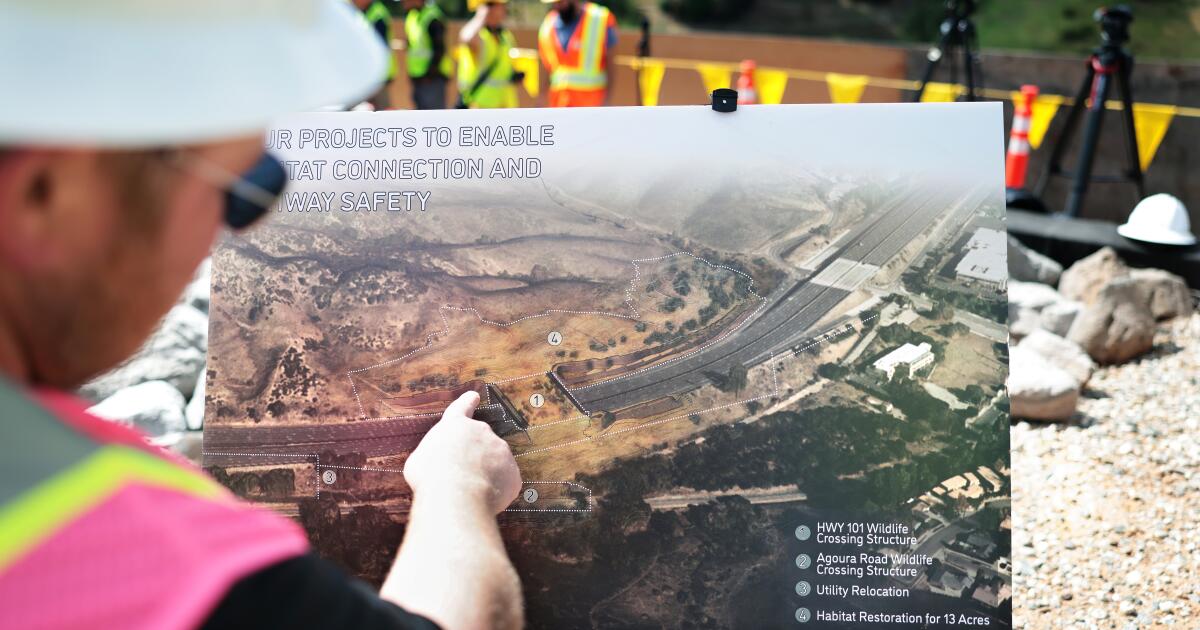
Right-wing pundits and politicos recently attacked the gargantuan wildlife crossing being constructed over the 101 Freeway in Agoura Hills over ballooning costs and delays.
A March 18 post in an outlet published by a conservative think tank set the outrage in motion, calling the now $114-million project a “bridge to nowhere” and “jobs program for environmentalists.” The Murdoch-owned California Post republished it and social media lit up. In an X post, U.S. Transportation Secretary Sean Duffy compared it with the state’s long-delayed, budget-busting high-speed train.
In short, they painted it as a boondoggle. One that might never get done.
But now the Wallis Annenberg Wildlife Crossing has a completion date: Dec. 2, announced at an Earth Day news conference held on the structure rising over a 10-lane stretch of the freeway. Cars whizzed by below.
That’s when the ribbon will be cut and mountain lions suffering from a lack of genetic diversity are expected to get their ticket out of the freeway-locked Santa Monica Mountains to seek mates elsewhere. Lions there have already shown alarming signs of inbreeding, including kinked tails and deformed testicles. The population could go extinct without intervention, and state wildlife officials listed the pumas as threatened earlier this year.
“This is a visionary project that was the impossible dream,” said Beth Pratt, California regional executive director with the National Wildlife Federation and the public face of the crossing. “This is something that’s captured the imagination of Angelenos, captured the imagination of the world.”
Driving under the crossing feels unremarkable; just another concrete behemoth. But it’s another world on top. Under a blue sky and puffy clouds, a gentle wind blew through a sea of about 6,000 native plants — Santa Barbara milk vetch, golden yarrow and purple sage.
It melts into the surroundings — and that’s the point. Soil that was hauled in was inoculated with the same microbes and mycorrhizal fungi that thrive in the nearby hills. The plants were grown just for the crossing, with another 40,000 on the way.
Miguel Ordeñana, senior manager of community science at L.A. County’s Natural History Museum, who discovered the late, great mountain lion P-22 in Griffith Park, saw the whole thing unfold.
Standing atop the suspended habitat, he envisioned bobcats hiding behind the bushes and ambushing ground squirrels: “I can see it now as this thing is coming to life.”
The event drew representatives from Caltrans, National Park Service, Santa Monica Mountains Conservancy, Agoura Hills City Council and other partners.
The plight of P-22, a celebrity mountain lion that once inhabited Griffith Park, helped inspire the wildlife crossing being built over the 101 Freeway in Agoura Hills
(Miguel Ordeñana)
There’s still significant work to be done before bobcats can come aboard.
Crews are currently building a second overpass over Agoura Road.
Once that’s completed over the summer, they’ll haul in 3 million cubic feet of soil — enough to fill half of SoFi Stadium — to bridge the gap between the two structures. Berms will be constructed to block out noise and light.
Like many dreams in California, the project didn’t come cheap. When it broke ground in 2022, it was expected to cost nearly $93 million. That held until last spring, when bids for the second stage of the project went out and “came back through-the-roof high,” Pratt told The Times earlier this year. The current estimate is $114 million but could potentially top out several million higher.
The surge came amid inflation and tariff-driven price increases. The National Highway Construction Cost Index, a figure calculated by the Federal Highway Administration, has increased by 67% since 2021. Torrential rains in 2022 and 2023 delayed the completion by a year.
There’s also the scale: It’s the largest wildlife crossing in the world, with two structures that together span roughly 320 by 175 feet.
The effort appears to be paying off. Driving down to L.A. earlier this month, Pratt was distressed because she was hitting painted lady butterflies in the midst of their long-distance migration. When she ascended the crossing the following day, she saw the dainty orange, black and white insects fluttering about. It moved her to tears.
They weren’t the only lepidoptera. American lady butterflies were laying eggs and white-lined sphinx moth caterpillars were inching along plants.
Then there’s Bob, a western fence lizard that’s taken up residence at the top of stairs that lead to the crossing. A rattlesnake has claimed the bottom. Birds like yellow-rumped warblers and California scrub jays round out the initial cast.
“I can say with some certainty that this is going to be the most popular reality show that L.A. produces,” Pratt said. Cameras will capture the action, though it won’t be broadcast live because “this is L.A. and someone will go try to pet the mountain lions.”
L.A. deserves a good show. The region is reeling from devastating wildfires, immigration raids and the upending of the state governor’s race. County residents reported record-low quality of life in a UCLA survey this year, with the high cost of living looming large.
Much is uncertain, uneasy. The soon-to-open crossing offers one non-abstract finish line.
More recent wildlife news
California lawmakers are considering a bill to create a statewide program to promote coexistence between people and wildlife, an issue reinvigorated by the euthanization of a beloved black bear with two cubs in Monrovia, writes Times reporter Katie King. The state’s wildlife agency operated a similar program until two years ago, when funding ran dry.

Blondie the bear wanders across a porch in Monrovia. The mama bear was euthanized by the California Department of Fish and Wildlife following two incidents where she swiped at residents.
(Brian Gordon)
The Golden State expanded the area in which boats are asked to slow down in an effort to avoid hitting and killing whales, reports the San Francisco Chronicle’s Brooke Park. Ship strikes are a leading cause of death for several whale species off California, where some of the world’s largest cargo ships pass through key feeding and migration routes.
Nutria, a hefty rodent with the tail of a rat, reappeared in California in 2017 — close to 40 years after it was deemed eradicated. As my colleague Samantha Lee explains, California wildlife officials recently published a study indicating the animal — considered a pest — was deliberately brought back to the state.
A few last things in climate news
California is in the midst of a powerful late-season storm, bringing significant rain to northern regions of the state. However, as fellow Times writer Ian James broke down, the state experienced the hottest March on record — a phenomenon that prematurely melted snow in the Sierra Nevada. The heat and early melt is expected to dry out forests earlier than normal, increasing the risk of wildfires.
After years of debate between fire officials arguing for the removal of anything that can burn within the first five feet of homes and ecologists backing selective landscaping, California proposed a compromise, reports my colleague Noah Haggerty. New regulations create a strict one-foot “Safety Zone” around homes where nothing burnable is allowed, while permitting some spaced-out plants beyond it.
Some who lost their homes in the Eaton and Palisades fires are rebuilding all-electric due to health and climate concerns. Per Times staffer Blanca Begert, burning gas and propane for cooking, as well as water and space heating, in California homes and businesses creates 10% of the state’s greenhouse gas emissions.
One last thing

BEY03F, the wolf pictured, briefly visited L.A. County before making her way to the Eastern Sierra.
(California Department of Fish and Wildlife)
Remember the wolf that stunned everyone by visiting Los Angeles County? She made history again by venturing into Inyo County earlier this month and remains in the Eastern Sierra. Experts believe she’s probably still looking for a mate.
This is the latest edition of Boiling Point, a newsletter about climate change and the environment in the American West. Sign up here to get it in your inbox. And listen to our Boiling Point podcast here.
For more wildlife and outdoors news, follow Lila Seidman at @lila_seidman on X and @lilaseidman.bsky.social on Bluesky.