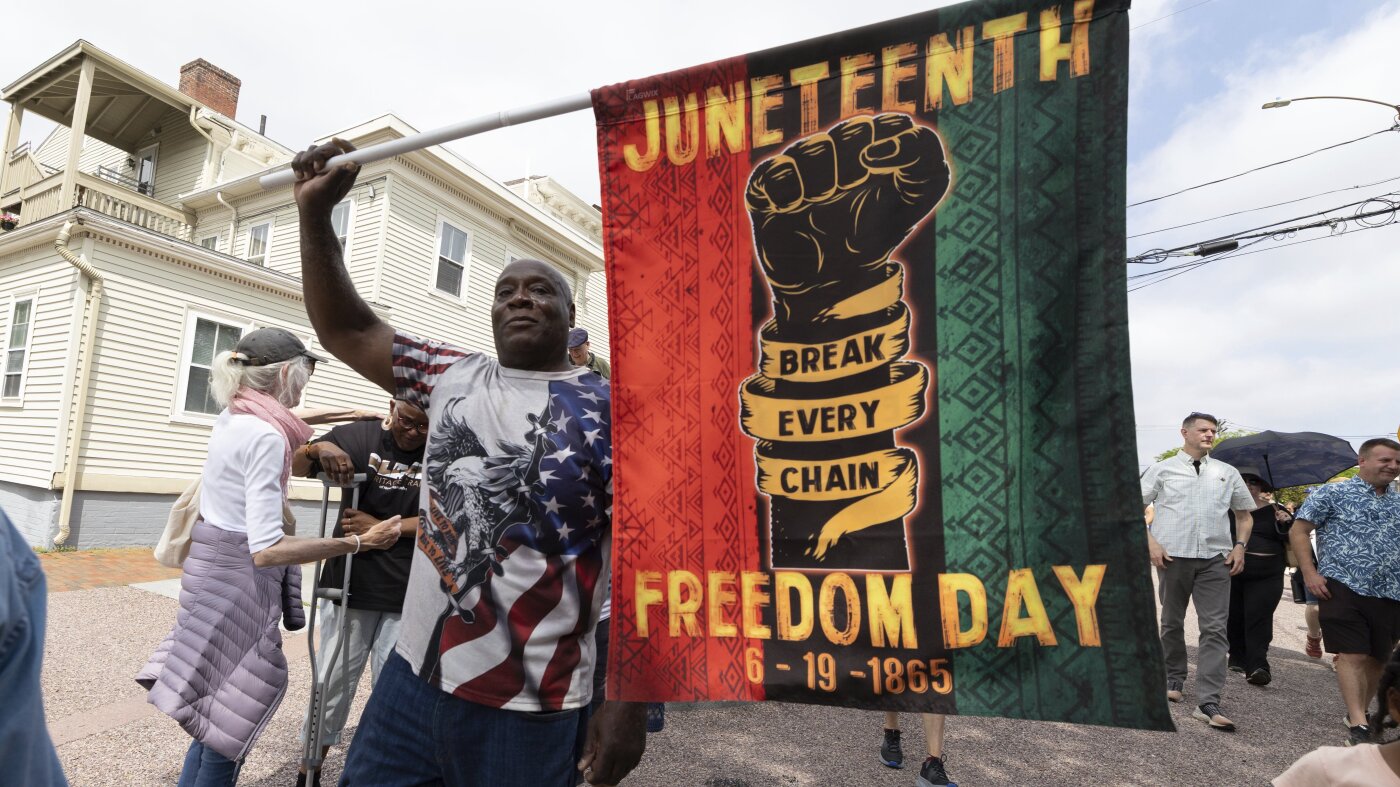
Robert Reid holds a flag during a Juneteenth celebration at the African Burying Ground Memorial Park on June 19, 2025, in Portsmouth, N.H.
Michael Dwyer/AP
hide caption
toggle caption
Michael Dwyer/AP
Weeks after the Civil War’s guns fell silent and barely two months after President Abraham Lincoln’s assassination, Union troops arrived in Galveston, Texas. They had come to enforce the Emancipation Proclamation, an order freeing enslaved people in seceded Confederate states. And the date they arrived — June 19, 1865 — is now remembered as the first “Juneteenth.”
The Emancipation Proclamation had been issued years earlier during the war, on Jan. 1, 1863. It’s the version most commonly emphasized in history books: the executive order that Lincoln himself reportedly said was “the great event of the nineteenth century” and his lasting legacy.

But word of such an order had already been circulating throughout the South for months. A preliminary proclamation, which contained much the same wording as the historic order, was issued on Sept. 22, 1862, days after the Battle of Antietam — the single bloodiest day in American military history. The purpose of it was to “warn that if the Confederate states don’t return to the Union by January 1st, [Lincoln] will in fact issue a final proclamation,” according to Harold Holzer, a Lincoln historian.
Not all enslaved people immediately knew about Lincoln’s orders, but many learned of it while the fighting was still raging. Rumors spread through informal networks, sometimes inadvertently from slaveholders themselves, says Holzer, who directs the Roosevelt House Public Policy Institute at Hunter College in New York.
Slaveholders would often discuss the proclamation right in front of the people they enslaved, he says. They wrongly assumed that since enslaved people were prohibited from reading and writing, they would be oblivious to discussion of events around them.
Black newspapers, abolitionist papers and Black church groups also shared information, according to Kellie Carter Jackson, chair of Africana Studies at Wellesley College. “All throughout the South, there are networks of communication” that allowed them to do so, she says. “So for [slaves] who know that this is happening, literally at midnight on January 1, 1863, … they’re … ready to party; ready for jubilee.”

The states bordering those who seceded, though, were an exception to the proclamation’s reach. These slaveholding states that chose to remain in the Union at the outbreak of war were exempted from the proclamation. They included Delaware, Maryland, Kentucky, Missouri and West Virginia, Holzer says. “Enslaved people in the border states were enormously frustrated,” he says. They largely knew of the proclamation, and that they were not eligible.
“There is a famous letter written by an enslaved woman named Annie to Abraham Lincoln in 1863,” he says. “‘Dear Mr. President, my name is Annie. I live in Maryland. I want to be free. How can I be free?'”
The “harpoon in the monster”
But the moral force of the Emancipation Proclamation and the seeming inevitability of the end of slavery led three border states to end the practice even before the end of the war, the historians who spoke with NPR say. Delaware and Kentucky held out until the ratification of the 13th Amendment —the constitutional change that officially abolished slavery in December 1865 and that Lincoln described as “the harpoon in the monster.”
As early as 1862, Black Southerners were already crossing into Union lines to escape slavery, an exodus that would intensify as the Confederacy increasingly lost ground to Union forces.
“The practice of running toward Union troops and offering their services begins before the Emancipation Proclamation,” according to Blair L. M. Kelley, president and director of the National Humanities Center and author of Black Freedom: A Visual History of Juneteenth and Emancipation Days.
“They are not participants in the cause of the Confederacy,” Kelley says. In many cases, she says, slaves withheld their labor and ran to the Union troops as soon as the opportunity presented itself.
“I think the idea really for most of the enslaved was that if the Union comes, you are free,” Kelley says. “They absolutely knew that the war was about their liberation.”
And although instructions to Union forces about how to handle escaped slaves were ambiguous before the proclamation — Union Gen. William Tecumseh Sherman famously complained about the thousands of camp-followers attached to his army — eventually Northern troops were a primary source of the news about emancipation, Holzer says.
Union soldiers carried copies of the Emancipation Proclamation as they pushed south through the Confederacy. Soldiers distributed them to slaveholders and even freed slaves who could read to “make it clear to them that all of the enslaved people in the area they had just conquered were … forever free.”
So, while the news was not entirely unknown to many enslaved people when federal troops reached Galveston, Juneteenth endures — marking the moment that the rumors of freedom finally became reality.