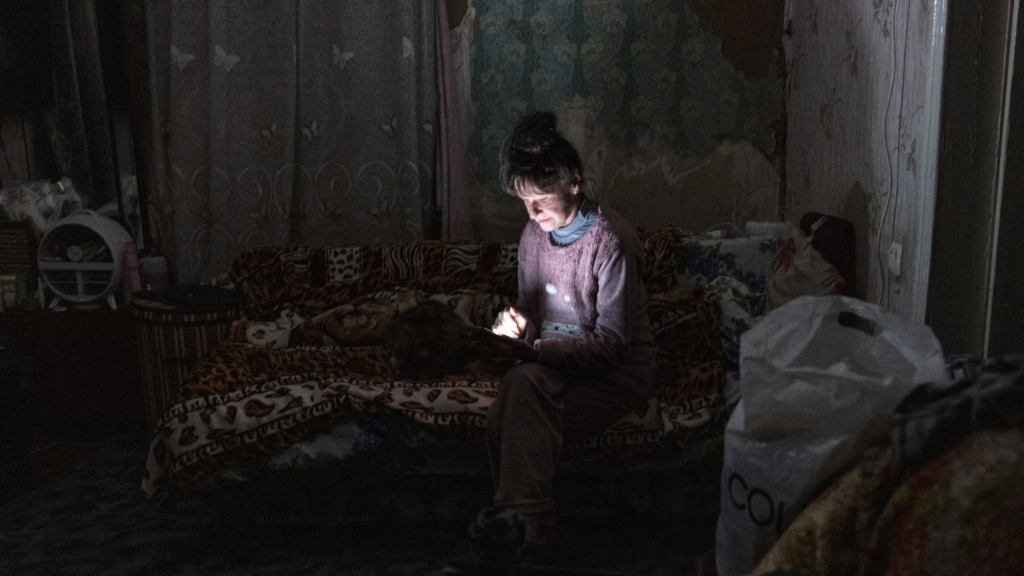
Sister Mary Consolata Nakawoojwa assists an elderly nun as she takes tea at the Little Sisters of St. Francis premises in Nkokonjeru, Uganda.
Stuart Tibaweswa for NPR
hide caption
toggle caption
Stuart Tibaweswa for NPR
Nkokonjeru, Central Uganda — Sister Jane Frances Nakafeero walks purposefully between rows of white crosses adorned with pink and yellow flowers in a cemetery at the Little Sisters of St. Francis convent in Nkokonjeru, Uganda.
She pauses, pointing at one of the simple graves. “This one was a nurse,” says Nakafeero. A few steps later. “This one was a teacher. This one was a social worker. This one was a doctor.”
A breeze blows softly between the headstones. Aspiring nuns begin their training in this convent, and novices take their vows before being sent out to serve the community. Eventually, the same sisters are laid to rest here. “The motherhouse,” Nakafeero says, referring to her order’s founding headquarters, “is where we begin and where we end.”

Sister Jane Francis Nakafeero, regional superior of the Little Sisters of St. Francis, walks with another nun at the cemetery in Nkokonjeru, Uganda, where members of the order are laid to rest.
Stuart Tibaweswa for NPR
hide caption
toggle caption
Stuart Tibaweswa for NPR
The convent also hosts retired nuns, and Nakafeero is increasingly worried about their fate.
Palliative care, which provides medical and emotional support to patients at the end of their lives, is a relatively new concept, arising only in the 1960s. There is little funding for, or knowledge about it, especially in the Church, she explains. The problem of caring for elderly nuns is particularly dire in African orders, which already are underfunded in comparison to American and European ones.
At the convent in Nkoknojeru, young nuns look after retired ones, taking them to and from bed and serving their meals, but the old women do not have the resources they need: adult diapers, wheelchairs, hearing aids – even warm blankets. At a meeting of the African Palliative Care Association in 2023, Nakafeero laid out these concerns one by one. She caught the attention of Jean Callahan, former chair of the Irish Hospice Foundation and an advisory board member of the association.

Sister Jane Francis Nakafeero stands outside the Little Sisters of St. Francis premises in Nkokonjeru, Uganda. After more than 25 years working in healthcare, Sister Jean Francis helped advocate for a partnership between the Little Sisters of St. Francis and the African Palliative Care Association to improve end-of-life care.
Stuart Tibaweswa for NPR
hide caption
toggle caption
Stuart Tibaweswa for NPR
Callahan was in Uganda to learn more about two projects funded by the Irish Hospice Foundation. She listened closely to Nakafeero, thinking of her grandmother, Sybil, who lost her husband in the 1950s and departed Ireland for Tanzania to work as a nun.
“These women, who could have been my grandmother’s colleagues, are being left at the end of their lives without the basic human supports they should have,” Callahan says.
So the two women decided to start a pilot program with the African Palliative Care Association to provide hospice support to aging nuns. The program, which began in September 2025, endeavors to cater to the nuns’ medical care and material needs. It will also provide psychological interventions for both emotional support and mental stimulation, along with activities for the retired nuns and training for the young nuns tasked with caring for them.
The program has yet to be fully realized. At present, researchers led by African Palliative Care Association director Eve Namisango are assessing the needs of some 50 retired sisters with the Little Sisters of St. Francis. Most of the nuns are from Uganda, but the order includes Kenyan and Tanzanian nuns. After that, Namisango and her team will begin training caregivers, with hopes of rolling out palliative care in Ugandan convents by 2027, and then across the continent.
“They have served humanity for all their useful years,” Namisango says of the nuns. Now, “they deserve decent, person-centered care.”
With some 82,000 nuns in Africa, according to the Vatican, the African Palliative Care Association believes that between 8,000 and 10,000 could be in need of end of life care.

Nuns attend morning mass in the chapel at the Little Sisters of St. Francis.
Stuart Tibaweswa for NPR
hide caption
toggle caption
Stuart Tibaweswa for NPR
Prayer … and then what?
Mornings for the 14 retired sisters in the Nkokonjeru convent begin with prayer. “Take what we b
ring and give what we need,” they warble. Since many of the sisters can no longer walk, they line up in wheelchairs, with graying hair peeking from under their habits. Father Joseph Balikuddembe, a young priest, weaves down the aisle for communion, depositing wafers on the nuns’ lips.
He fears the sisters do not have enough to do. “They have retired but their brains need to be kept active,” he says, before departing to give communion to the nuns too weak to rise from bed.
After praying, the nuns eat a breakfast of hardboiled eggs along with mashed plantain and bread, sitting at assigned places around scuffed wooden tables. After eating, some of the nuns are wheeled out into the sun, but there are not enough wheelchairs. About ten of the nuns have mobility issues, while there are only seven wheel chairs at the convent. Those chairs are in bad shape, with sticky wheels and faulty hand brakes. Some nuns go back to their rooms.

Young nuns prepare to serve breakfast to elderly sisters at the Little Sisters of St. Francis premises.
Stuary Tubaweswa for NPR
hide caption
toggle caption
Stuary Tubaweswa for NPR

Elderly nuns sit in their dining room at the Little Sisters of St. Francis premises, where they’ll have tea. Retired and aging members continue to live within the community compound.
Stuart Tibaweswa
hide caption
toggle caption
Stuart Tibaweswa
On the May day of our visit, 81-year-old Ugandan President Yoweri Museveni was being inaugurated for a seventh term in office. A few of the retired sisters watched on a wall-mounted television in the dining room. Those that could speak chatted quietly, and others stared into the distance.
Sister Mary Hedwig Agoya came to the convent in Nkokonjeru in 1951, when she was only 14. When Agoya arrived at the order of the Little Sisters of St. Francis, she was met by its founder, Mother Kevin Kearney, another Irish woman who traveled to Uganda in 1903. Over the course of 50 years, Kearney founded numerous hospitals. Today, she is a candidate for sainthood.
The aspirant nun gave up her clothes and possessions, while Kearney helped her dress in khaki-colored robes and a veil. “She embraced me,” Agoya, now 89, says.

Sister Mary Hedwig Agoya, a retired nun of the Little Sisters of St. Francis, joined religious life at the age of 14 and is now 89 years old. She is among the elderly sisters living within the convent compound.
Stuart Tibaweswa for NPR
hide caption
toggle caption
Stuart Tibaweswa for NPR
After that, Agoya worked as a teacher for 40 years.
Since she retired, life has felt different. Before, she spent her days managing a classroom, supervising students and marking papers. Now, she says, “it becomes a bit dull.” Her voice is staccato and hoarsened by age. She prays in the morning and again before lunch and at bedtime. Most of the other nuns who entered the convent with her have died.
Sister Rosemary Luyiga, who’s 95, spends most of her time in her room, which holds a single bed and a chair. It’s decorated with a black-and-white portrait of her mother as a young woman, and a candle celebrating the centennial of the Little Sisters of St. Francis, adorned with Kearney’s face.Sun slants through the window.

Sister Rosemary Luyiga, who’s 95, holds a portrait of her late mother in the room where she lives within the residential compound.
Stuart Tibaweswa for NPR
hide caption
toggle caption
Stuart Tibaweswa for NPR
Luyiga was 12 years old when she came to the convent in 1944. She ran a school teaching young girls to cook and clean. She lived through the Second World War and through Uganda’s independence from Britain. But “I don’t remember much of those things,” she says of world events that occurred beyond the convent walls. “I don’t think we were very much interested.” She best recalls the ten different locations in which she served, written out neatly in blue ink on a sheet of paper.
Mostly immobile, she is often by herself. “I don’t know what can take away loneliness,” Luyiga reflects. “You would like to sit and talk, but you find that you cannot do that.”
There are not enough caregivers at the convent to assist her, she adds, even in cases of emergency. Resources are stretched thin and qualified nurses are few. If she needs medical aid or simply has to go to the bathroom, “I don’t even call for help” she says.
Training the Caregivers
Looking after elderly nuns like Agoya and Luyiga is Sister Mary Consolata Nakawoojwa. A social worker, she studied geriatric care in the United States. She is now part of a team with two other sisters and a handful of cooks and caregivers, responsible for about a dozen retired nuns. The demands are constant, and Nakawoojwa hardly has time to sit down.
“Thank you for eating,” she tells one of the elderly sisters gently at mealtime, before eating, herself. “You have eaten very well.”

Sister Mary Consolata Nakawoojwa wheels an elderly nun to her room at the Little Sisters of St. Francis premises in Nkokonjeru, Uganda on May 12, 2026.
Stuart Tibaweswa for NPR
hide caption
toggle caption
Stuart Tibaweswa for NPR
The sisters in her charge often suffer from depression and anxiety. “They are not sure really how life will be,” she says. “We define ourselves by what we do. But now they’ve got to be instead of doing. They have to be, and then they have to redefine identity.”
As a result, she wants nuns to receive psychological support. Palliative care is not just about pain relief but adjusting to new circumstances at the end of life. “Whether you’re a nun in Africa or you’re a construction worker in the Bronx, you face those same kinds of concerns as you face the end of your life. And it means a lot to have people to walk with you in that place,” says Kristina Newport, chief medical officer at the American Academy of Hospice and Palliative Medicine.
Who cares for the nuns?
Callahan has wondered if nuns, like those at the Little Sisters of St. Francis, are overlooked simply because they are women. “I feel very aggrieved that nuns are second-class citizens,” she says.
Nakafeero has arrived at a similar conclusion. “We have the bishops, who are in charge of the dioceses and in charge of the priests. They would do something for the priests, but they will not do something for the nuns,” Nakafeero says. As as a result, she concludes, nuns like her “have to do it ourselves.”
The Vatican did not respond to repeated requests for comment, including questions about who is responsible for female religious orders upon retirement.
For now, survey research with elderly nuns, including those in Nakawoojwa’s care, is ongoing, funded by an Irish donor who wishes to remain anonymous. Campaigners are currently trying to raise about $135,000 needed to carry out the rest of the program, including providing material support to nuns, and training to their caregivers. “I’m an optimist and I’m also bloody determined on this,” Callahan says.
For Nakafeero, the program is personal. She cared for her own father as he died, which later inspired her to establish a palliative care program at Naggalama Hospital, where she is chief operating officer.
In Nkokonjeru, she looks across the rows of graves leading to the mausoleum where Mother Kevin Kearney is buried. Nakafeero is 65 now and contemplates what will happen to her as she grows older too. “In a few years time, I myself will be there,” she says, reflecting on her impending retirement. Having worked hard all her life, “when that time comes, I would want someone to gently, gently journey with me.”
Sophie Neiman is an award-winning journalist. She’s based in Kenya and writes about the region.