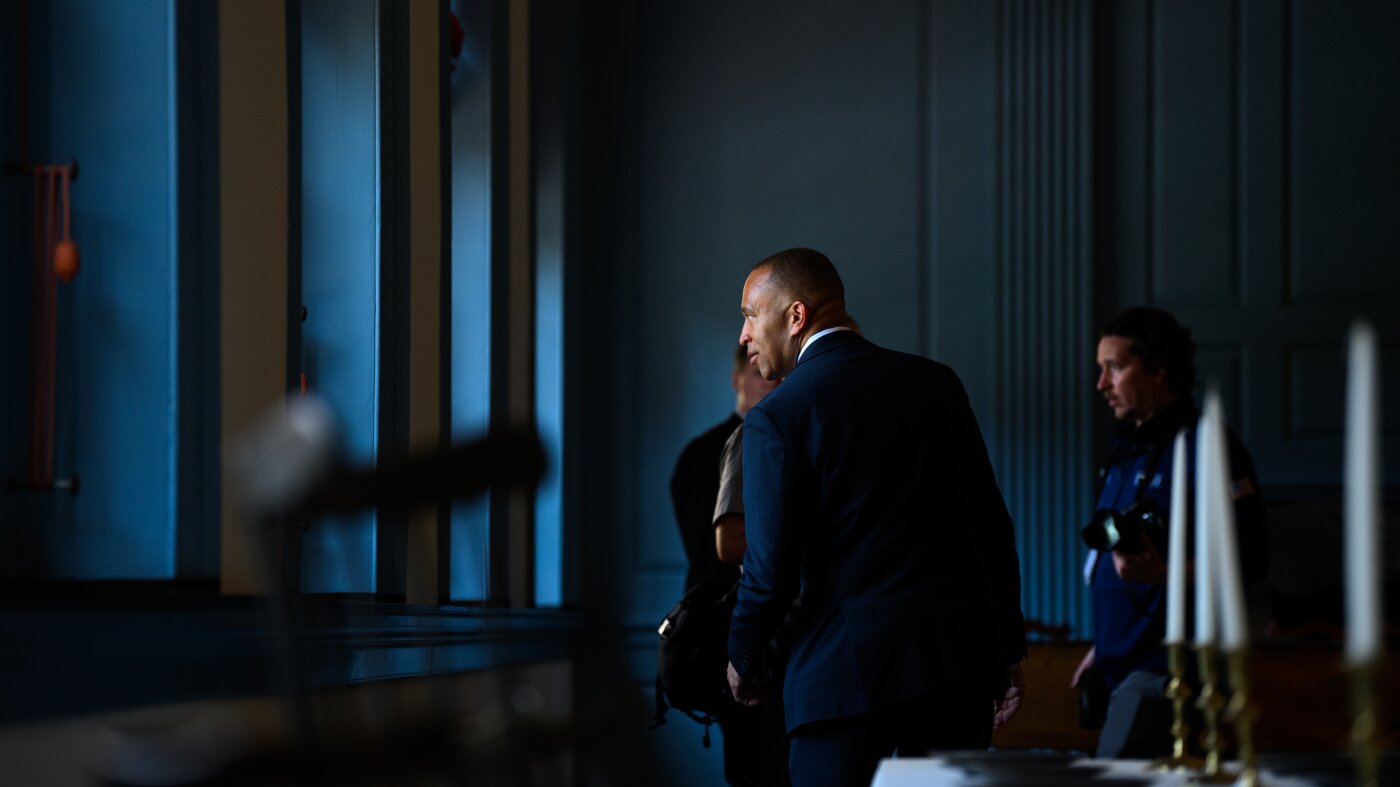
House Minority Leader Hakeem Jeffries, D-N.Y., looks out a window at Independence Hall in Philadelphia on July 2, 2026.
Kriston Jae Bethel for NPR
hide caption
toggle caption
Kriston Jae Bethel for NPR
Stay up to date with our Politics newsletter, sent weekly.
As soon as the National Archives in Washington opens to the public, visitors stream into its rotunda to view the country’s most cherished documents.
“Oh my word,” a tank-topped tourist says as he gets his first look at the Declaration of Independence, produced 250 years ago by the Second Continental Congress.
The Declaration is not the only legacy of the Continental Congress. Another is the legislative branch we know today. And as the nation celebrates its semiquincentennial, it has also sparked conversations on Capitol Hill about whether the modern Congress is living up to the aspirations of that era.
In a vault a few floors above the rotunda, archivist Jane Fitzgerald has selected a lesser known set of records to study, the rough journals of the Second Continental Congress.

Between 1775 and 1781, Charles Thomson, the secretary of the Second Continental Congress, kept meticulous daily records of resolutions, motions and correspondence.
Like the entry for June 11, 1776 when a committee of five was appointed to draft the declaration. Their names are scrawled on the page in Thomson’s neat cursive: Thomas Jefferson, John Adams, Benjamin Franklin, Robert Livingston and Roger Sherman.
Fitzgerald flips to July 2, when the Congress voted for independence. A page later is the entry noting the vote to adopt the Declaration of Independence. The date scrawled atop that page: July 4, 1776.
A first rough draft of history
These marbled logbooks do not contain the soaring prose of their famous cousin in the rotunda downstairs, but they are like a first rough draft of history, showing this early assembly at work as delegates slowly coalesced around independence.
“The hard work of the members of the Continental Congress, through their motions, through their committees, made the Declaration of Independence come alive on the parchment,” Fitzgerald says.
Jay Wyatt, the director for legislative archives, unpacks another faded document, this one written by Oliver Ellsworth from Connecticut, who served in the Continental Congress and later the U.S. Senate.
Wyatt says the Bill of Rights was the seminal product of that first session of the U.S. Congress. On these pages, you can see a throughline between the Continental Congress and its modern descendant.
“It shows that the end product has the consent of the people, an idea that is put forward in the Declaration and worked and refined all the way until you get to the Bill of Rights,” Wyatt says.
Yale University history professor Joanne Freeman says the trajectory between these two bodies was not a given — and not just because of the long odds of a ragtag continental army defeating a global power.
At first, Freeman says, “People’s colonies in many ways felt like their country. You have people noting the Southerners seem to dress very loudly, the Northerners have no sense of humor, they are sticks in the mud, all dressed in brown.”

The entry for July 4, 1776 in one of the journals from the Second Continental Congress reports the approval of the Declaration of Independence.
Sam Gringlas/NPR
hide caption
toggle caption
Sam Gringlas/NPR

The National Archives houses the rough journals of the Second Continental Congress, kept by its secretary, Charles Thomson, between 1775 and 1781.
Sam Gringlas/NPR
hide caption
toggle caption
Sam Gringlas/NPR
And, of course, there were more fundamental divides, including over slavery, that would not be resolved by the Continental Congress or by its successors for many years. When the First Continental Congress convened in 1774, Freeman says it was more like a temporary union of allies responding to a crisis than a national legislature, of which colonists would have been deeply skeptical.
But the war effort required raising money, dealing with foreign powers and recruiting troops, says Jack Rakove, a history professor emeritus at Stanford University. He says the weak Continental Congress struggled to meet those demands, but it did represent the glimmers of a fledgling government.
“It had no real precedent in American history,” Rakove says. “So it is the basis of a national government, but a national government of a very strange and anomalous kind.”
While delegates were not popularly elected, they were concerned with public opinion, encouraging local town halls where regular people could debate whether they were willing to fight for independence.
“Now would Congress have acted without them? Probably,” Freeman says. “But one of the things that was different was the public was first and foremost.”
This idea of a government close to the people, albeit at that time a very narrow segment of them, became foundational. Freeman says this moment also previewed the role a Congress could serve.
“The clashing and the interaction and negotiating, it’s in that stuff that you get something bigger than any one person or state or interest, and that’s true throughout,” she says.
Congress today
The U.S. Congress is now much bigger, more diverse and more reflective of the nation. It is also extremely polarized. That is one reason Rep. Brendan Boyle, a Pennsylvania Democrat, organized a July 2 bipartisan Congressional delegation to Independence Hall, which sits inside his district.
Boyle says it is only the second formal gathering of Congress at this site in Philadelphia since the U.S. Capitol relocated from the adjoining Congress Hall to Washington, D.C. in 1800.

Rep. Brendan Boyle, D-Pa., gives remarks during a ceremonial gathering of members of Congress at Independence Hall in Philadelphia on July 2, 2026.
Kriston Jae Bethel for NPR
hide caption
toggle caption
Kriston Jae Bethel for NPR

House Minority Leader Hakeem Jeffries returns to his seat after delivering remarks during a ceremonial gathering of members of Congress at Independence Hall.
Kriston Jae Bethel for NPR
hide caption
toggle caption
Kriston Jae Bethel for NPR
He says the idea was for, “the most conservative Republican to the most progressive Democrat, to return to the room where it all began and remind ourselves that we are the inheritors of this great tradition.”
In an interview last week ahead of the event, Boyle said Congress is not always succeeding at safeguarding that inheritance, as the legislative branch has ceded so much of its Constitutional authority to the president.

Congress in recent years has given presidents broad leeway to wage war and has increasingly declined to assert its power of the purse when the executive branch has attempted to act unilaterally.
“I do think our founders would be surprised and alarmed that this current Congress has not jealously guarded its prerogatives as the legislative branch, not just in the last two years but over the last 25 years,” he says.
The festivities in Philadelphia will include the burial of a time capsule. Another has been sealed for burial on Capitol Hill, where lawmakers also reflected on their place in the history of the institution.
Congress is still grappling with versions of some of the same questions those early congresses faced, like the scope of government and what fair representation means.
“The Congressional Time Capsule is a reflection of our faith in the future of this grand experiment in self-governance, faith that this moment is worth preserving, and faith that the great American story will endure for another 250 years,” House Speaker Mike Johnson, R-La., said at a ceremony last month.
One of the larger-than-life artworks in the Capitol Rotunda is the iconic painting by John Trumball, which is supposed to show the moment the Second Continental Congress received the draft of the Declaration of Independence at Independence Hall in the summer of 1776.

Tourists visit the U.S. Capitol appear under John Trumbull’s larger-than-life painting depicting the moment the Declaration of Independence was presented to the Second Continental Congress.
Ted Shaffrey/AP
hide caption
toggle caption
Ted Shaffrey/AP
Gazing up at the painting of that historic place in his district, Boyle says he feels awe and pride. “I also feel a certain burden to live up to what those founders intended 250 years ago.”