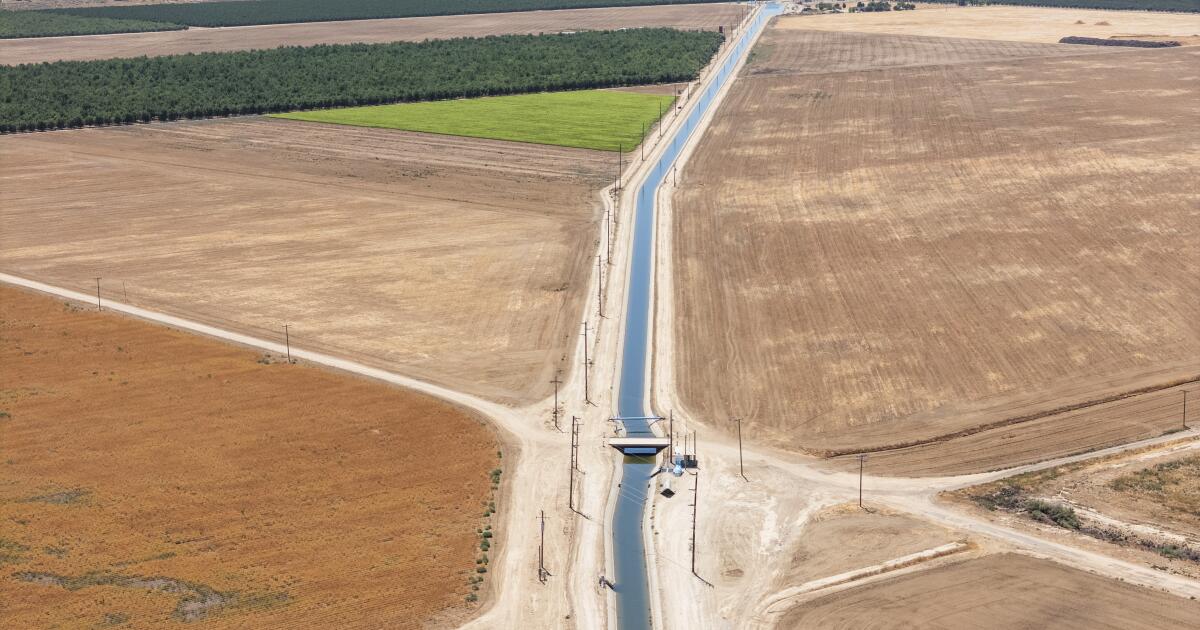
California’s Central Valley is one of the country’s richest farming regions, blessed with fertile soils, sunny days and a massive man-made system of irrigation canals and reservoirs.
But as climate change intensifies, droughts deepen, and water restrictions kick in, growers in much of the valley are getting less water for their fields. They also face new limits on how much they can pump from underground, forcing them to leave hundreds of thousands of acres dry in the coming years. Some are turning to an answer they never thought they’d embrace: solar.
“We still want to farm, but taking the chance that water will be here was too risky,” said Todd Tracy, a fifth-generation farmer, as he drove through his groves of green pistachio trees about a half-hour west of Bakersfield.
Farmer Todd Tracy is converting 2,600 acres of his Buttonwillow farm to solar.
(Myung J. Chun / Los Angeles Times)
In 2021, he optioned about a third of his family’s 8,600 acres to a solar developer, Avantus. The company is planning the largest solar-plus-storage project in the country, called Buttonbush. Its panels will eventually cover almost 12,000 acres and link up to a substation near the tiny town of Buttonwillow, before sending two gigawatts of electricity, enough to power 1 million homes, across the state.
“We weren’t all for this, but we had to find a use for this ground,” Tracy said of the discussions among his family members when they were first approached by the developer.
The farm grows cotton, corn, wheat, carrots, potatoes, pistachios and almonds. But stretching between the planted fields lie wide swaths of dusty, brown soil, fields fallowed over the years for lack of water. The home Tracy’s father lived in before he died in 2024 sits in a cluster of trees right next to one.
“We’re still paying mortgages, we’re still paying taxes and employees, and we see the writing on the wall,” Tracy said.
What the writing says is dire. Roughly half the farm receives water from Northern California via a vast system of aqueducts. The amount has been shrinking for two decades, and this year growers got 45% of what they are allotted.
The rest of the fields rely on water pumped from underground, and that’s also getting squeezed as California’s Sustainable Groundwater Management Act kicks in. Tracy says growers in his area could see 30% cuts by 2040.
The law was adopted in 2014 to address acute overpumping causing dry wells and sinking ground. Pumping limits ratchet down each year until 2040 in many areas, and farmers now face fines if they exceed them.

The Midway Substation in Buttonwillow is to connect with power generated by solar projects on nearby farmland. Farmers are converting their fields to solar over lack of water.
(Myung J. Chun / Los Angeles Times)
“I want to be optimistic, but being realistic, there’s not going to be water there in 2040,” Tracy said, pointing to a 600-acre field of “very good soil” left bare since he ripped out almonds at the end of their 25-year productive cycle two years ago.
He said he may need to lay off five or six seasonal workers once all the land in the solar project moves out of production.
Kern County approved Buttonbush solar in March. It includes land from about 18 farmers in the Semitropic Water District and neighboring Rosedale-Rio Bravo Water Storage District.
“Now we’re just waiting for the developer to move,” Tracy’s cousin Mike Frey said. “It’s looking like they will.”
Buttonbush is one of dozens of large, 100-plus megawatt solar fields cropping up across water-stressed regions of the state, especially the San Joaquin Valley.
Researchers at the Public Policy Institute of California estimate as much as 20% of the valley’s irrigated land may go dry by 2040.
“Growers are feeling pinched,” Caitlin Peterson, associate director of the PPIC Water Policy Center, said. “Solar is one of the potential options for folks that are having to take land out of production that has the potential to be fairly lucrative.”

A drone view shows how Todd Tracy is converting 2,600 acres of his Buttonwillow farm to solar for lack of water. Top and right are wheat and cotton.
(Myung J. Chun / Los Angeles Times)
Farmers’ desperation coincides with California’s solar dreams. The state is legally mandated to reach 100% clean electricity by 2045. That will require an additional 10 gigawatts of clean energy a year and between 0.5 and 1.3 million acres of in-state solar development, the California Energy Commission says.
Solar on retired farmland in the Central Valley could go a long way, potentially 30 gigawatts of the way, according to the PPIC, toward meeting that goal.
Some of the largest arrays are planned for places that have historically been bastions of anti-solar sentiment.
Just three years ago, several board members of the Westlands Water District, the largest agricultural water agency in the Central Valley, expressed concern about solar. “I thought we were a farming board,” one said when the prospect of converting more land came up.
Since then, the Westlands Solar Park, which launched in 2016 as a small pilot, has continued to expand toward a 2.27-gigawatt target in Kings and Fresno counties. The 1.15-gigawatt Darden Clean Energy Project broke ground this year in Fresno, also in Westlands.
But the biggest indication of the shift came in December, when the Westlands board of directors approved converting 135,000 acres, about a fifth of all the land in the irrigation district, into a giant network of solar farms.
More than half that land is owned by the district but is unsuitable for farming. The ground is loaded with crop-harming salts, or in some areas prone to sinking if pumping resumes.
Individual growers will also put land into the project.
A decade ago, converting farmland to solar farms was “something nobody wanted to talk about,” Allison Febbo, Westlands’ general manager, said. But now, “I kind of call it our survival plan into the future.”
Advocates say retired farmlands are some of the best places for solar because permitting is faster than on ecologically sensitive desert areas. Unlike farmland converted to housing, solar installations could more easily revert back to farming at the end of a project’s 30-year lifespan.
And, according to a recent report from the Solar Energy Industries Assn., there is more than enough fallowed land in California to meet the solar need.
But not all farmers want solar. A 1965 law, the Williamson Act, was designed to preserve farmland from suburban sprawl by giving tax breaks to growers if they agree to keep their land in farming.
There’s a hefty fee for breaking a contract, which the solar industry has been trying to get rid of for years, most recently with a proposed bill from Assemblymember Buffy Wicks (D-Oakland). Some farming groups consistently fight the effort.
“Water availability in California changes all the time, and the response has never been to give people a free pass out of a contract they signed,” said Peter Ansel, director of policy at the California Farm Bureau. He said the organization would want to see any changes to existing law tailored narrowly to only the most water-stressed areas and not allow full cancellation with no fees.
Yet in a sign of the changing times, the Kern County Farm Bureau broke last year with the state Farm Bureau on this to support Wicks’ bill after hearing from members who wanted solar.
“Kern would prefer to have water and to have farmland being farmland,” said Todd Snider, president of the Kern County Farm Bureau. “If that’s not an option, we advocate for property right holders to do what they want to do with their property.”
Westlands Water District is pushing the state grid operator to prioritize more transmission lines in the Central Valley, Febbo said. If that happens, construction of one of the world’s biggest solar complexes could start within five years.