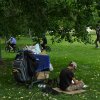
Joseph Williams, 49, a chronically homeless man, was arrested on June 28 and charged with two felony counts of camping on state property after police found him living in a public park in East Nashville. He spent nine days in jail before the felony charges were dismissed by a judge. After his release, he returned to the park.
Erica Lynn for NPR
hide caption
toggle caption
Erica Lynn for NPR
NASHVILLE, Tenn. – In the burgundy booth of a diner, John Lozier leaned in, lowered his voice and asked his friend a question he’s carried for nearly two weeks.
“Joe, we haven’t talked about when they arrested you,” said Lozier, 73.
The man across the table shrugged. Dark sunglasses obscured his gaze. The plastic-sheathed menus still lay open on the table.
“They tased you?” Lozier pressed.
“Yeah,” said Joseph Lamont Williams, 49, taking a swig of coffee.
When he refused to leave the Nashville public park where he has lived for the past several years, Williams became one of a handful of homeless people in the country to be arrested and charged with a felony for camping on public property.

Eleven states have passed homeless camping bans over the last four years, according to the National Homelessness Law Center. In the two years since the U.S. Supreme Court ruled that cities can ban people from sleeping and camping in public, more than 300 municipalities have joined them. Supporters of these laws say they enable public officials to enforce rules that already exist and provide incentive for unhoused people to seek shelter. But opponents call the laws cruel and say that an arrest record only makes it harder for those experiencing homelessness to secure a job or a home.

John Lozier sits with Joseph Williams. Lozier has befriended Williams over the last few years and in early July helped Williams after he was released from jail.
Erica Lynn for NPR
hide caption
toggle caption
Erica Lynn for NPR
The maximum penalty for felony camping in Tennessee is six years in prison. Williams pled to a lesser charge and was released from jail after nine days.
“The slickest thing was asking me if I knew what I was pleading to,” Williams said. “I’m just trying to plead to get out of here.”
Lozier, a neighbor and retired social worker who befriended Williams years ago while walking his dog through South Inglewood Park, said he picked him up from jail. He thought it might be nice if Williams saw a familiar face, one who could take him where he wanted to go next.
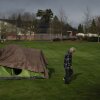
Williams didn’t want to go to a hotel or a shelter or a different part of town. He told Lozier to take him back to his spot in East Nashville.
By nightfall, he was settling back in under the picnic pavilion.
More states are passing anti-camping laws
Williams was one of two people arrested in the park on June 28 and charged under Tennessee’s no-camping law — the only one in the country to make sleeping on public property a felony.
Though the law was passed in 2022, advocates for the unhoused say they have never before seen it used like this.
Lindsey Krinks, co-founder of Open Table Nashville, a nonprofit homeless support organization, said it’s another escalation by officials after years of policies aimed at pushing homeless people out of public view.
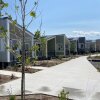
“Welcome to the city of Nashville, where luxury condos are going up every few blocks, and everyone living in their shadows are being left out of the progress and sometimes freezing to death or getting heat stroke and dying on our streets,” Krinks said.

Joseph Williams grew up in East Nashville, a historically African American community that has rapidly gentrified over the last two decades.
Erica Lynn for NPR
hide caption
toggle caption
Erica Lynn for NPR
Homelessness in Nashville has been on the rise, according to the city’s Homelessness Planning Council, which in December 2025 estimated that roughly 4,300 people experience homelessness in the city, an uptick of more than 30 percent in less than a year.
Nationally, homelessness has dipped slightly, after reaching record levels in 2024. But chronic homelessness has grown, according to 2025 data from the U.S. Department of Housing and Urban Development. HUD’s most recent tally of chronically homeless people in the U.S. found more than 155,000.
Camping bans differ from state to state — some enable the state to level penalties against cities that refuse to enforce the ban; others make it easier for law enforcement to involuntarily commit people experiencing homelessness — but the broad strokes are the same. No camping, or sleeping, on public property.
Many state legislators have taken inspiration, or even borrowed legislative language, from the Cicero Institute, a conservative think tank founded by tech billionaire Joe Lonsdale. Lonsdale is a co-founder of Palantir, whose data mining software has been used by local and federal law enforcement, including the CIA and U.S. Immigration and Customs Enforcement (ICE).
Cicero has called for more measurable accountability and ways to push homeless people, under threat of arrest if necessary, to engage with agencies that provide various social services, including shelter space, mental health and addiction treatment and somewhere to sleep in state or county run campsites.

Joe Lonsdale, founder of the conservative think tank Cicero Institute, at Stanford University in 2017. Many state legislators have taken inspiration from the think tank regarding policies around homelessness.
David Paul Morris/Bloomberg via Getty Images/Bloomberg
hide caption
toggle caption
David Paul Morris/Bloomberg via Getty Images/Bloomberg
Devon Kurtz, who oversees Cicero’s homelessness and public safety policy efforts, has been a vocal critic of the longstanding program model known as Housing First, saying it is ineffective. Housing First, which has long been promoted by experts and homeless outreach workers, aims to get unhoused people into stable housing before attempting to address any other needs, such as mental illness and drug or alcohol addiction.
Earlier this summer, Cicero supported a law in Louisiana that bans public camping by making it a misdemeanor, punishable by up to a $500 fine and six months in jail. Those charged could forego jail time if they agree to enter into a program geared toward substance abuse or mental health treatment, the law says. But they could end up on the hook for paying the state back for the costs of such treatment — either in cash or by performing unspecified labor.
North Carolina’s legislature also passed a bill outlawing public camping and allowing any resident or business owner to sue the state if an encampment was not cleared within five business days. The bill was vetoed by Gov. Josh Stein, a Democrat, though lawmakers in the Republican-controlled legislature have vowed to force the law through.

“My hope is that no one is ever convicted under any of these camping bans,” Kurtz said. “The intention is not to jail people. I’ve also said, however, that sometimes, at the margins, it is essential that law enforcement has the ability to jail them because it can save lives.”
In Tennessee, Krinks, of Open Table Nashville, said the state has made it easier to clear homeless encampments.
Nashville’s oldest homeless enclave, Old Tent City, was disbanded last year. The area along the Cumberland River where more than 100 people once lived is now encircled by fences and no-trespassing signs. Krinks said the encampment had been there since the 1980s.
Krinks has seen more security cameras installed around public parks and benches ripped out of the ground in downtown Nashville. The no-camping felony, she said, only makes things more dire for the city’s homeless community.
“Punishing people and using police to address homelessness only makes the crisis worse, and it prolongs people’s experience of homelessness,” said Krinks, who also helped start the statewide coalition Housing for All Tennessee. “Most people I know experiencing homelessness are so hungry for freedom, for agency, for their dignity to be seen and recognized and understood. Jail erodes every aspect of a person’s agency.”
A changing neighborhood
If you ask Williams how long he’s been living in the park, he’ll say he doesn’t think of it that way. It’s not living, he says. It’s a place he goes to stay because he doesn’t feel like he has anywhere else.
Williams has been offered a bed at a Nashville shelter. He’s been approached by service providers over the years. But he doesn’t trust those organizations, and doesn’t want to leave the neighborhood he considers his own. Instead, he sleeps sprawled across the wooden picnic tables, heats his food up in the sun and does pullups on the monkey bars at the playground.
But the park is not home. Home is the aging public housing complex just up the hill; that’s where he grew up. Williams can see it from the picnic benches. No one lives there now.
East Nashville is a historically African American community that has rapidly gentrified over the last two decades and lost many of its Black residents.
“It has changed so much,” said Williams, who is Black. “The color boundaries, let’s keep it real, that’s changed. Putting more, better housing and stuff like that around. Knocking some old ones down.”

Joseph Williams holds a cross and rests his arm on top of his suitcase under the pavilion where he sleeps.
Erica Lynn for NPR
hide caption
toggle caption
Erica Lynn for NPR
About three months ago, Alex Bilbrey, 33, moved into a house on a lot just across the street from the park. He said he was drawn to the neighborhood, in part, because of the green space — the hiking trails, the wildlife, the pavilion and picnic tables and grills, the playground that he could see from his front door.
Bilbrey noticed the man living under the pavilion, he said, but didn’t think much of it.
“I’ve lived around homeless people before. It’s no big deal,” Bilbrey told NPR. “But when it becomes a big deal, and I start to see stuff…” His voice trailed off.
After dark, Bilbrey said, the park transforms: Cars pull in and out with suspicious frequency, he said. Bilbrey said he’s seen men and women have sex out in the open, and has found drug paraphernalia on the ground near the jungle gym.
Bilbrey said he contacted his city council representative and suggested they contact Open Table Nashville to come out and help. Later, he called the police. Open Table has no record of being contacted about this case prior to Williams’ arrest.
Last month, prosecutors charged Williams with two felony counts of camping and one misdemeanor charge of evading arrest. According to charging documents, Williams attempted to flee after police officers told him they had a warrant for his arrest. That’s when he was tased.
Alissa Heydari, a court-appointed attorney who represented Williams in the camping case, said the arrest “makes what is already a very difficult life situation for Mr. Williams harder and worse.”
Williams pled guilty to the misdemeanor charge and was sentenced to time served. Prosecutors dropped the two felony counts on the condition of his plea, Heydari said. He was released from custody on July 6, nine days after his arrest.
As far as Cicero is concerned, this is the law working as it should.
“I understand the way it seems a bit ineffective that he ended up right back where he was,” Kurtz said. “But even insofar that he is back in that park, the fact that whatever encampment he had created … was cleared, that park is safer. Him being in that park is actually safer.”
Bilbrey doesn’t think it has changed much. The same shady cast of characters has been showing up again, he said, night after night.
Back to where it began
Williams said he doesn’t ruminate on what could happen if he got arrested again.
He doesn’t want his mind to wander into dark places, he said, or think about what it was like to be behind bars.
Instead he has returned to his routines: Going on long walks. Making up songs to pass the time. Breakfasts with Lozier.

Joseph Williams is one of a handful of homeless people in the United States to be arrested and charged with a felony for camping on public property.
Erica Lynn for NPR
hide caption
toggle caption
Erica Lynn for NPR
On a recent Friday, they hit the diner. Williams didn’t need to read the menu. He always knows what he wants; it’s called the lumberjack.
The description reads: “For those who may not see a meal soon.”
His plate, stacked high with pancakes and eggs and sausage and bacon and homefries and Texas toast, was clean before Williams got up to leave.
Outside, it was raining. But Williams wanted to walk back to the park. He knows the way; he’s lived there his whole life.