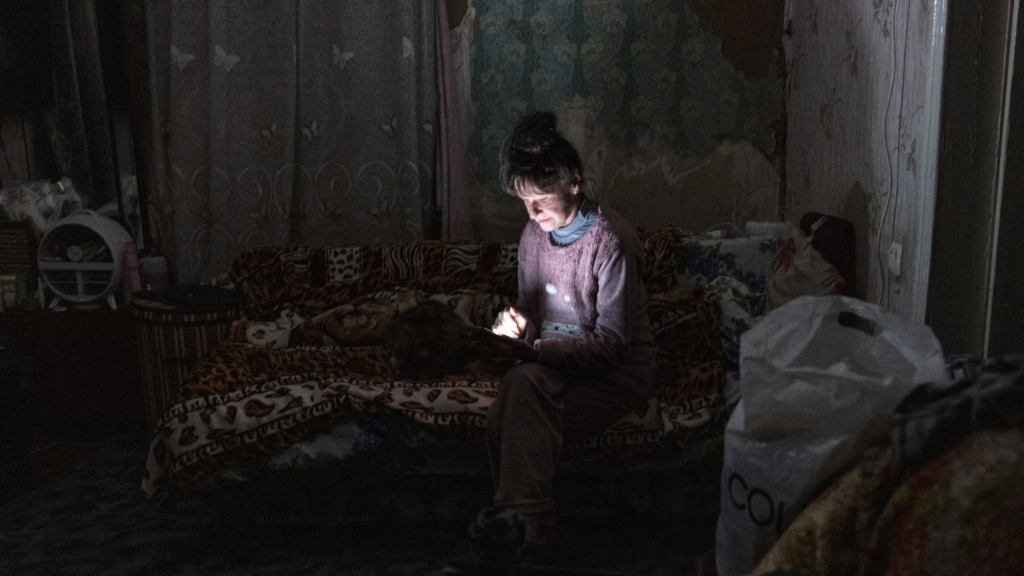
Colorado’s biggest wildfire this year has destroyed more than 300 homes. People who lost them are just now being allowed back to their properties.
Transcript
AILSA CHANG, HOST:
New wildfires continue breaking out in multiple states in what has already been a very active summer fire season. The most destructive fire so far has been in Colorado. More than 300 homes have been lost in the largest fire there. It started in June, but people are only now being allowed to return to their properties. KRCC’s Briana Heaney takes us to Beulah, Colorado.
BRIANA HEANEY, BYLINE: At a National Guard checkpoint outside the southern Colorado town, dozens of cars and trucks are lined up. Ned Pittman, Doc, age 70, is in one. He looks a little like a wizard in a big straw hat with a flowing white beard and has a reentry permit. It allows him to be escorted back into his neighborhood.
NED PITTMAN: Howdy.
UNIDENTIFIED PERSON #1: Are you here for the 8 a.m. escort?
PITTMAN: Yeah, I am.
UNIDENTIFIED PERSON: OK. Sounds great. I’ll have you pull down just right down there.
HEANEY: This is the first time a lot of the people who live in these forested hills have seen each other since the Aspen Acres fire reached them.
PITTMAN: Howdy. How y’all doing?
(SOUNDBITE OF ENGINE CHUGGING)
UNIDENTIFIED PERSON #2: We can go in, huh (ph)?
PITTMAN: Yeah. Been waiting here quite a while.
UNIDENTIFIED PERSON #2: Yeah.
PITTMAN: And it looks like a nuclear bomb up there.
UNIDENTIFIED PERSON #3: How are you doing?
PITTMAN: I’m not – I’m doing better.
UNIDENTIFIED PERSON #3: Are you?
PITTMAN: Better than I was. Yeah.
HEANEY: The morning the fire got here, Pittman says he didn’t think his place was in danger.
PITTMAN: It was clear as a bell out. No smoke or nothing.
HEANEY: He drove to nearby Pueblo for a doctor’s appointment. The smoke plume that formed later was his only sign that something was wrong.
PITTMAN: I never even got a warning.
HEANEY: Oh, what?
PITTMAN: A pre-evac warning or nothing.
HEANEY: We drove around a barren, burned mountain into Beulah, where about 800 people lived.
PITTMAN: It’ll start getting darker and darker now.
HEANEY: Further in, closer to Pittman’s house, the color gradient of the landscape quickly turns black. Few houses stand untouched. Through the shadowy valley of destruction, some folks we pass survey their properties, firefighters by their side. Others are doubled over or sitting in the ash with their heads in their arms.
PITTMAN: Here’s my property. Oh, God, it takes my breath away. Yeah, this used to be – you couldn’t see 20 feet. It used to be so thick. That was a green – used to be a green truck. That was a trailer right there.
HEANEY: Now the blackened landscape feels creepy – scorched trees arch over ground that’s a velvety charcoal color. Pittman lived and raised his four children here. It’s now a pile of mostly light-gray ash and rubble. The only thing intact was a standing bathtub and a cooking range.
PITTMAN: The devastation’s so…
HEANEY: Yeah.
PITTMAN: …Overwhelming.
HEANEY: Pittman – like a lot of folks who live in the area told me – doesn’t have fire insurance. There are a lot of uncertain days ahead. He’s not sure what he’s going to do. In the meantime, he’s been staying with his brother in Pueblo and is taking things one day at a time.
The sprawling Aspen Acres fire is still not fully contained. Local governments have lifted evacuation orders in some areas and issued new ones in others. About 3,000 people are currently out of their homes. Fire managers say it may continue burning until it snows.
For NPR News, I’m Briana Heaney in Beulah, Colorado.
(SOUNDBITE OF MUSIC)
Copyright © 2026 NPR. All rights reserved. Visit our website terms of use and permissions pages at www.npr.org for further information.
Accuracy and availability of NPR transcripts may vary. Transcript text may be revised to correct errors or match updates to audio. Audio on npr.org may be edited after its original broadcast or publication. The authoritative record of NPR’s programming is the audio record.