Breakfast you can eat with one hand, the making of the ultimate birthday cake plus a viral tote bag. I’m Laurie Ochoa, general manager of L.A. Times Food, with Tasting Notes.
Engineering breakfast
Herb Peterson, the creator of the Egg McMuffin, seen in 1997 showing off his invention at one of his McDonald’s franchises in Santa Barbara.
(John Hayes / Associated Press)
The gastronomy drama “The Bear,” which officially comes to an end this week on FX (though it’s been streaming in full on Hulu), opens its final season in full stress mode: an ominous rainstorm, a car accident, a plumbing system about to burst, the near financial ruin of the fictional Chicago restaurant’s chief backer and the blanket of dread weighing down the not-so-merry band of chefs and servers trying to stave off the closure of their admired but unstable restaurant.
But there is one moment of joy. And it comes with a McDonald’s McGriddle.
Marcus, the beef sandwich shop worker turned star pastry chef (played by Lionel Boyce), hands the fast-food breakfast to Luca (Will Poulter), his Copenhagen mentor turned Chicago stagiaire, or intern, as they head to work.
“So this is the much talked-about McGriddle,” Luca says to Marcus as he opens the wrapper.
“Your first McGriddle?” asks Marcus, who claps his hands in appreciation.
“I don’t want to like this,” Luca says after he takes a bite.
“But you have no choice,” responds Marcus. “No matter where you are, no matter when you are, this thing always tastes like this.”
“Honestly, for consistency?” Luca says, “McDonald’s should have a Michelin star.”
It’s one of the scenes that led writer and Best Food Blog co-founder Anna Hezel to call “The Bear” “one big ad.”
It’s an understandable take, especially when, as Hezel points out, head chef Sydney (Ayo Edebiri) is seen pouring bottle after bottle of Coca-Cola over short ribs as a marinade.
And if you think about it, the entire show, which in large part hinges on whether or not the restaurant in “The Bear” gets a Michelin star, is great advertising for the France-based guide, which has been questioned for requiring city and state tourist boards to pay sometimes hundreds of thousands of dollars to assess a region’s restaurants.
Still, I must admit, the Marcus-and-Luca scene did lead me to my own first McGriddles experience. (My McDonald’s breakfast call has always been the Egg McMuffin.)
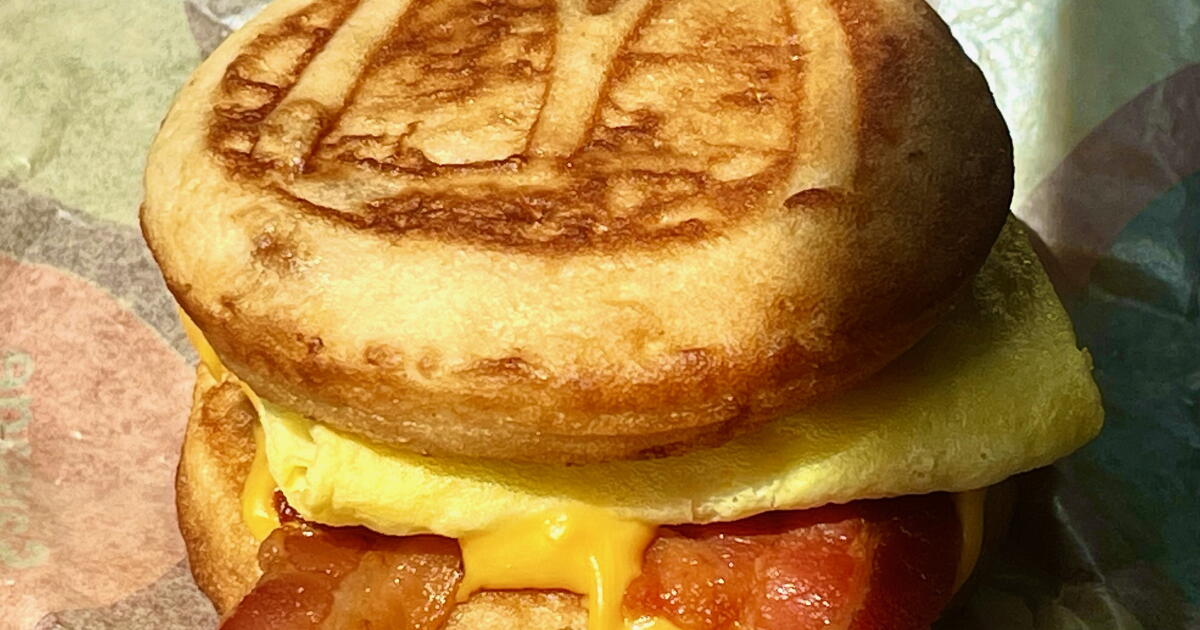
And after trying two McGriddles — one with bacon, one with sausage — I understood why series creator Christopher Storer had his two high-end pastry chefs — no strangers to food manipulation — express their admiration for the highly engineered sandwich. In one bite, it instantly satisfies our human cravings for sweet, savory and fat. (At 430 calories, 21 grams of total fat and 9 grams of saturated fat, it should.)

Sweet, savory and fat layered in one breakfast sandwich — the McDonald’s bacon, egg and cheese McGriddle.
(Laurie Ochoa / Los Angeles Times)
McGriddles were reportedly conceived in 1999, when Gerald Tomlinson, former executive chef for McDonald’s, decided the chain needed to augment its salty-savory McMuffin with a breakfast item that would attract customers seeking something sweet. The solution: a pancake in place of the muffin or bun.
There were a lot of false starts before the eventual introduction of McGriddles in 2003, including a muffin-shaped pancake with sausage crumbled into the batter, then “two flatter pancakes sandwiching sausage with syrup poured on top.” This, as Time magazine’s Jeffrey Kluger wrote in a how-they-did-it story soon after the sandwich’s launch, “was an impossible mess to eat.”
Sugar crystallization technology is what finally saved McGriddles and allowed customers to experience “that maple flavor in every bite,” as the chain’s former R&D head Wendy Cook told Time.
“The crystal size had to be calibrated precisely,” wrote Kluger, “so it would melt uniformly and provide a smooth texture, or … mouth feel.”
Tom Ryan, the food scientist behind Pizza Hut‘s Stuffed Crust Pizza, co-founder of the Smashburger chain and the person most often credited for bringing McGriddles to market, told Dan Pashman on “The Sporkful” in 2014, “We put Denny’s Grand Slam breakfast in your hand.”
And yet, when I next find myself in a McDonald’s drive-through line at breakfast, I’ll skip the McGriddle and go back to the Egg McMuffin. Of all the chain’s many processed offerings, it tastes like real food.
In fact, the perfectly round egg at the heart of the sandwich is not a pre-manufactured product sliced and slapped on a muffin like so many cafeteria hard-boiled eggs. It’s a real egg cracked on site into a low-tech ring mold. And in 2015, McDonald’s started using real butter instead of margarine on its muffins.

The egg is real in a McDonald’s Egg McMuffin.
(Laurie Ochoa / Los Angeles Times)
The ring and the sandwich were invented in Santa Barbara by McDonald’s franchisee Herb Peterson, a former ad executive who contributed to the creation of the chain’s Ronald McDonald mascot and was the first to hire women to work in McDonald’s stores.
Peterson wanted to open his stores for breakfast and offer a version of eggs Benedict, a difficult dish to eat for customers on the go. Some reports say that he consulted with cooking icon Julia Child for guidance.
Eventually, he replaced the hollandaise sauce with a slice of American cheese. McDonald’s transformational CEO Ray Kroc gave Peterson the go-ahead and in 1972 the Egg McMuffin was introduced in test markets and soon went national. A full breakfast you could eat with one hand.
It’s a good thing to keep in mind for McDonald’s newly named U.S. president, brought in as Daniela Sirtori reported, to bring “focus and urgency” to the chain experiencing “a decline in visits” even as “check sizes rose.”
A piece (or two or three) of cake

The L.A. Times Ultimate Birthday Cake.
(Catherine Dzilenski / For The Times)
We’ve been doing our own R&D in the Times Test Kitchen, all with the goal of creating the Ultimate Birthday Cake.
First, deputy Food editor Betty Hallock asked readers to tell us about their favorite birthday cakes. As recipe developer Carolynn Carreño wrote, “The answers were as mixed as the city itself: Tres leches cake. Hazelnut dacquoise. Tropical fruit pavlova!”
The overall favorite? That was carrot cake with cream cheese frosting. But when we tallied the votes by component — cake, filling and frosting — yellow cake was the clear winner. For the filling, readers wanted frosting, followed by berries. And the most popular outer frosting was cream cheese with whipped cream a close second.
Carreño took these answers and after many tries developed, yes, the Ultimate Birthday Cake recipe. The light and airy frosting combines whipped cream, cream cheese, crème fraîche and mascarpone. The filling is mixed berries with a layer of berry jam. Try making the cake, which is light in texture but with a sturdy crumb, and let us know what you think in the recipe’s comments. And if you’ve got favorite birthday cake memories, senior Food editor Danielle Dorsey is collecting your stories through a survey form and will share them in a future feature.

These might be the 15 best birthday cakes you can buy in L.A.
(Catherine Dzilenski / For The Times)
Dorsey also organized the entire Food team to search for the best birthday cakes you can buy — everything from Hannah Ziskin‘s cocoa chiffon cake with black currant Bavarian cream, blackberry preserves and chocolate cremeux frosted with Okinawan brown sugar buttercream at Quarter Sheets to Costco‘s affordable and nostalgic chocolate cake with whipped fudge icing.

Rose Wilde decorating the Ultimate Birthday Cake in the Times Test Kitchen.
(Catherine Dzilenski / For The Times)
For cake decorating advice, we turned to Rose Wilde, founder of Red Bread custom bakery, author of the grain-baking cookbook “Bread and Roses” and cake workshop teacher. She not only made our ultimate cake look gorgeous, she demonstrated nine decorating tips to create, as Hallock wrote, “visually striking, deeply personal cakes.” In addition, she gave us her expert advice on how to cut a cake — one of those jobs that strikes fear into many party hosts.

At one of her cake decorating workshops, pastry chef Rose Wilde shows how fresh flowers look fantastic on a cake with tomato leaf buttercream.
(Betty Hallock / Los Angeles Times )
Wilde also shared her recipe for Tomato Leaf Swiss Meringue Buttercream. And for those of you asking, “What about chocolate frosting?” Carreño considered several methods before developing her own No-Fail Chocolate Frosting recipe. It would go great on the yellow cake in our Ultimate Birthday Cake recipe.
Set your clocks for 10 a.m. Tuesday …

Senior Food editor Danielle Dorsey, left, and cooking editor Cody Reiss show off the new L.A. Times Food tote bags designed by artist Jaya Nicely and made for us by Big Bud Press.
(Stephanie Breijo / Los Angeles Times)
The last time we put our L.A. Times Food tote bags up for sale at the L.A. Times Festival of Books, they sold out fast. Really fast.
So we asked Big Bud Press to produce a new limited run of the pink bags with a big red tomato designed by artist Jaya Nicely, along with a new purple bag with a big green tomato.
If you’re reading this on Tuesday morning, the new totes go live at 10 a.m. sharp at shoplatimes.com. Don’t miss out!
Also …

In 1978, David Hirsch purchased an 860-acre sheep ranch on a ridge top less than three miles from the Pacific near Fort Ross, Calif., in the outer reaches of Sonoma County and a stone’s throw from the San Andreas fault.
(Erik Castro / Courtesy of Hirsch Vineyards)
- Winemaker David Hirsch, the Hirsch Vineyards founder who coined the term “earthquake terroir” to describe the soils on his coastal land in Sonoma County, died last week at 81. Patrick Comiskey writes an appreciation.
- What is the Woodland Hills restaurant dethroning Porto’s famous potato balls? Jenn Harris’ review of Puerto Rican spot Taínos tells all. She also knows why people are lining up at the Pasadena street cart Onigiri Time for giant stuffed rice balls.
- Reporter Nava Rawls spent time with the vendors and customers at L.A.’s Central Avenue Farmers Market learning about the effect of funding cuts to the federal Supplemental Nutrition Assistance Program (SNAP), known as CalFresh in this state, as well as the ICE raids that for a time drove the market indoors.
- Crustacean, known for its garlic noodles and for popularizing modern Vietnamese cuisine, will close on Oct. 31, after three decades in Beverly Hills, reports Melody Xu. She talked with founding chef Helene An, along with daughter Elizabeth An and granddaughter Bosilika An, about their hopes to find a new space.
- Sky’s Gourmet Tacos, a Pico Boulevard fixture for 34 years, is closing on Aug. 15 and will transition to a catering operation. Food’s senior editor Danielle Dorsey talked with owner Barbara Burrell “soul food-inflected take on Mexican cuisine.”
- Dorsey has updated our guide to L.A. rooftop eating and drinking, organized by height. And together with Stephanie Breijo, she put out a guide to 20 new and notable places to eat and drink in L.A. this month.

The original Hot Dog on a Stick stand on the boardwalk near the Santa Monica Pier in 2019, before it was renovated.
(Allen J. Schaben / Los Angeles Times)
- There’s a new owner of Hot Dog on a Stick, which has experienced plenty of financial ups and downs since the 1991 death of its founder, David Barham. Business reporter Caroline Petrow-Cohen details the comeback plans, which include Vegas outposts and lobster on a stick.