AFP via Getty Images, Claire Harbage/NPR/Collage by Emily Bogle/NPR
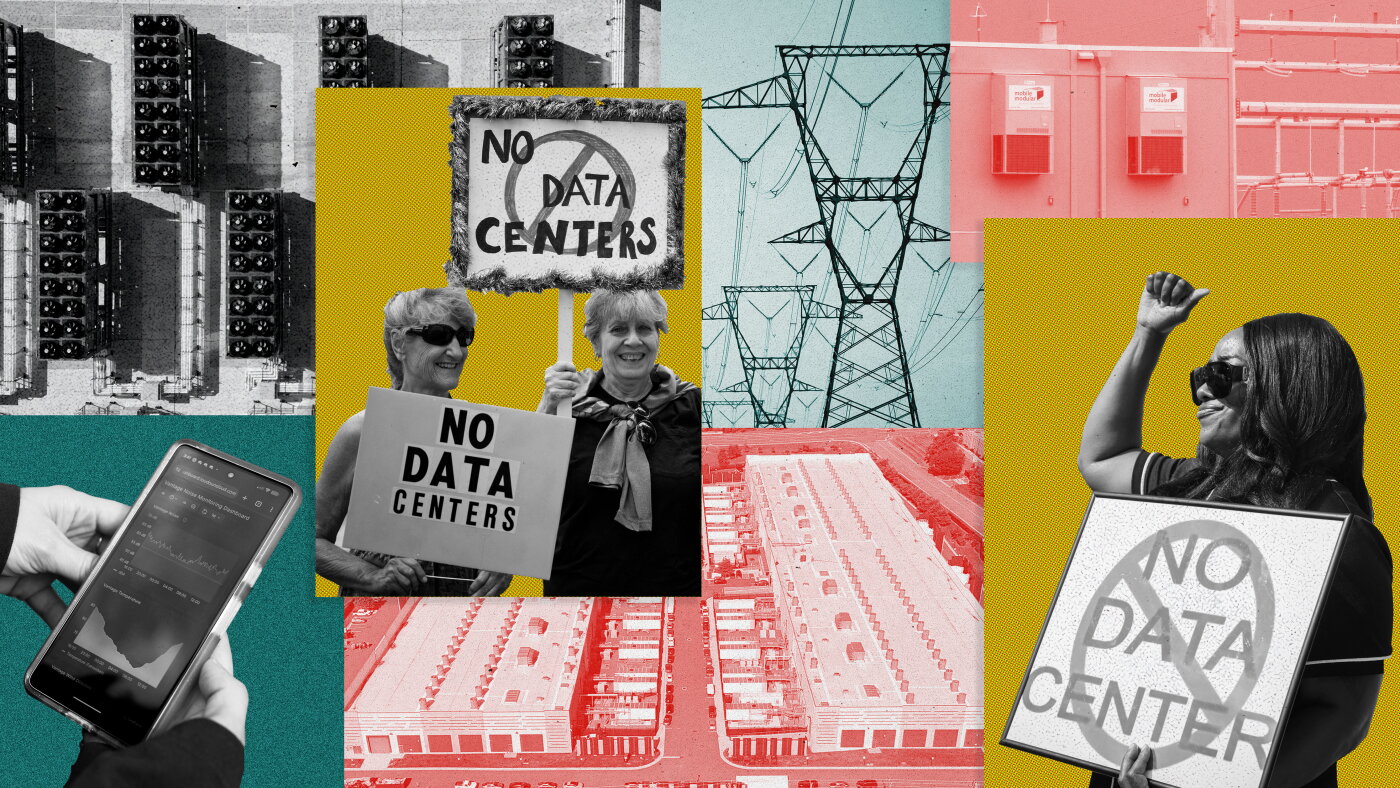
With striking speed, the widespread debate around data centers has become a fault line in American communities, cutting across political parties, splitting constituencies and forging unexpected alliances.
In city halls and county commission chambers, east to west and north to south, people are squaring off against their local representatives.
It starts with distrust
Data centers have “upended politics as we know it,” says Darrell West, a senior fellow at the Brookings Institution. It’s more than a not-in-my-backyard issue, he says — it also reflects existential fears that artificial intelligence will take jobs or eliminate humanity entirely.
“People just feel like they no longer have control over the technology, [and] that worries them,” West says. “This is a real grassroots movement. It’s ordinary people all across the country, both Republicans and Democrats.”
For this story, NPR traveled to data center hot spots and spoke to dozens of activists, politicians, developers and everyday Americans.
The picture that emerges is complicated. Data centers have been an economic boon for some communities, helping to lower land taxes and providing jobs. At the same time, the proliferation of secretive deals that often involve elected officials signing nondisclosure agreements has exacerbated suspicions.

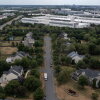
The Vantage VA2 data center sits next to residential buildings in Sterling, Virginia. The center is powered by gas turbines, which create noise.
Claire Harbage/NPR
hide caption
toggle caption
Claire Harbage/NPR
A recent poll by The Economist and YouGov of nearly 1,600 adults found that about two-thirds of Americans oppose new data center construction in their communities. A rare cocktail of concerns has fueled the opposition, according to Chris Borick, a political science professor at Lehigh University.
“It’s aligning interests in ways that aren’t traditional,” he says. “If you’re in power right now and you are dealing with this issue, you have a target on your back.”
Elected officials have had to scramble to recalibrate. “It’s a recognition that the ground shifted under their feet and they were not ready for that to happen,” Borick says.
Parties are divided
In Loudoun County, Va., data centers are driving a wedge between fellow Democrats.
On one side is Juli Briskman, a member of Loudoun County’s Board of Supervisors, who has led efforts to slow further data center development. On the other is Phyllis Randall, also a Democrat and the board’s chair, who has argued in favor of data centers for the tax revenue they bring into the county, even while acknowledging they are “a double-edged sword” for nearby residents.

Juli Briskman, a member of Loudoun County’s Board of Supervisors, stands along the street in front of the Vantage VA2 data center in Sterling.
Claire Harbage/NPR
hide caption
toggle caption
Claire Harbage/NPR
Briskman is running to unseat Randall in next year’s primary. She says her opposition to data centers dates back to 2020, when the board was seeing land-use cases seeking to convert residential and flex-industrial properties into the centers.
“I feel like I have been singing this song for a while, and now all of a sudden everyone’s grabbing my music and singing along with me,” Briskman says. Randall did not respond to NPR’s request for comment.

Briskman is tapping into a sentiment in her area.
Kasey Hatch lives near Loudoun County’s Vantage VA2 data center, which is powered by eight natural-gas-fired turbines. Residents say the turbines produce a constant low-pitched rumble along with a high-frequency whine that has become a major source of noise complaints in the surrounding neighborhoods.
Hatch, an IT infrastructure engineer for a bank who uses AI in her job, says she and her staunchly Republican cousin “never saw eye to eye on politics.” But to her surprise, the last time they met, they were “on the same page about everything” when it came to data centers.

Kasey Hatch was surprised to learn she and her cousin agreed on data centers, despite having different political beliefs.
Claire Harbage/NPR
hide caption
toggle caption
Claire Harbage/NPR

Hatch, who works in tech, designed a dashboard for people to see the levels of noise measured in the area near the Vantage data center in Sterling.
Claire Harbage/NPR
hide caption
toggle caption
Claire Harbage/NPR
At the grassroots level, that translates into Democrats and Republicans working together on an issue of mutual interest. Nusheen Farahani also lives near VA2 and is part of a group of women organized against the facility who regularly show up at public hearings.
“I’m a liberal and I’m a Democrat, and the people that are in our little team … not all of them are liberals or Democrats,” Farahani says.
A similar story is playing out in Minnesota, Pennsylvania and Indiana, to name just a few, where locally organized groups are uniting against data centers — and elected officials.
According to the Data Center Opposition Report, which tracks grassroots nonprofits on the issue, some 640,000 people are active in the anti-data center movement and 220 new groups sprang up in just the three months from June through August.
They are driven by a feeling that government is part of the problem, according to Ben Green, an assistant professor at the University of Michigan’s School of Information. With that comes a real sense of abandonment, he says.
“If the policymakers, if my city council or zoning board or township board and governor, if they’re on the side of the companies, who’s standing up for me?”
The economic impact
Data centers have been around for a lot longer than the recent AI hype, quietly humming along in the background of the modern internet, powering cloud computing and storing vast amounts of data. AOL set up in Loudoun County, for example, back in the 1990s, giving the tech industry an early beachhead in the county that has only grown due to demand from government agencies in nearby Washington, D.C.
To be sure, these facilities have brought economic benefits to the counties where they are located by creating billions of dollars in private investment, construction jobs and a limited number of well-paying positions at the data centers themselves, all the while providing an infusion of tax dollars that have stabilized and even lowered the tax burden for ordinary property owners.
And among the many people NPR spoke to for this story who oppose data centers, nearly all acknowledge using AI in their daily life. Farahani, for example, says she “begrudgingly” uses chatbots for certain tasks “to make things easier.”
“I really make a concerted effort not to use it very often,” she says, adding: “I don’t like it to micromanage my life.”
In Loudoun County alone, data centers generated about $1.2 billion in property tax revenue in fiscal year 2026, representing around 39% of the county’s overall budget.
“We’ve seen property taxes go down two years in a row, as well as the vehicle tax rate in the county go down,” says Dan Diorio, who oversees state policy and government affairs for the Data Center Coalition, the main trade association representing the industry. “That’s money directly back into people’s pockets made possible by the revenue from the data center industry.”

Nusheen Farahani was drawn to Loudoun County, Va., for its beautiful farmland and natural areas and is now concerned about the growing number of data centers.
Claire Harbage/NPR
hide caption
toggle caption
Claire Harbage/NPR
Loudoun County confirms that over the past decade its Board of Supervisors reduced the real property tax rate by about 30% as a result of data center revenue, and that vehicle taxes are also down.
However, these facilities come with enormous electricity requirements, and their on-site systems for keeping countless racks of microprocessors cool can also require substantial quantities of water, a particularly sensitive issue in areas facing population growth or periodic drought.
And the tides are turning. It wasn’t long ago that state and local governments competed for data centers by offering generous tax incentives, but now several have reversed course. In many places, the burden has suddenly shifted to the data center developers to prove that they are a benefit to the communities where they want to locate.

Just last Friday, Virginia Gov. Abigail Spanberger — who campaigned in 2025 on qualified support for data center expansion — signed an executive order that seeks to put far greater limitations on development.
Across the U.S., at state and local levels, restrictions and moratoriums on data center developments are being put in place. Meanwhile, incumbents of both major parties on county boards in places such as Virginia, Maryland, Missouri, Wisconsin, Michigan, Texas, Tennessee and California are finding themselves on the defensive — or, in some cases, voted out of office — as residents accuse them of putting the interests of data center developers ahead of their communities.
Secrecy and NDAs take a toll
In an industry known for going fast and breaking things, Diorio acknowledges it’s paying the price for an early lack of transparency. And what NPR heard from officials, political analysts and local residents is that it’s the secrecy that has surrounded some developments that has galvanized opposition.
In several states, local elected officials signed nondisclosure agreements with data center developers that have muddied the waters even more.
A study led by Eric Bonds, a sociology professor at the University of Mary Washington, found that in 31 Virginia localities where there was an existing, approved or proposed data center, nondisclosure agreements (NDAs) had been signed for 25 of them.
Vantage Data Centers’ senior vice president for public policy, John Stephenson, says he understands that people are angry and says that in hindsight, it would have been better to engage “earlier and more proactively” with residents on issues such as noise and air quality.
“I wish we could have had some of the conversations back then, but to be perfectly honest, we had no reason to think that there would be an issue because we’ve been building these for a long time,” he says.

Data centers generated about $1.2 billion in property tax revenue in the 2026 fiscal year for Loudoun County.
Claire Harbage/NPR
hide caption
toggle caption
Claire Harbage/NPR
In Bessemer, a suburb of Birmingham, Ala., secrecy has bred voter suspicion. The city’s mayor, a four-term incumbent, has been forced into a runoff after he, his chief of staff and the city’s attorney signed NDAs that included a clause requiring them to destroy communications considered “confidential” by developers, according to the Southern Environmental Law Center.
In Wisconsin, a grassroots campaign sprang up last year to oppose a $12 billion hyperscale data center in the Madison suburb of DeForest that would cover more than 2 square miles. Ed Morganroth Jr., a member of that campaign, says that the Village Board had negotiated with the developer behind closed doors and that most residents learned of the plan only after hearing that local farmers had agreed to sell their land for the project.
“People have put in a lot of effort and written a lot of emails and met with a lot of board members and posted a lot of things on Facebook and inquired a lot [at] village meetings,” Morganroth says.
That effort paid off, and the project was abandoned this year.
A canary in the coal mine
In Virginia’s Loudoun County, it’s too late for citizens to reverse course on the dozens of projects already in the pipeline. However, just last week the board voted to pause new data center applications.
For Briskman, of the Board of Supervisors, Loudoun County is on the front line of the fight. “We are the case study, not just for the region, but for the nation,” she says.

Just across the state border, in Maryland’s Frederick County, there are also signs of distrust — literally. They’re scattered across front lawns and street corners proclaiming “no data centers” and chastising state and county officials for their past support of data centers.
Frederick County is trying to learn from the lessons of its neighbor. The county executive has issued a freeze on new data center development until the state can finish a cost-benefit analysis on their impact.

Construction is underway on a data center campus covering more than 2,000 acres near Adamstown, Md., in an area surrounded by farmland in Frederick County.
Claire Harbage/NPR
hide caption
toggle caption
Claire Harbage/NPR
But a sprawling, 2,100-acre hyperscale data center campus north of Adamstown that was once home to an Alcoa aluminum-smelting plant is already well underway. For now, the noise it’s producing comes from heavy construction equipment, as beeping cranes and earthmovers erect massive concrete and steel structures.
Quantum Frederick is destined to dwarf the relatively tiny, 18-acre Vantage VA2 campus just across the state border.
Steve Black’s tree nursery is located about a mile from the incomplete facility. Like Briskman, he views Loudoun County as something of a canary in the coal mine when it comes to unchecked data center development.
“The [Frederick] county government now is square in the middle of a demanding developer and an outraged citizenry,” he says.
Black is a key figure in a nonprofit that has filed requests for documents and even won a lawsuit against the county to get access to emails, letters and documents related to the Quantum Frederick project.

Steve Black owns Raemelton Farm, a tree nursery not far from the sprawling data center campus under construction near Adamstown.
Claire Harbage/NPR
hide caption
toggle caption
Claire Harbage/NPR
He says he has invested an enormous amount of personal time fighting data center expansion. “When I have to go to some council meeting and stay there till midnight … that is all on my time,” he says.
Such commitment tracks with what Kathy Cramer, a political science professor at the University of Wisconsin-Madison, has found. Cramer leads a team of graduate students who attend public hearings and community group meetings and who conduct one-on-one interviews with people about data centers. She says the concerns she’s hearing reflect a deep suspicion of government, Big Tech and the economic fairness of such projects.

“Data centers have become … a way for people to channel their discontent and resentment about bigger things in society that they’re really not happy about,” she says.
And for people like Black, this has solidified as political action.
“I have become a single-issue person,” he says, but not in a partisan way. “I will help you in your campaign and give you talking points and answer your questions and help you be smart on this.
“Some people are Democrats that I’m supporting and some are Republicans, and it no longer matters to me.”

