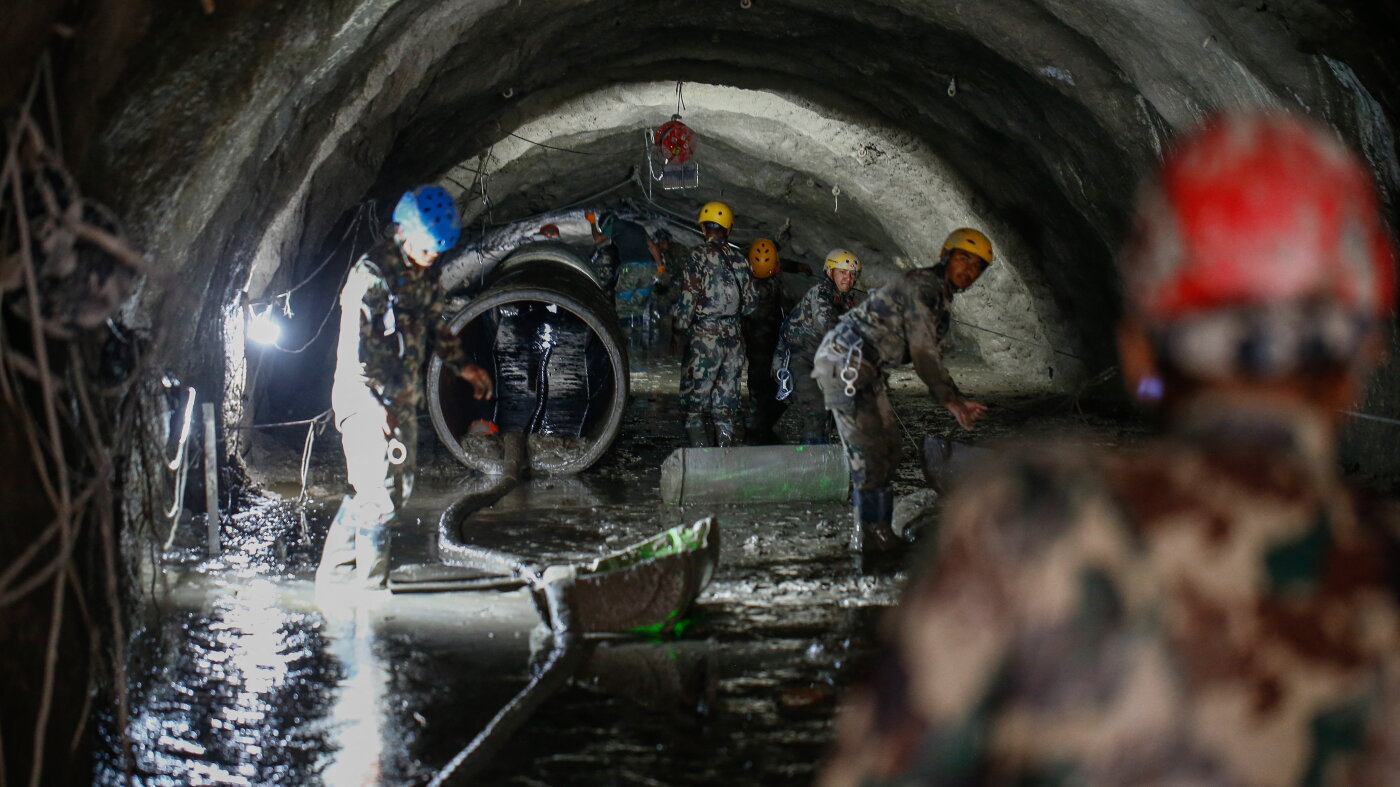
The Nepali Army conducts a search-and-rescue operation on Sept. 10 inside the Chilime Hydropower Station tunnel days after the deadly flash floods and mudslides in Nepal’s Rasuwa district in August. In the wake of the disaster, concerns are being raised about the impact of the construction of hydropower plants and dams in the Himalayas.
Skanda Gautam/AFP/via Getty Images
hide caption
toggle caption
Skanda Gautam/AFP/via Getty Images
KATHMANDU, Nepal — On a recent September day, Sumana Shrestha Amatya stood alongside other protesters in the Nepali capital, urging the government to work faster to find their loved ones, trapped inside hydropower plants since flash floods devastated miles of a river valley in late August.
Amatya says she hasn’t heard from officials about her husband, Sunil, a geologist. Still, she acknowledged the scale of the disaster that the government was grappling with: “It was like a Himalayan tsunami.”
It’s a description other Nepalis have used for the events of Aug. 26, when a glacier and its bedrock spanning more than 3,800 feet in width collapsed into a river valley, some 4,000 feet below.
That triggered 30-foot-high waves of boulders, water and ice that surged for miles downstream. It swept away a multistory border building and some 70 bridges and miles of highway, and buried 12 hydropower plants under mud and boulders along the Trishuli River, which was badly impacted by the floods.
Some 1,400 bodies have been recovered in Nepal, and more than 5,000 remain unaccounted for.
The dead and missing include 121 people who were trapped in hydropower plants, according to Brig. Gen. Subas Jung Thapa of the Nepali army, which is leading rescue efforts. He spoke in early September.
It took days just to find the power plants under the mud. It was like “a bomb’s gone off,” said Arnold Dix, a tunneling expert helping with rescue efforts. “It’s removed the power stations from the surface, like they’re just not there.” Only three men were found alive in the plants since rescue efforts began.
Did hydropower projects add to the risk?
It is those hydropower plants that have received the most scrutiny in regional media since the floods, with experts reviving questions about whether developers had properly assessed the risks of building them in the Himalayas.
“We need to understand what is happening now in Nepal can happen in other parts of the Himalayas,” says C.P. Rajendran, an Indian geoscientist who has been critical of big construction works in the Himalayas. (Rajendran, like many Indians, uses initials for his first name.)
Critics have also focused on the role of international institutions like the World Bank, which has long supported some of these hydropower projects and their associated dams.
They include one of the biggest hydropower projects in the river basin, known as the Upper Trishuli-1, which cost Nepal over half a billion dollars. It was backed by about $300 million in loans and equity by two arms of the World Bank.
The Upper-Trishuli-1 was under construction. Now it’s under the mud. Thapa of the Nepali army said in his press briefing that he estimated some 50 people were trapped inside. On Wednesday, the Kathmandu Post reported the bodies of five men were recovered from the plant.
“Why did it have to happen in the first place?” asked Parineeta Dandekar, an expert on rivers who has written critically about these projects for the advocacy group South Asia Network on Dams, Rivers and People.
Dandekar accuses the World Bank of producing a flawed risk assessment report for the project from the get-go. Its many omissions, Dandekar says, included ignoring “the cumulative disaster risk that can happen after having so many projects across the same river.”
Experts say the Trishuli river basin has 36 hydro power projects — including the dozen now under the mud.
Dandekar says the constant blasting of mountains to build these projects, including for miles-long tunnels, has its own impact.
It’s a region where earthquakes and landslides are common, and where climate change is causing its glaciers to melt more rapidly, making them — and their slopes — more unstable. Initial analysis suggests global warming exacerbated the melting of the glacier that snapped off in August, triggering flash floods.
There’s no clear evidence that the construction of these projects had a role in causing the severity of the Aug. 26 disaster. But experts like geoscientist Rajendran say construction has caused damage in other communities where hydropower projects are being built, including damaging mountain springs, causing homes to crack and even landslides.
In this case, though, says Dipak Gyawali, a hydropower engineer with the Nepal Academy of Science and Technology, “compared to the tectonic forces at play that caused this event, dynamiting is minuscule. This is almost nothing. It’s like scratching your skin.”
But he and other experts said developers were not seriously investigating the risk caused by so many projects built in the same zone. “These risks have to be properly studied and assessed. Unfortunately, they have not been,” Gyawali said.
Retired Indian ambassador Shyam Saran, who served as the Indian prime minister’s special envoy for climate change, says developers typically look at risks that could be triggered by their project, alongside environmental risks to it, and they appear safe. “But if you do actually a cumulative environmental impact assessment of the whole river system,” he says, “then a different picture emerges.”
And the Trishuli river “is a really high-risk area to build [hydropower] dams, says Austin Lord of the Stimson Center, who works on disaster risk reduction in the Himalayan region at the Stimson Center. In events exacerbated by climate change, there’s been deadly flooding three years in a row in the Trishuli basin. In 2024, it was extreme rainfall. In 2025, a glacial lake burst. This year, a glacier snapped off.
A pre-flood warning
Days before the August flood, Lord and others authored a paper warning that the area was particularly vulnerable to glacial lakes bursting. “Recurring landslides, and prolonged closures,” they wrote, “had all highlighted its vulnerability.”
In a statement, the World Bank told NPR that the hydropower plant’s design reflected assessments that looked at the risk of flooding and landslides using evidence available when the assessment was made in 2018. The statement said that as more information becomes available about the August floods, “the World Bank Group will consider any implications for risk assessment, monitoring, early warning and emergency response measures in hydropower projects.”
Another major funder for the Upper Trishuli-1 was the Asian Development Bank, which loaned $60 million for the project. In 2024, independent experts who visited the site reported that no climate resilience assessment was undertaken. They described that as a “significant gap.” The bank did not immediately respond to NPR’s question as to whether that assessment was ultimately undertaken.
Arnold Dix, the tunneling expert, defended the hydropower plants’ construction. “They were built properly to start with,” he said, noting the underground infrastructure, including tunnels, was still intact. He said the collapsing glacier that triggered the August flash floods was an unforeseen new threat that “will change the way we do the designs of the power station.”
Rethinking hydropower in the Himalayas
Advocates say they hope this devastating flood might prompt a rethink of how hydropower is constructed across the Himalayas. Reuters reported in 2025 that China and India, the world’s most populous countries, have built 68 major dams in the Himalayas and another 101 are in the pipeline.
Most prominently, China is constructing one of the world’s largest dams and hydropower plants in Tibet, costing around $170 billion. It’s estimated that it will provide power to 300 million people.
In July, Chinese geologists reported that the dam is being constructed over an active fault line, risking the integrity of the project’s infrastructure. Chinese officials have maintained that the project is safe and that they had considered downstream communities.
“If something happens, it is going to be a monumental disaster,” says retired ambassador Saran. He says Chinese authorities have assured their neighbors that the hydro project is safe. “But as we see,” he says, “those precautions which supposedly had been taken don’t mean very much when you have nature’s fury to deal with.”
That Chinese hydropower plant and dam is being built some 30 miles from the border of the Indian state of Arunachal Pradesh, according to the state’s Chief Minister Pema Khandu. In 2025 statements to the media, he described two possible threats: It could hold back much of the water that presently passes downstream, and it could inundate downstream areas, whether by negligence, design or natural disaster.
For now, India’s strategy appears to be building its own dam in Arunachal Pradesh in case China releases — perhaps deliberately — enormous quantities of water, as Chief Minister Khandu suggested in June last year to the outlet, Press Trust of India. “Setting aside the military threat from China, it seems to me that this is a far bigger issue than anything else. It is going to cause an existential threat to our tribes and our livelihoods. It is quite serious because China could even use this as a sort of water bomb,” Khandu was quoted as saying.
Many in the local community have opposed the dam, even damaging bridges to prevent surveyors from entering the area. On Wednesday, local media reported that India’s premier criminal investigation agency filed a case against Bhanu Tatak, the adviser to a group resisting the hydropower project, accusing her of illegally taking funds from foreign entities. She’s previously said the Indian state has been trying to find ways to stop her advocacy.
Rajendran, the geoscientist, said both China and India needed to undertake smaller projects that are less politically attractive but less disruptive to people and their environments. “The kind of construction they are doing,” he says, “it might happen probably 25 years later, or maybe 30 or 40 years later, but there will be a huge tragedy
Bhandari reported from Kathmandu. Hadid reported from Mumbai.
For stories about life in our changing world, subscribe to NPR’s Global Health newsletter.