On an atypically muggy evening in Highland Park, several Angelenos sit beneath a shade sail in a parking lot behind the Bearded Beagle vintage shop on Figueroa. A pandemonium of parrots screeches by, a siren wails in the distance, a helicopter chops the air above. But these folks have their ears trained on something else. Coming from two high-performance speakers arranged before the group? The sounds of a fax machine.
The group is silent and still, reverently absorbing the mechanical chug of this nearly outmoded office machine like Hollywood Bowl-goers taking in Joshua Bell. When the recording ends, everyone claps enthusiastically.
This is a listening session hosted by the Los Angeles Field Recording Club.
George Jensen’s bimonthly gatherings attract roughly 25 attendees, who come with just their phones or advanced audio equipment.

A songbird perches in a tree during a recent field recording meetup.
Field recording is most simply defined as recording sounds outside a controlled studio environment. The idea to engage in such an activity is not new. Eight-year-old Ludwig Koch made what’s considered one of the earliest field recordings in 1889, using a wax cylinder. Humans have been collecting sounds ever since, and archiving them in institutions like the British Library Sound Archive and Library of Congress, for purposes scientific, ethnographic, historical and artistic.
Before the fax machine clip, listening session attendees enjoyed the sounds of a Seattle ferry, rain on a tent, someone playing sax under a bridge, an owl conversation in Silver Lake, the “dawn chorus” in Northern California, and steam from a volcanic vent. Next up: goats wearing bells on a remote Greek island, presented in quadraphonic sound.
Throughout the event, a guy bounds around, introducing the recordists, then crouching to cue their recordings on a laptop, his dark, longish hair under a black dad cap bearing the club’s name. This is George Jensen, who founded the club in June 2025 after a friend asked if he knew of any local field recording clubs. He didn’t but thought it was a great idea. A lifelong musician and veteran online radio DJ with shows on community-run Dublab and KCHUNG Radio, he put some feelers out and was stunned by the response. At the club’s first meeting, people were “billowing out onto the sidewalk.”
“I was like, whoa, this is crazy!” he says.
While field recording is typically a solitary activity, Jensen embraces the alone-together paradox of building a community around a bunch of people wearing headphones. “What happens is people want to do it, but they don’t know how or where to go. When we do outings, I always hear the same thing: ‘This is so great because now I can come out and record, and I’m doing it with other people, so I don’t feel weird!’ ”
The club hosts two events a month: one outing where they record at various sonically interesting locations around L.A. — past highlights include Greystone Mansion, a scrapyard in the Valley and early morning at the Americana at Brand in Glendale — and a listening session like this one, where they share recordings.

Eric Buechel prepares his audio equipment.
The group has grown to about 25 “somewhat regulars,” with a steady stream of curious newcomers. In a music and film town like L.A., there are plenty of people who have serious recording setups and extensive know-how, and Jensen indubitably loves to connect with recordists on this level. But he’s just as interested in those who turn up with nothing more than a phone. “Hey, that’s a recorder too,” he says.
On a recent club outing to birding hot spot Sepulveda Basin Reserve, artist Whitney Richardson tested a hydrophone (underwater microphone) for a project she’s doing on Los Angeles waterways. Eric Buechel, an experienced recordist but first-time club attendee, came out to see what equipment other people were using. Newcomer Amy Ma decided to check out the club after Instagram recommended it, perhaps based on her interest in other niche activities. “It might be because I follow Clown Cardio,” she said.
At the outing’s end, participants compared notes about sounds they captured — a swarm of gnats, a twin-engine plane, fish jumping in a pond — but also about their experiences.
“It’s relaxing,” said Sherman Aline, who used an entry-level Tascam recorder to catch the sound of mating dragonflies’ wings brushing against each other. “And I feel like if you’re recording, it’s easier to be present.”

Sherman Aline raises his audio recorder amid the trees at Sepulveda Basin Wildlife Reserve.
Sam Hamer, a professional sound mixer, put it practically: “I catch myself if I’m fidgeting, so it makes me sit still. Otherwise, I hear myself on the recording.”
Jensen says when he started field recording more than 12 years ago, it had little to do with the recordings themselves; he was more interested in how he could visit unique places and experience them on a different level. He created “Los Angeles,” his show on KCHUNG Radio, to showcase recordings he made around the city, in iconic places like Griffith Park or the corner of Sunset Boulevard and Vine Street, but also in everyday spots like strip malls and swap meets.
“L.A. is such a driving city,” Jensen says, explaining that field recording gives people a reason to pull over and “listen for a purpose.” Sometimes, this is rewarded with the comfortingly mundane, a mash-up of bird and traffic sounds, for instance. Sometimes, the city has other plans. Jensen recounts a time the club went to Union Station, “just to record reverb and stuff.” Then 10 teens peeled through the historic terminal on electric bikes. “That didn’t even exist like five years ago, the culture of kids riding those things. That’s a moment in time we got to capture in Union Station.”
For Jensen, moments like these can enrich the practices of both recording and listening. During listening sessions, he encourages recordists to offer context when they introduce their sounds. “You may go out and get that perfect mallard quack, and clean out all the excess noise, and that’s cool too if that’s what you’re going for,” he says. But things that may sound ordinary can also resonate with a little backstory. A chicken playing a toy piano, for instance. Or the journey of an iPhone, when Jensen lost his while it was recording, including the voices of all the nice people it met on its way home.

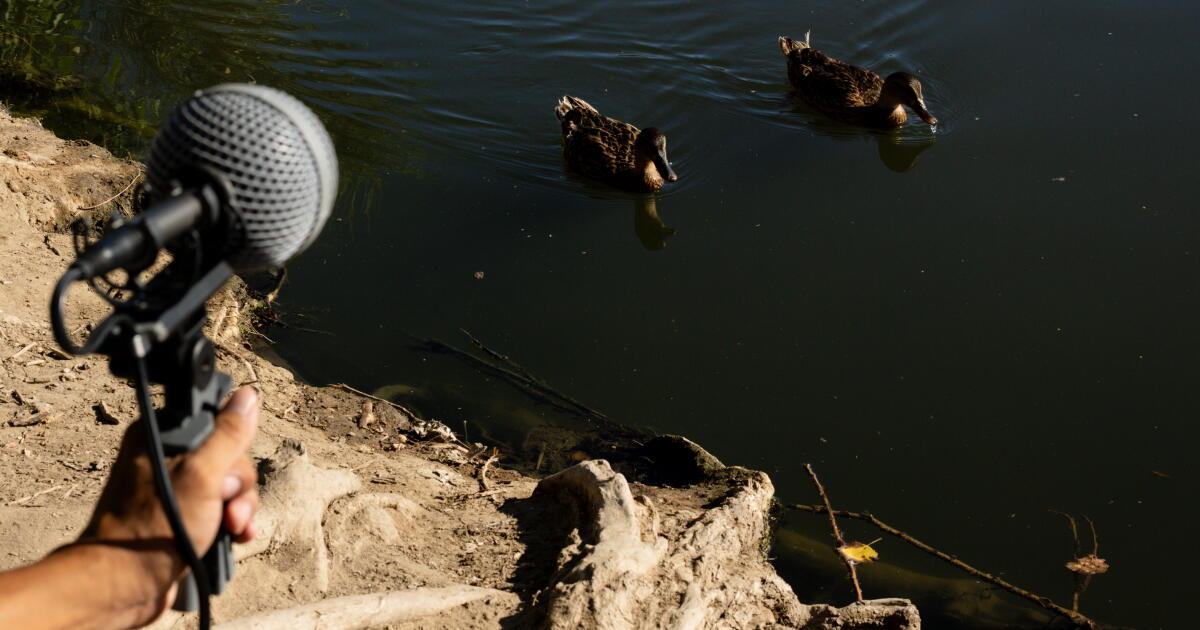
There are various approaches to field recording, George Jensen says. You might seek the perfect duck quack, removing background noise afterward, or sometimes the background noise itself is what you’re looking to record.
The club recently published an official Field Guide, a journal (available at events) that includes a list of sites and recording prompts, as well as space to log metadata and the stories behind the sounds. There’s also a soon-to-be-launched Sound Map on the club’s website, which will serve as a hub for recordings.
Jensen is quick to attribute the club’s popularity to the fact that field recording is free and easy to do, though he does acknowledge a certain now-ness. “I feel like now everything’s so … doctored. But when you’re recording, this is what’s really happening. You’re hearing real sound. You’re engaged with the world in a real way.”

George Jensen, left, and Whitney Richardson record sound during a Los Angeles Field Recording meetup.
Back at the listening event, Buechel, wearing a T-shirt that says, “Ask Me About Interspecies Communication,” gives a short preamble for a recording he made at Sepulveda Basin. The group listens intently as a symphony of airplanes, freeway traffic and the ploop! of jumping fish rises from the speakers — sounds unexpectedly captivating, and soothing.
When the recording ends, everyone claps enthusiastically.
And perhaps someone recorded it.
The next meetup will be a field recording outing on Oct. 18 at 10 a.m. at Old Los Angeles Zoo in Griffith Park. Follow the club on Instagram for more information.