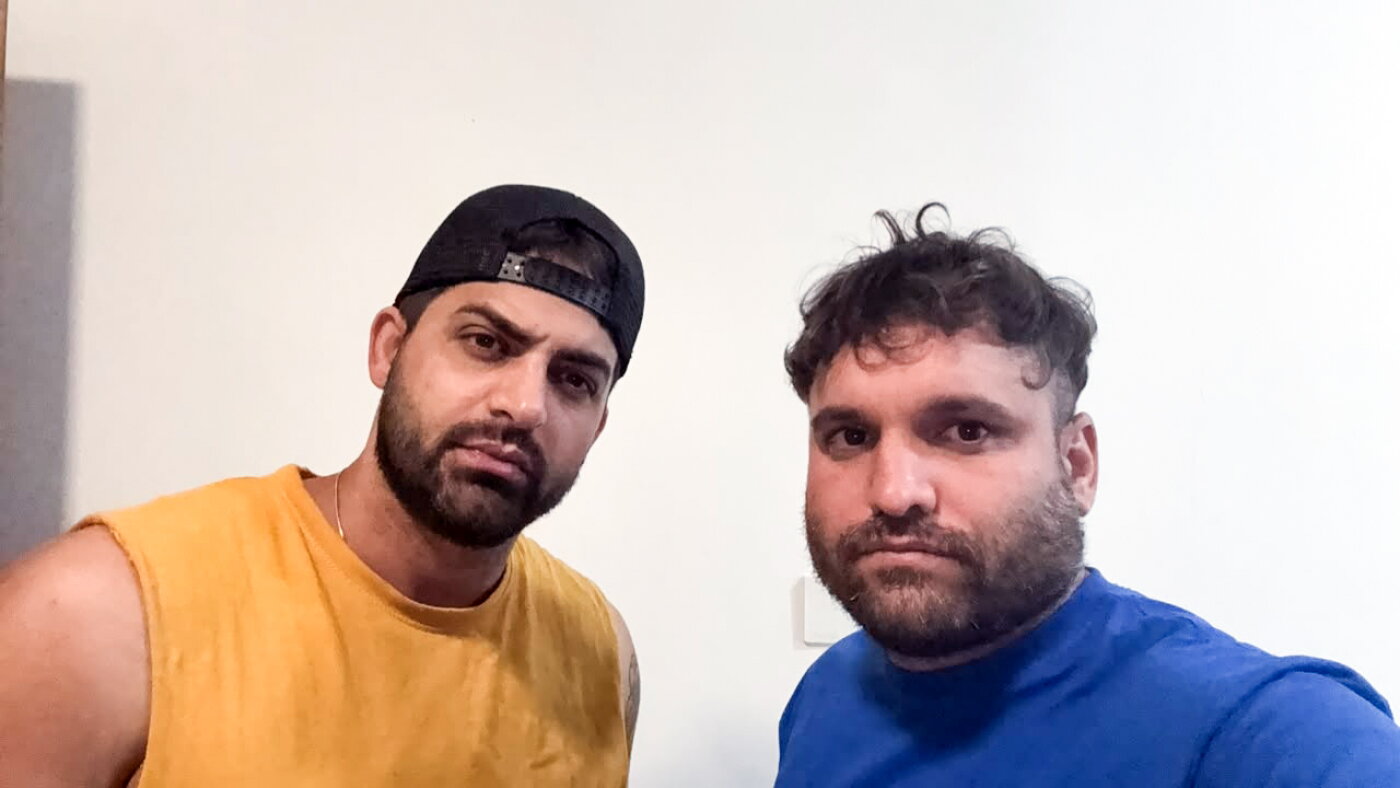
Arístides Fernandez-Garcia (left) and Yasmany Moreno-De Armas were deported to the Central African Republic on July 30, 2026.
Courtesy of Yasmany Moreno-De Armas/
hide caption
Courtesy of Yasmany Moreno-De Armas/
MIAMI — José Díaz, 85, had never asked his grand-nephew for a single thing.
But late last year, he noticed the baseball cap Arístides Fernandez-Garcia was wearing on his visit to New Jersey. He liked it.
Fernandez-Garcia promised himself that he’d give his great-uncle the cap after returning from a Miami hearing in his pending asylum case.
He never got the chance.
On Jan. 6 Fernandez-Garcia, a Cuban immigrant, was arrested by Immigration and Customs Enforcement in a targeted operation at the courthouse in Miami.

He told NPR that as he moved through a maze of detention centers across the U.S., losing 60 pounds and witnessing shocking violence, he held hard onto his promise. When his great-uncle got sick, Fernandez-Garcia called him from detention.
“I would tell him: ‘Stay strong, because I have to give you the hat,'” Fernandez-Garcia recalled. The old man would laugh.
Eight months later, Fernandez-Garcia sits in the living room of an apartment in the Central African Republic. He feels torn: guilty for giving Díaz hope, but resolved, nevertheless, to keep his promise.
“That is something I have to do in life before anything else happens to him,” he says about his great-uncle. “I have to give him that hat.”
Fernandez-Garcia is among the more than 25,000 people the Trump administration says it has deported to countries to which they have no ties. On Sept. 18, a federal appeals court ruled this “third country deportation” policy violates due process. The court said migrants weren’t given enough notice or a meaningful chance to say they were afraid to be sent to another country. On Sept. 24, the Trump administration appealed that ruling to the Supreme Court.
In a statement to NPR, the Department of Homeland Security said “Third country removals are an essential public safety tool that remove the most dangerous criminal illegal aliens from our streets.”
But NPR found no record of criminal charges in Florida against either Fernandez-Garcia or his roommate, Yasmany Noel Moreno-De Armas, who is also a Cuban immigrant deported by the U.S. Fernandez-Garcia didn’t have a deportation order either. Both men say they don’t feel safe returning to Cuba.
“I face punishment from the Cuban regime for having been a balsero — someone who fled Cuba by raft — and for trying to avail myself of the ‘wet foot, dry foot’ policy and enter the United States under that protection,” said Moreno-De Armas.
DHS says people being deported to third countries receive “notice and assurances prior to their removal.” DHS added that ICE obtains diplomatic assurances from destination countries that once people are deported they will be safe after they arrive.

But both men said they didn’t know where they were going when they boarded the plane in Texas. From his shared apartment in the Central African Republic, Fernandez-Garcia showed NPR how he sat on the plane for 12 hours, his hands shackled together and chained to a belt around his waist. It wasn’t until they landed and he looked out the window, he says, that he saw a flag. It was striped green, yellow and red, with a green star in the center. That’s the flag of Senegal, he realized. They were in Africa.
“My mind just went blank,” said Fernandez-Garcia. “I went blank because I realized that my life was out of my hands, like I didn’t have control over my own life anymore. I still don’t.”
The men say they don’t feel safe in the Central African Republic, a country the State Department warns Americans not to visit, citing risks of kidnapping, landmines and terrorism. The International Organization for Migration, a group affiliated with the United Nations, is providing protection for the deportees. Armed guards accompany them whenever they leave the complex. The IOM is also providing housing in Bangui, the capital of the Central African Republic. The deportees live four to an apartment. Fernandez-Garcia and Moreno-De Armas share a bedroom.
Their building neighbors a small market: low-slung buildings with concrete walls and corrugated-metal roofs. The road is unpaved and often muddy. They shop there twice a week for canned goods and water. When the power is on, the men talk to their families on WhatsApp, do interviews with reporters and make social media videos, trying to get their story out. Maybe that will help them return to the U.S., they think. Sometimes, viewers donate money. It helps them buy supplies for their shared apartment and minutes on their phones.
But two months after arriving, both men remain in limbo, unsure of their legal status or what comes next.
“We don’t have documents that would allow us to work. They haven’t given us a visa,” said Moreno-De Armas. “We were deported from the United States to a third country and we’re still detained.”
Both men have gotten sick in Bangui. Fernandez-Garcia with malaria, which kept him weak in bed for days. Moreno-De Armas with high blood pressure, shortness of breath, and panic attacks when he heard his mother was in the hospital.
But what affects them most isn’t the physical toll. It’s time.

“Time with family, time with those people who have less time left, no, no, that can never be recovered again,” said Fernandez-Garcia. “Not even with millions of dollars can that be recovered or bought.”
The men know other “third country deportees” who have been in Africa for a long time. Like Roberto Mosquera, who has been imprisoned in Eswatini for over a year.
“This is all I do. Walk outside. Come back in. Fix some food. Lay down. Think,” said Mosquera from his prison cell in Matsapha Correctional Complex, a high security prison. “You think about your kids, that life that you had before, the life that they took from you.”
Mosquera has a criminal record and has already served his time in the U.S. But according to his lawyer, Alma David, he has no criminal charges in Eswatini. Mosquera also doesn’t know if and when he’ll be released. Since he’s been imprisoned, his oldest sister died in America. So did his best friend. He’s also going to miss his daughter’s wedding.
“My youngest one’s going to be the flower girl,” said Mosquera. He looks away from the screen and sighs. “It’s rough. I didn’t expect this to happen at my age.”
When de Moreno-De Armas’ father got a call from his son that he had been deported to Africa, he felt like “the world fell on top of me,” he says. Hiovany Moreno Noa sits in the backyard of his home in South Florida. Thick worry lines stretch across his forehead.
“If at least he were in a Spanish-speaking country, with more or less the same customs as us, then we could be a little more at ease,” he says. “But there, we don’t know anything. The little we do know is that it’s a country that has been at war. It’s a very dangerous country.”
Moreno Noa tries to talk to his son every day. He sends what money he can though Western Union. He prays for him. But the separation is hard.
After Moreno-De Armas fled Cuba on a raft, years passed before he saw his family. They reunited in 2022.
“We went six years without seeing each other. Then we came to this country, and now we’re being separated again,” he said. “Every parent longs to have their children beside them. And that’s why we suffer.”
On Sept. 29, the Supreme Court put the appeal court’s ruling on hold, clearing the way for the Trump administration to continue third-country deportations while the legal battle plays out.
In Eswatini, Mosquera still dreams about the day he can leave Africa and return to his family. In the Central African Republic, Moreno-De Armas hasn’t given up hope either, despite a recent curfew that kept him and his roommates indoors for three days.
“We’re waiting for God to give us the opportunity to return to the United States,” he says.
Fernandez-Garcia is not so sure. Hope exists, he says. But it disappears very easily.

He still loves America.
“I felt what freedom was like for the first time in my life. I felt what it was to dream for the first time in my life, to leave the Cuban bubble of the dictatorship,” Fernandez-Garcia said about the U.S. “You can’t judge a country by one particular moment.”
But then he thinks about his great-uncle in New Jersey, who lives with his great-aunt. Like grandparents, they had taken care of him in his youth. Now, he thought, it was his turn to take care of them, help them feel less lonely. He had plans. Walking with them in Central Park. Watching the sun reflect on the surface of the Jersey Shore.
“They are older people, and I feel that I have little time left with them,” said Fernandez-Garcia, choking back tears. “And maybe I’m not going to be there when they pass away.”
At her home in New Jersey, Martha Piedra grieves for her great-nephew.
“I’m an old woman of 79 years with a whole lot of illnesses, so just imagine. What am I going to be able to do? I can’t do anything,” she says, her words dissolving into tears.
On the phone, his great-uncle’s voice trembles. He remembers Fernandez-Garcia’s cap and his calls from detention. He remembers the promises his grand-nephew made to gift it to him: a black baseball cap with a white Dodge Ram logo on it. Simple, but impossible to find elsewhere.
“I hope that he comes and brings it to me someday,” says Díaz.
Piedra corrects him. “No, not someday. Please,” she says. “Let it be soon.”