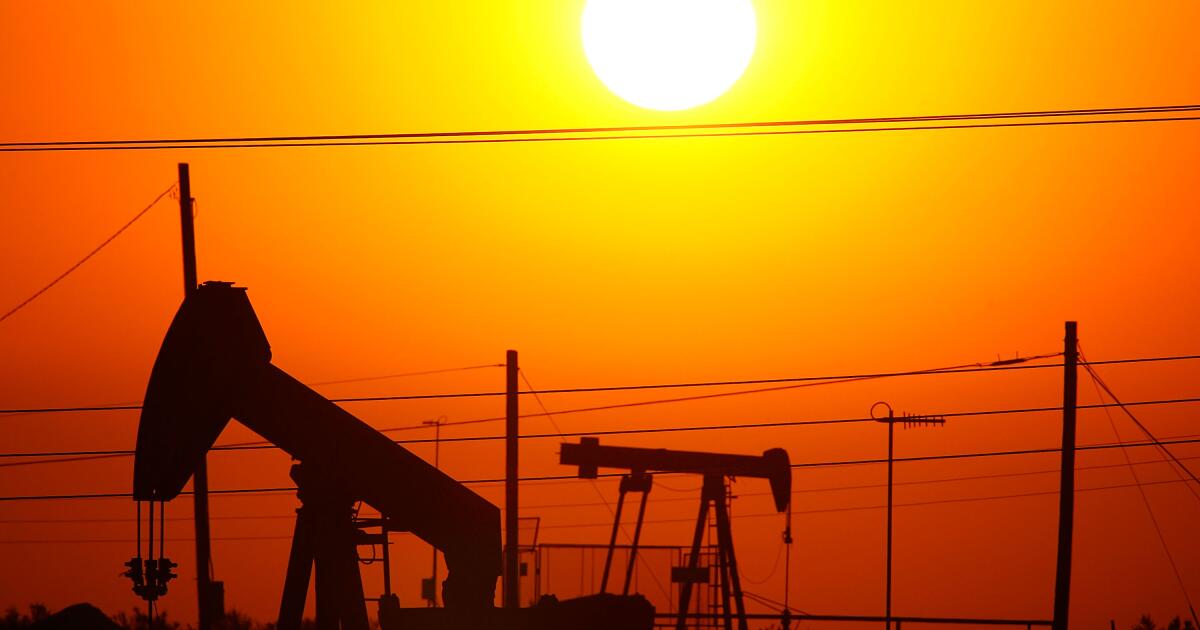
If you are an oil producer with wells in California and global oil prices have risen to over $100 a barrel in the last week, are you going to drill new wells?
It’s a question that touches the lives of hundreds of thousands of Californians who either live near oil wells or receive royalty checks as mineral rights owners.
Experts said probably not, given this state’s aging fields and the unpredictability of global prices.
It’s too early for data that will show if companies have ordered more drilling rigs on their fields — known as the rig count — since the U.S. and Israel invaded Iran and sent oil prices soaring. But analysts and producers say only if prices stay above $80 for at least a year do they expect an increase in drilling.
“Nobody expects today’s high prices to last and we could very likely get back to the low $60 [per barrel] environment we faced just a few weeks ago,” said Rock Zierman, chief executive of the California Independent Petroleum Assn. trade group.
Experts say the unique geology of California’s fields, and the nature of its heavy crude, make new projects, and efforts to pump more oil out of existing ones, costlier and more energy-intensive than drilling in other parts of the country.
In the Permian basin of New Mexico and west Texas, for example, producers can more quickly and economically ramp up extraction of light crude oil trapped in shale rock.
But even there, “operators are wary of adjusting plans to spend more drilling capital if prices come back down after the conflict ends, which is currently suggested by the oil price curve,” said Matthew Bernstein, vice president of North America oil and gas at the consulting firm Rystad Energy.
“Instead, companies will enjoy the added cash flow buffer of higher prices and boost cash on their balance sheets and pay out shareholders,” he said.
California oil production has been on the decline since the 1980s, largely because existing oil fields are becoming depleted and there are more economical places to produce.
At a certain point, that can begin to hurt the whole local business ecosystem of oil wells, pipelines and the refineries that turn crude oil into gasoline, jet fuel and diesel.
Last April, Valero announced its intentions to take its Benicia refinery offline next month, citing a difficult regulatory environment. Phillips 66 in Wilmington shuttered in December, blaming market dynamics.
That same month, the San Pablo pipeline, the sole line connecting Central Valley oil fields to refineries in the San Francisco Bay Area, also shut down, citing low oil volumes and a loss of refinery customers. Drillers started sending their product north in trucks.
In September, in an effort to boost pipeline throughput, Gov. Gavin Newsom signed a bill to streamline permitting for up to 2,000 new oil wells in Kern County, where new permits had been held up in litigation since 2020.
Since that took effect this year, the California Geologic Energy Management Division has permitted 139 new wells in Kern County, more than the 121 wells permitted from 2023 to 2025 across the state.
That signals “an appetite to drill,” said Matt Woodson, an analyst at Wood Mackenzie. But oil companies, which lobbied for the change, are still blaming refinery and pipeline closures, as well as the lower prices fetched by California crude compared with imports, for limiting projects.
“A temporary bump in price is not enough incentive to overcome the uncertainty of whether or not we can get our oil to market,” Zierman said.
Chevron, which operates two California refineries in addition to some of the state’s largest oil fields, said the permits were a welcome change but that proposed updates to the state’s cap-and-trade program that would make refiners pay more to pollute “threaten to reverse any kind of benefit that the industry has received.”
California Air Resources Board officials say the updates were designed to keep fuel supplies reliable and affordable “throughout the transition to carbon neutrality.”
Analysts expect a slowed but ongoing decline of oil, in line with the intentions of the state.
“I think you can start to stabilize that a little bit to where production declines slow,” said Robert Auers, an analyst with RBN, of the new permits. “But I would be shocked to see actual production growth. It’s more just ‘what’s your decline rate?’”
It’s dicey to balance. Last year, the California Energy Commission identified declining crude production as a problem for local refineries, which produce 90% of the gasoline used in the state.
In a letter to Newsom in June, commission Vice Chair Siva Gunda said the main factors driving refinery closures were falling demand for gasoline, increasing competition from global consolidation, aging infrastructure requiring significant maintenance, and a high cost of operating.
But he also warned that low in-state oil volumes could contribute to refinery instability because even though California refineries import about 75% of their oil, some of them are engineered for the specific qualities of California crude.
Refinery instability is a problem, Gunda wrote, because additional closures could “outpace demand decline for petroleum based-fuels,” leading to future price spikes.
In other words, California is trying to transition away from oil-based fuels, but the gasoline can’t disappear faster than people are giving it up.
Several experts have said that instead of trying to drill, the state should move to reduce its reliance on the California’s teetering refineries that have what UC Santa Barbara professor Paasha Mahdavi called a “cartel-like” market hold over the state.
That looks like boosting public transit and electric vehicles, but, in the shorter term, it could also mean improving California’s capacity to import more finished gasoline from abroad and other states, where prices are typically lower. Already officials are looking into a project from Phillips 66 and pipeline giant Kinder Morgan that could deliver gasoline, diesel and jet fuel from as far as Missouri by 2029.
“Let’s just be like the rest of America,” said Mahdavi, who directs UCSB’s Energy Governance and Political Economy lab. “Let’s quit this energy island that we’ve created for ourselves, because we’re not connected.”
Whether energy companies drill more in the U.S. or not, he added, it’s not going bring down the high price of gasoline, which is driven by crude oil prices set on the international market. To shift the needle there, you would have to meaningfully add to supply to replace the 20 million barrels per day being cut off by Iran, and any new production isn’t going to do that.