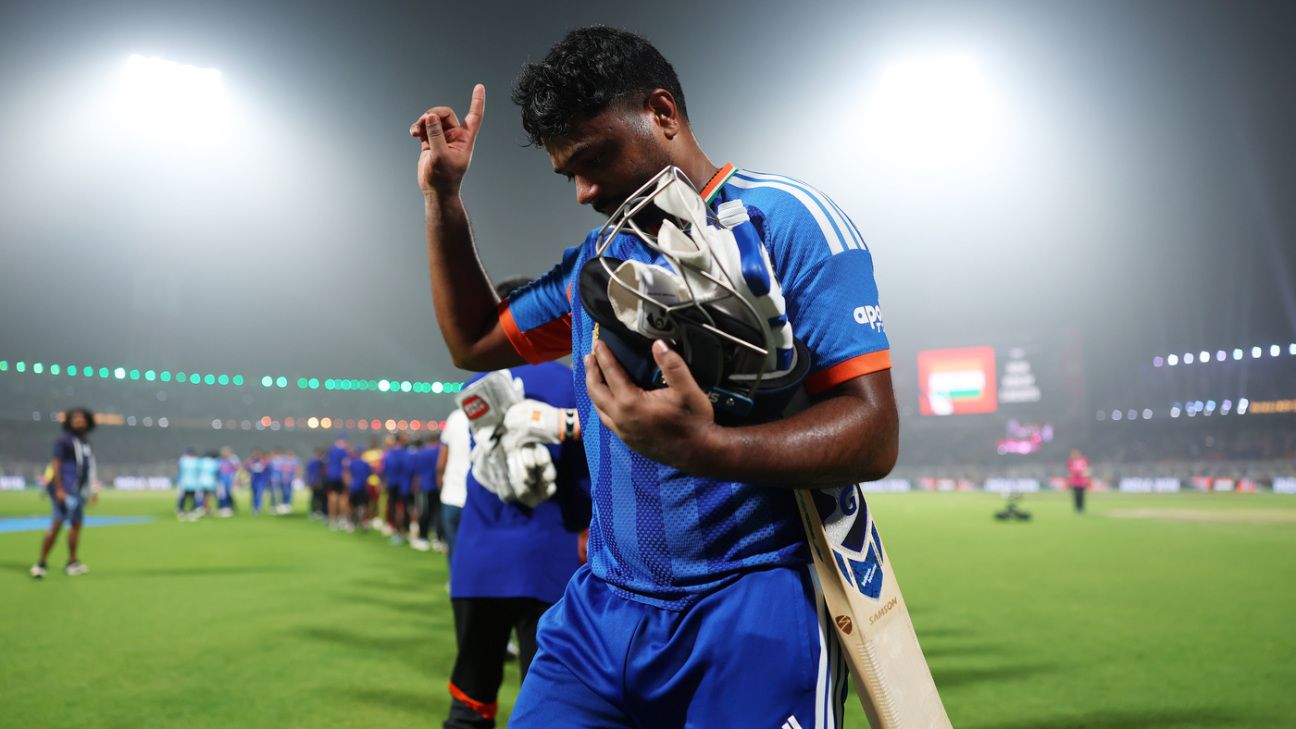
Stillness. It’s always been a defining feature of Sanju Samson‘s batting. Perhaps even the defining feature.
And it seemed to have deserted him at the most inconvenient time. A T20 World Cup was around the corner, and he was all set to start it as India‘s first-choice opener-keeper. He had been part of the squad that won the 2024 edition, but he had spent all of it on the bench. This was going to be his time.
Except he fell into the worst kind of rut. Not merely one of low scores, but one featuring a recurring pattern of technical issues leading to early dismissal. He wasn’t just getting out early but getting out in similar ways, to similar kinds of delivery. Worst of all, he was radiating not stillness but a sense of hurried, harried movements.
Between that series against New Zealand and Sunday night’s virtual T20 World Cup quarter-final against West Indies, Samson had been out of India’s starting XI, then briefly in, then out again, and finally back in.
Somewhere amid those ins and outs, though, the stillness had returned.
On Sunday, facing the second ball of the seventh over of India’s chase of 196 against West Indies, Samson seemed to stand still and wait interminably for the ball to arrive. And then he did what he does so well and with such apparent simplicity that its difficulty only becomes clear in the periods when he’s out of rhythm: hitting good balls into unexpected areas.
This was one of those middle-overs balls of mostly defensive intent: hard length, climbing awkwardly – in this case aided by Jason Holder’s height – and hidden well outside off stump with plenty of protection square of the wicket. Samson swatted it between the bowler and mid-off, barely moving other than rising to the tips of his toes to get on top of the bounce and swivelling through his hips in sync with his bat’s tennis-forehand downswing.
Apparent stillness giving way to apparent effortlessness.
This was trademark Samson, but only 90% of the way there. His previous innings, against Zimbabwe, had featured the full-blown version of this shot. It was his first scoring shot, against a ball of similar length from Richard Ngarava, slanting away with the left-arm over angle. On that occasion, he hadn’t looked to get on top of the ball: instead, he had hit underneath the ball and launched it for six over long-off.
If the shot off Holder fell on the cut end of the flat-bat spectrum, this one fell on the drive end. If the shot off Holder wasn’t full-blown Samson, neither was the innings that surrounded it, which circumstances had moulded into an unusual shape, a rare and exhilarating one for his fans. India were chasing 196, and losing wickets just often enough to keep Samson’s most Samsonesque instincts in check.
“[The] last game [in Chennai against Zimbabwe], we were batting first, so it was all about setting a very high score, so that’s how I wanted to go big, right from ball one,” Samson said at the post-match presentation. “But this game was completely different.
“As soon as I wanted to go a bit higher, we were losing wickets, so I wanted to build a partnership and wanted to keep on focusing on my process.”
This was Samson easing off the pedal at certain intervals, choosing not to play certain shots, choosing to go along the ground when he might have typically aimed skywards. And yet, he scored 24 off 13 in a powerplay where India lost two wickets. And yet, he scored 37 off 17 against spin when India’s other batters combined to score 21 off 19. And yet, he faced 50 balls and ended up with the best strike rate of any India batter to face at least five.
It wasn’t an anchor-style innings where his partners took more risks and got out quicker. It was simply an innings of serene, unstoppable quality on a day that belonged to him. Things happened around him without disturbing his poise, and whenever India seemed to come under pressure, he found a way to ease it.
He did so with a wide range of shots, and the one thing that tied them together, particularly against pace, was that trademark Samson quality, recently lost and regained, of stillness. Even a loopy Romario Shepherd legcutter, aimed wide outside off in an effort to wrench him out of shape, had no effect on it: he simply stayed still a little bit longer and launched the ball sweetly over wide long-off.
During his horror series against New Zealand, Samson’s trigger movement against pace had come under a lot of scrutiny. Critics had been quick to dismiss his way of stepping leg-side and deep in his crease as fundamentally unsound, and it had certainly made him look ungainly, his weight moving away from the ball and his bat slicing across it, often with a closed face, putting him at risk of missing the ball or meeting it with the leading edge.
Here in Kolkata, Samson was adopting the same trigger movement against pace: back and leg-side, finishing with both feet inside the crease. He seemed to be triggering earlier, though, so when the ball left the bowler’s hand he seemed to be in a more stable, better-balanced position, ready to shift his weight forward or back as required. The old sense of stillness, in short, was back.

4:18
Samson showed his true potential, says Gautam Gambhir
India coach discusses his team’s progress into T20 World Cup semi-finals
India batting coach Sitanshu Kotak confirmed in the mixed-zone interaction after the match that Samson had indeed worked on the timing of his trigger movement.
“I wouldn’t want to go into the detail, but yes, we did work on his initial [movement] a little,” Kotak said. “We were just trying to create a better base for him. He also felt he was getting ready a little early, and that helped him.”
Kotak clarified that this change had been in the works for a long time, and that he had had various discussions with Samson ever since his run of dismissals against the short ball during a T20I series against England last year. He seemed to suggest that Samson’s poor form through most of 2025 may have affected his confidence, with numerous voices offering advice and confusing him.
“A lot of doubt comes, a lot of people tell him a lot of different things, and when you are having a rough time, everybody wants to help you with good intentions, but whether it helps or not I’m not sure,” Kotak said. “To me it puts a lot of doubt in the batsman’s mind.”
In a Player-of-the-Match interview of honesty that’s rare from most cricketers but not from him, Samson spoke of these doubts himself – not just over this recent period but over a career that he has mostly spent on the fringes of India’s T20I line-ups, sometimes in, sometimes out, often on the bench.
“I’ve always had a very special journey with lots of ups and downs,” he said. “I’ve kept on doubting myself, kept on thinking, what if? Can I make it? But I kept on believing and thanks to the Almighty for actually blessing me today, so I’m very happy.”
Sanju Samson: wicketkeeper, opener, match-winner. This is exactly what India had in mind when they picked their squad for this World Cup. No one could have foreseen the circuitous route they and he have taken to get to this point, going from Plan A all the way back to Plan A, just in time for the semi-finals, but this is what cricket does. It works in mysterious ways.