I wanted to know more the moment I read “Sister Elsie Peak” on an old map.
I discovered the name while researching trails around Mt. Lukens, the highest peak in Los Angeles proper. Looking at the peak’s location on a historical map of L.A. County’s mountains, I noticed that it was previously named for a woman I’d never heard of.
Few of Southern California’s mountain peaks are named after women, so Sister Elsie Peak stuck with me. Who was she? And why was her mountain renamed to instead honor local leader Theodore Lukens?
In this edition of The Wild, our weekly outdoors newsletter, I will take you with me on my arduous journey to find the origins of the first known name for Mt. Lukens. Over the past week, I enlisted help from multiple librarians, map experts and one gracious historian (who you’ll meet later). We all scoured newspaper archives and history books, catching the fever of curiosity that seems to consume anyone who tries to find out who Sister Elsie was.
What we collectively found was this: Sister Elsie was most likely not a real person, and her legend was most widely shared in the early 20th century by a local landowner who was known to embellish, including claiming that Josephine Peak near Mt. Lukens was named after his daughter. (It wasn’t.)
There appears to be no record anywhere — in newspapers, in history books, in Catholic Church records — as to the existence of a Sister Elsie or, as you’ll learn more about below, an alleged orphanage, ranch or school that she ran in the Tujunga area for Indigenous children or the broader Indigenous community.
In that same vein, I want to call something out before we begin: Stories about the relationships between colonizers and Indigenous peoples often get romanticized (see: Thanksgiving), with storytellers and early historians intentionally leaving out any details of forced assimilation or the American genocide. I cannot report anything concrete about how Sister Elsie actually treated Indigenous people in large part because I don’t believe she was real.
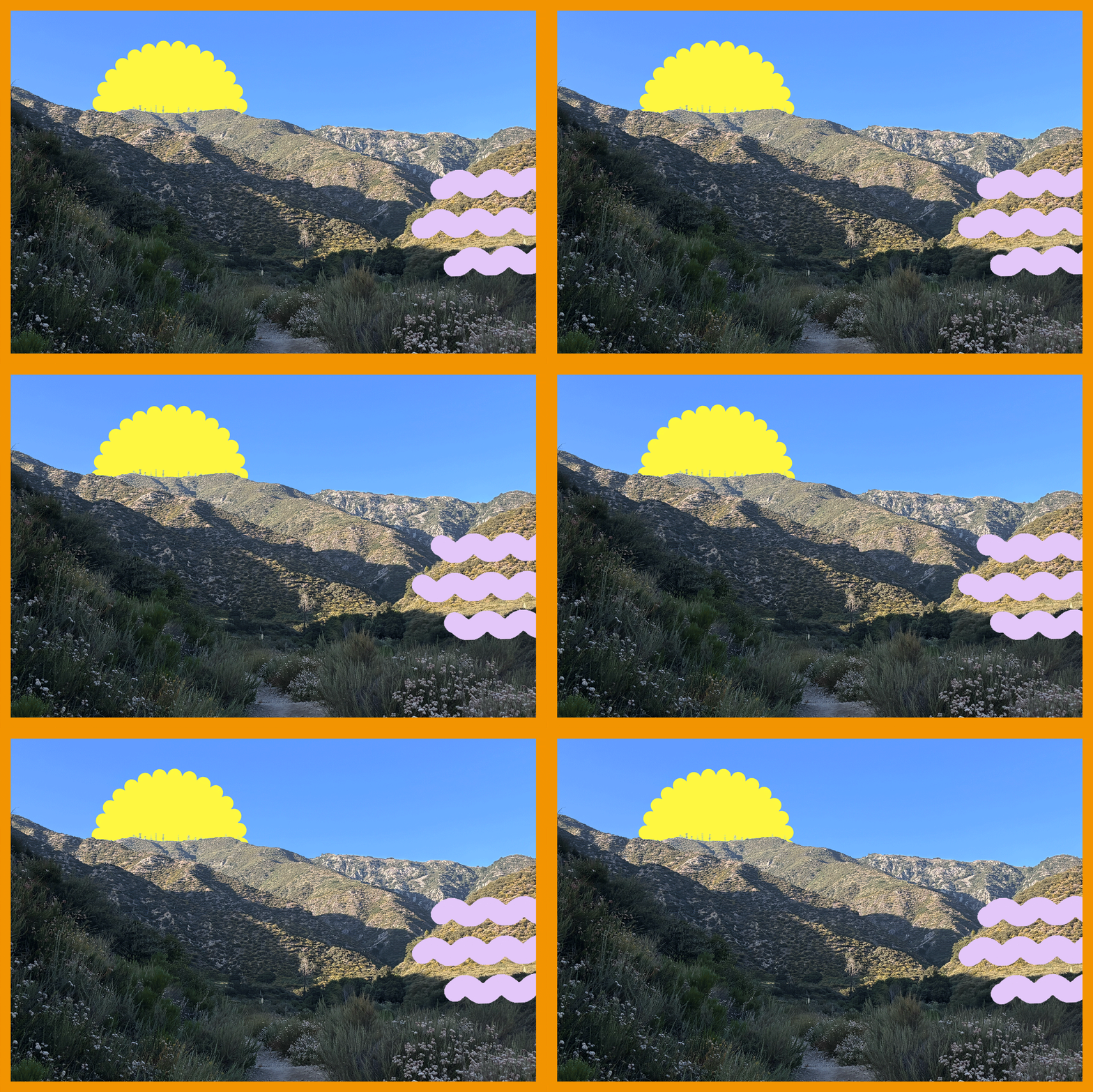
The sunset as viewed from a trail near Mt. Lukens in the San Gabriel Mountains.
(Jaclyn Cosgrove / Los Angeles Times)
OK, I’ve held you in suspense long enough. Let’s jump into everything under the actual sun that I could find about Sister Elsie Peak.
To begin my reporting, I contacted Times editorial library director Cary Schneider, who is always eager to help me with prospective stories (i.e. highly specific internet rabbit holes I’ve fallen down).
Cary found what might be the earliest mention in a local newspaper: A story in the Monrovia Daily News on April 23, 1910, in which a writer mentions a new trail leading to Sister Elsie Peak, but tragically gives no details of its namesake.
Next, we jump 20 years into the future when The Times and the Pasadena Star-News covered the dedication of Sister Elsie’s Well in Tujunga. Both publications described the well in their stories on April 28, 1930, as named after “the Catholic nun” who ran a school for Indigenous children “in the days of the Spanish missions.” The Times called her a “pioneer nun and teacher.”

Multiple radio towers and other infrastructure sit at the top of Mt. Lukens, as seen on a 2022 hike there.
(Jaclyn Cosgrove / Los Angeles Times)
The dedication occurred on the land of Philip Begue, a crucial character to understand in the Sister Elsie legend, as he’s believed to have either spread or made up the story, according to a local historian. Begue’s family bought land around Tujunga and La Crescenta in 1882, and later, Begue was an early pioneer and one of the first forest rangers in what would later become Angeles National Forest.
Throughout the late 1920s and 1930s, Begue seemed set on sharing the story of Sister Elsie. In 1934, he told the Pasadena Star-News that the sister “ministered to the sick and needy” Indigenous people.
A Times story on Sept. 29, 1935, announced a barbecue fundraiser for a local Catholic institution at the “old Basque rancho” owned by Begue. “The ranch on Honolulu avenue was famous in early days when Los Angeles was a pueblo and Sister Elsie had a children’s home where the ranch now stands.” The Begue family planned to cook “hundreds of pounds of meat for the affair.”
Times columnist Harry Carr offered in his column, the Lancer, a completely different take. Carr wrote on April 3, 1935, that Sister Elsie Peak was named “for a nun who lost her life trying to walk from San Fernando to San Gabriel.” No, he doesn’t provide a source for where he learned that information. Trust me: I too shook my fist at the sky.

The last rays of sun blanket across Mt. Lukens, as seen from Dunsmore Canyon in Deukmejian Wilderness Park near Glendale.
(Jaclyn Cosgrove / Los Angeles Times)
I would be remiss to mention that the oldest reference to a “Sister Elsie” in The Times’ archives appears to be an 1889 story about — buckle up — a psychic medium in Azusa. For a brief and beautiful moment, Cary and I hoped Sister Elsie Peak would turn out to be named after Elsie Wheeler, a spiritualist medium whose own story relates to an astrological tool. Alas, the peak was named before she was born (which doesn’t work unless she was a really good psychic). That said, a peak named after a mythical nun and a clairvoyant feels arguably appropriate for the highest point in L.A.
Cary also discovered one of my favorite facts about the Sister Elsie legend — that it was turned into a play titled “Sister Elsie in Tujunga.” It was written by Frances Muir Pomeroy, superintendent of summer school at Our Lady of Lourdes Catholic Church. It was said to be about “the experiences of Sister Elsie when she conducted an orphanage here many years ago,” according to a 1938 Times story.
There are other references to Sister Elsie in The Times’ archives over the next several decades, but nothing that gives concrete evidence that she actually existed.
Cary advised me to contact the Los Angeles Public Library. Librarian Kelly C. Wallace, who specializes in California history, quickly got back to me.
Knowing that Cary had already scoured The Times’ archives, Wallace sifted through the agency’s Los Angeles Area Historical Newspapers database, which contains the Los Angeles Daily Star (1870-1879), the Los Angeles Evening Post-Record (1896-1936) and the Los Angeles Star (1851-1871), along with community newspapers such as the Eagle Rock Sentinel and the Highland Park Herald. She found little there.

The trail through Stone Canyon to reach Mt. Lukens.
(Mary Forgione / Los Angeles Times)
This is especially puzzling if Sister Elsie did exist because, before the advent of television, newspapers reported seemingly everything that we now post on social media — detailed trip reports, the attendees of parties, birth announcements, and even basic road repairs.
Wallace did discover a few interesting tidbits in books, but curiously nothing before 1930.
The earliest reference that Wallace found was in the 1938 book “History of La Crescenta-La Canada Valleys” by Grace J. Oberbeck. She spoke to Begue, who spun quite the yarn:
“On El Rancho de las Hermanas, the ranch of the sisters, a group of nuns who had an orphanage not far distant, kept a herd of cows which was looked after by” local Indigenous people “who supplied milk to the school whenever needed. Sister Elsie was the much loved nun in charge of” the Indigenous dairy workers, “and her name was given to the well. Almost directly north from here towers a high peak of the Sierra Madre range and this bears the name of Sister Elsie Peak.”
Legendary outdoors writer and historian John W. Robinson, Wallace found, told the Sister Elsie story in his 1977 book “The San Gabriels,” but followed it up with a correction in his 1983 tome, “The San Gabriels II”: “The derivation of Mt. Lukens’ original name, Sister Elsie Peak, is clouded in uncertainty. Exhaustive research into Catholic Church records fails to find any evidence of a nun named Sister Elsie nor an orphanage named El Rancho de Dos Hermanas.”
You’re telling me, John!
Wallace also found an entirely different story about Sister Elsie on page 47 of “The San Fernando Valley” by Jackson Mayers, published in 1976.
“Sister Elsie, a Sister of Charity, came to Tujunga from Los Angeles between 1850 and 1875 to work with” Indigenous people “at a school and orphanage. Near Haines Canyon was Sister Elsie’s well; Sister Elsie’s Peak was named, it is said, because when troubled she would gain strength by raising her eyes to that eminence, one whose top she was to be buried. Others held that two nuns on their way from Mission San Fernando to Mission San Gabriel lost their way in Tujunga and died atop the peak.”
There is tragically no footnote on the page, so I have no idea who Mayers’ source was.
I hoped that finding out when Sister Elsie Peak was named would help, but that also proved to be a dead end.
Local historian Mike Lawler, former president of the Historical Society of the Crescenta Valley, told Realtor Sharon Hales in a 2016 interview that cartographer George M. Wheeler and his team named the mountaintop Sister Elsie Peak during their survey of California in the late 1800s.
“We don’t know why he named it Sister Elsie Peak,” Lawler said. “The reasons why he named everything are lost to history. They were destroyed in the 1906 San Francisco earthquake.”
This led me to contact the staff at the David Rumsey Map Center at Stanford University Library, as its collections are vast, and I hoped maybe they’d somehow find half a charred page of notes with Sister Elsie’s biography scrawled in quill pen.
Instead, Kristina Larsen, the center’s associate curator, came up short, finding only that a misspelling, “Sister Else Pk” was on the 1881 land classification map from Wheeler.
Evan Thornberry, the center’s head and curator, unearthed “Vignettes of California Catholicism,” a 1988 book by Monsignor Francis J. Weber, longtime archivist for the Archdiocese of Los Angeles at the San Fernando Mission.
Weber conducted an exhaustive search for the existence of Sister Elsie and found no proof of any existence of Sister Elsie or a Catholic orphanage in the Tujunga area at the time.
Weber offered my favorite suggestion for why no one can find any hint of Sister Elsie’s existence: “Maybe the good Sister was kidnapped by Martians!”
If so, I hope someone there takes better care to protect knowledge regarding the names of that planet’s mountains.
You’d think I’d give up here, right?
Instead, I contacted historian Kristine Gunnell, who wrote “Daughters of Charity: Women, Religious Mission and Hospital Care in Los Angeles, 1856-1927” (Vincentian Studies Institute).
I hoped Gunnell would have an answer, as Sister Elsie was said to be in the Sisters of Charity, an American version of the Daughters of Charity, a group that was founded in France in the 1600s with an aim of serving low-income and sick people.
The Daughters group eventually inspired American Catholic women to serve in a similar way, first forming the Sisters of Charity until the groups essentially merged. In the 1850s, as more people moved to the American West, a bishop in the L.A. area requested that Daughters of Charity come to L.A., Gunnell said.
But, there’s no Sister Elsie referenced in Gunnell’s book.
Gunnell said after hearing from me, she contacted a history professor from DePaul University who is compiling a database about all the Daughters of Charity who served in California. He found no one referred to as “Sister Elsie” between 1850 and 1900.
A 1931 news story references that Sister Elsie treated Indigenous children diagnosed with typhoid fever.
Tujunga “was only a day’s wagon ride from Los Angeles, and if these Tongva were Catholic or had Catholic connections, the sisters may have considered their request,” Gunnell wrote to me. “I was hoping that I’d be able to find a record of the typhoid outbreak in Tujunga in the 1860s or 1870s and cross reference it with the Daughters’ records. It’s a good story, and the sisters likely would’ve reported it if it’s true. However, I can’t isolate a specific outbreak.”
Later, Gunnell and I hopped on a Zoom call to commiserate.
With all of our research before us, we reached the same conclusion: A Catholic sister could have feasibly traveled to Tujunga at the request of a bishop to help Indigenous people, but currently there is no record of a woman known as Sister Elsie who did so. There’s no record of much of anything told in the Sister Elsie story. It seems, instead, to have been an urban legend of its time.
At least for now.


Hikers in Elysian Park.
(Dania Maxwell / Los Angeles Times)
3 things to do
1. Reach for the rainbow in L.A.
One Down Dog, an L.A. yoga and fitness studio, will host a Pride hike from 10:30 a.m. to noon Saturday in Elysian Park. Guests will hike a loop trail through the park. For more details, register at eventbrite.com.
2. Marvel at mollusks in Malibu
The Wishtoyo Chumash Foundation will host a tidepooling event from 8 a.m. to 1 p.m. June 19 near the Wishtoyo Chumash Village (33904 Pacific Coast Highway) in Malibu. Guests will learn about Wishtoyo Village, which is typically not open to the public. All experience levels welcome. Learn more at the foundation’s Instagram page.
3. Learn along the L.A. River in Downey
The California Native Plant Society and Friends of the L.A. River will host a guided bike ride along the L.A. River. Naturalist Cris Sarabia will teach participants about local ecology during the ride. Binoculars will be provided. Guests should bring safety gear and water. Learn more at the group’s Instagram page. Register at folar.org.

The must-read

Burn damage to the Torrey pine grove at Santa Rosa Island.
(Kayla Bartkowski / Los Angeles Times)
The length of time that it will take for Santa Rosa Island to recover after a blaze scorched about one-third of the island remains unclear, Times staff writer Grace Toohey wrote after a recent visit to the island. The fire, which grew to 18,379 acres, is now fully contained. Firefighters faced vicious winds and, at times, 30-foot flames. “They held the line, and we have them to thank for saving housing, saving the island, saving the history of the Santa Rosa Island,” said Ethan McKinley, superintendent of Channel Islands National Park. The island has long been a respite for hikers and backpackers, including Times staff writer Lila Seidman, who shared her experiences on the island and her grief that came in the wake of the blaze. “Now fear clouds the memories: Does the rugged, magical place of my mind’s eye still exist?” Seidman wrote.
Happy adventuring,

P.S.
I have a flurry of good California animal news to share. First, three mule deer were the first animals to walk over California’s first wildlife crossing over State Route 97 in Siskiyou County. Second, scientists have feared that the population of endangered steelhead trout in the Santa Monica Mountains were killed in massive debris flows after the Palisades fire. However, researchers recently spotted the fish — and their babies — in Topanga Creek. And finally, the California Department of Fish and Wildlife shared earlier this week that five orphaned black bear cubs that were rehabilitated and released into northern California in November successfully hibernated through the winter and returned to the landscape this spring healthy and active, according to recent data reviewed by the agency’s scientists.
For more insider tips on Southern California’s beaches, trails and parks, check out past editions of The Wild. And to view this newsletter in your browser, click here.