Walking through the Redondo Beach farmers market, I found myself staring at a small amber jar labeled “Bison Tallow Moisturizer.” Of all the things I expected to encounter between the heirloom tomatoes and artisanal honey, rendered animal fat marketed as skincare wasn’t one of them. Intrigued, I asked the vendor for an explanation. He told me that because animals like cows and bison share a similar fatty acid profile with humans, tallow-based creams are uniquely compatible with our skin. In practical terms, he said, they help lock in moisture, reduce water loss, and (perhaps most enticingly) keep wrinkles at bay.
These kind of moisturizers are the latest skincare trend sweeping the market. While attending this year’s Expo West in Anaheim, which bills itself as one of the industry’s largest trade show and conventions for “natural” and “healthy” products, I was struck by the number of exhibitors showcasing cosmetic creations featuring tallow as their starring ingredient.
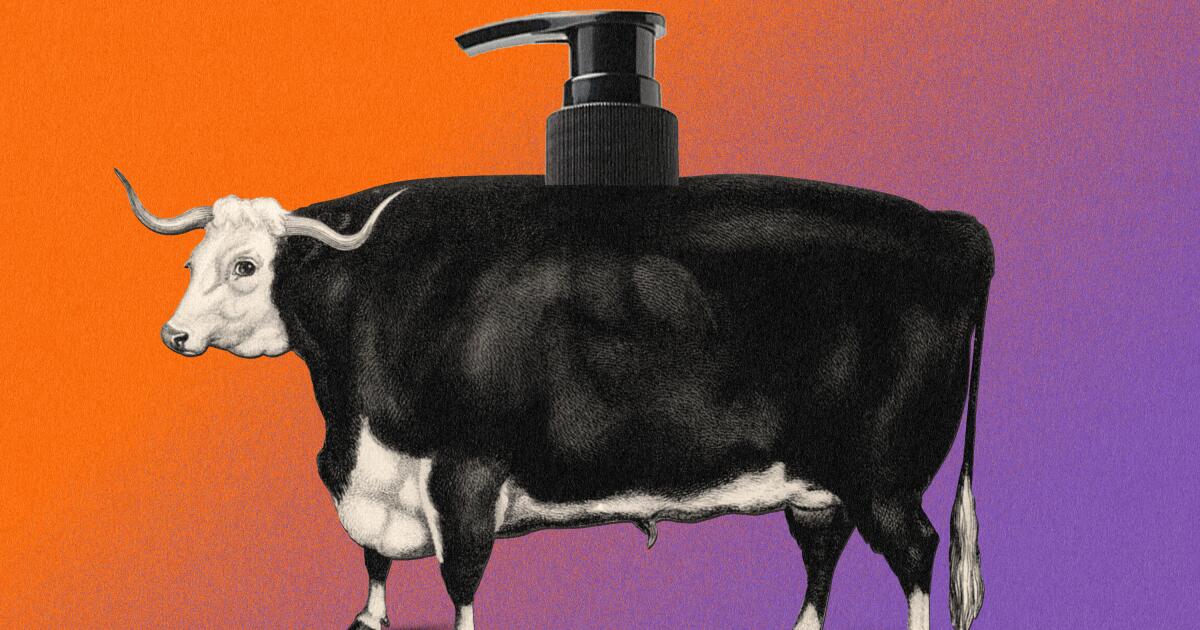
So is rubbing animal fat on your face worth it? Or is it simply an evidence-lacking marketing scheme capitalizing on the appeal of “natural” (more on this term to come) skincare? I decided to talk to some experts and conduct my own personal hydration experiment to find out whether the claims are legitimate or basically all bull.
What others are saying
Dr. Heather Rogers, a dermatologist in Seattle and founder of the Doctor Rogers skincare line, told me that there are few modern scientific studies examining beef tallow as a skincare ingredient. One of the most frequently cited papers dates back to 1994 and evaluated animal fats in combination with other oils, making it difficult to draw conclusions about the benefits of pure beef tallow for conditions such as eczema or acne.
As for claims that the substance mimics the amino acid profile of human skin, Rogers said the comparison is often overstated. Tallow consists of a much higher amount of saturated fat compared to our own sebum. According to Rogers, “It’s not identical.” Human skin is composed primarily of ceramides, fatty acids and cholesterol, which are not classified as saturated.
Dr. Elizabeth Bahar Houshmand, a dermatologist practicing at Houshmand Dermatology in Dallas, said it’s not just the lipids themselves that matter, but the proportions in which they appear. “Tallow does not replicate that [human skin lipid] structure.”
All the same, the fatty acid profile of tallow does overlap with some lipids found in human skin and sebum, including palmitic, stearic and oleic acids. Tallow may also contain small amounts of vitamins A, D, E and K, though Houshmand pointed out that those trace amounts are not comparable to a formulated retinol product, where concentration, stability, delivery mechanisms and clinical outcomes have all been studied.
Ramón Pagán, a cosmetic chemist and independent consultant based in New York City, sees another force helping drive tallow’s popularity: branding. In many corners of the internet, tallow isn’t marketed simply as a moisturizer but as a return to something more primal and distinctly masculine. “There’s such a push for this rugged, of-the-earth mentality when it comes to men’s skincare. Conventional cosmetics are deemed as ‘effeminate’ due to unnecessary misogyny. Actually, what can be more manly than killing a cow and spreading its fat on your face?”
That marketing often overlaps with another popular selling point: the word “natural.” Yet none of the experts I interviewed viewed the term as inherently meaningful from a scientific standpoint.
“There seems to be a widespread chemophobia,” said Pagán. The irony, he noted, is that “everything is a chemical.”
“Poison ivy is natural,” Houshmand said. “Essential oils are natural and can be irritating allergens. And ‘chemical-free skincare’ is scientifically impossible; water is a chemical, lipids are chemicals, and vitamins are chemicals.”
The experiment
So I went ahead and swapped my normal creams containing high amounts of glycerin, aloe and other plant-based ingredients for tallow-based alternatives for a two-week period. I applied beef and bison tallows from three companies. Each blended its tallow with additional ingredients — jojoba oil being the most significant. I rotated among brands to lessen the likelihood that these additives would heavily influence my results.
Below are my findings after using only the listed products (aside from my established cleansing and toning routine). You can generally find these items for between $15 and $40 for a two- to four-ounce jar.
- Sky&Sol advertised a “natural, restorative” cream offering 48 hours of nourishment.
- Ancient Nature was the brand I stumbled upon in Redondo Beach. Owner Bruno Neves uses bison instead of beef fat and also offers deodorants and coffee exfoliants.
- Stoked Beekeeping Co. offered a manuka honey and tallow balm. Manuka honey is known for its antibacterial and anti-inflammatory properties.
On day three, I started to notice something similar among all three brands: staying power. Unlike the plant-based moisturizers I had been using before this experiment, the tallow-based creams lingered on my skin for hours. They created a heavier, more occlusive layer. Aesthetically, I appreciated the glow they produced. My skin took on the sheen of someone who had just returned from a brisk run. As for smell, a common concern among skeptics, I only found the bison tallow scent noticeably strong.
So should you try it? Some doctors point to the fact that there are already countless evidence-backed moisturizers with decades of clinical research behind them. Others, like Rogers, put it simply: “If you’re interested, try it. Know that there are better moisturizers out there, but it’s not going to cause harm.”