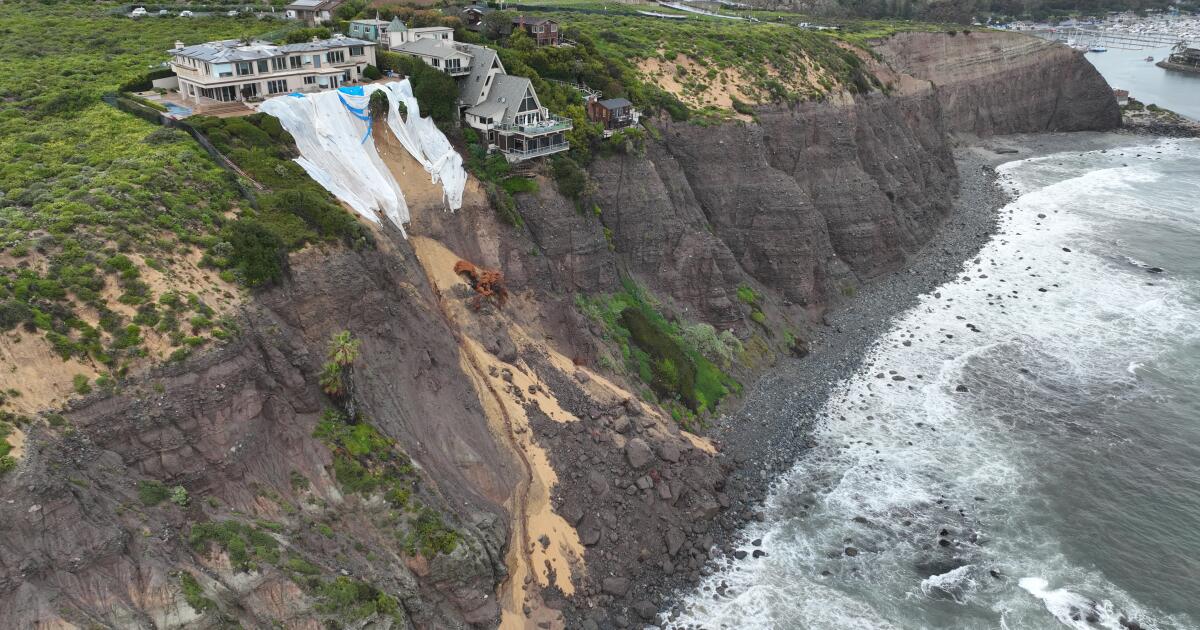
Researchers have figured out how to develop hurricane warnings, tsunami warnings, even an earthquake early warning system. But when it comes to predicting cliff collapses along California’s iconic shoreline, the science has been infamously tricky to pin down.
But with every dramatic landslide and tragic death along the coast, officials have turned to scientists for help. Is it possible, many have wondered, to foresee when and where a bluff might collapse — and perhaps even turn these predictions into early warning alerts?
Now, after an innovative pilot study backed by decades of specialized research, scientists at UC San Diego’s Scripps Institution of Oceanography say they may have cracked the code. In a report released this month, the team shared a proof of concept and found that there are remarkably reliable ways to detect a coastal landslide well before it happens.
The pilot study was able to predict five collapses at least several hours — sometimes even days — before they happened.
“It was surprising how good the data turned out to be, and how consistent it was for these types of landslides that we were monitoring,” said Adam Young, a coastal geomorphologist at Scripps who led the study. “We have a lot of confidence that what we’ve learned in San Diego could absolutely be applied to other places throughout the state.”
Bluff collapse predictions have been in high demand along the California coast, and the stakes are even greater with sea level rise and a particularly strong El Niño on its way. In Southern California, cliffs could erode more than 130 feet by the end of the century, and the consequences of erosion have already proved to be severe on major roads, railways and other critical infrastructure.
The consequences are also deadly. At least 25 people have died on California beaches due to coastal landslides, and many in San Diego’s North County are still reeling from a 2019 bluff collapse that killed three women in Encinitas. That same year, a similar collapse in San Francisco killed a woman who was walking her dog at Fort Funston.
Search and rescue personnel look at a section of oceanfront bluff that collapsed in August 2019 at Grandview Beach in Encinitas. Three members of a family were killed.
(Denis Poroy / Associated Press)
These collapses have haunted state Assemblymember Tasha Boerner (D-Encinitas), who first floated the idea of an early warning system.
She imagined something admittedly more science fiction than science (“in my mind it was a rod with a light and a sound,” she said) but when she reached out to Scripps about what might be possible, the scientists considered her question seriously. It was not going to be easy, but they agreed to try.
Coastal cliffs are particularly challenging to study, they explained. Cliff height, wave action, the type of rock and the slope of the beach could all factor into a cliff’s stability. How rainfall seeps into cracks can also build up pressure and lead to collapses.
The human urge to build right to the shoreline — whether it’s the coastal highway or a bluff-top home — also affects erosion by altering water drainage and adding weight to the cliff.
It also doesn’t help that when talking about cliffs, scientists tend to speak in averages. Stretched over a long period of time, an average rate of erosion — say, a few inches or a foot a year — might not sound like much.
But cliffs tend to crumble slowly over time, punctuated with a sudden collapse. A cliff averaging one foot a year might actually not do anything dramatic for 20 years, and then a 20-foot collapse will abruptly topple in one go.
Boerner listened to the research needs and rallied the state Legislature. Through Assembly Bill 66, she secured $2.5 million in funding for Scripps to start with a pilot study.
Young, who is considered one of the world’s leading experts on coastal bluff collapses, teamed up with Mark Zumberge, a geophysicist at Scripps who has spent decades developing advanced sensors that can take precise measurements of earthquakes.
They picked three known hot spots to study: San Elijo State Beach, a popular beach with a clifftop campground; Beacon’s Beach, a beloved beach in Encinitas with a public access trail on an intermittently moving landslide; and a critical rail corridor in Del Mar that runs along unstable bluffs. At each study site, they installed a wide range of sensors to see what worked.
The sensor technology included seismometers, wave pressure sensors and a special sensor called a tiltmeter, which is often used to measure the movement of earthquake faults and can detect how much the ground is tilting toward the ocean down to an accuracy of 1/8 the width of a human hair. They also installed advanced sensors that can detect movement up to one-billionth of a meter by using fiber optic cables that can extend or compress if any ground deformation occurs.
Their team also installed rain gauges and went into the field each week with advanced laser-imaging technology, known as lidar, to measure and track the cliffs before and after a collapse.
Patterns soon emerged. In the hours, sometimes days, leading up to a collapse, the sensors could clearly detect a rapid increase in the ground tilting motion.
Their most notable prediction came on April 21, 2024, in Del Mar. During a maintenance visit earlier that month, researchers had observed a tiny new crack in the clifftop that was about 0.1 inch wide. Over the next several weeks, their sensors noted that the crack was widening about 0.015 of an inch per day, a rate invisible to the eye.
Then it rained on April 7, and again on April 14. By April 19, the tilt sensor measurements were accelerating at a rate that made scientists determine a collapse was imminent. They notified coastal managers, and two days later, at about 5 a.m., more than 200 tons of the cliff toppled onto the beach. Fortunately, it was early enough in the morning that no one was hurt.

On April 21, 2024, about 200 tons of cliff material toppled onto the beach in Del Mar. A tiltmeter sending data in real time had alerted Scripps researchers two days before that a landslide was highly likely.
(Adam Young/Coastal Processes Group at Scripps Institution of Oceanography)
“The results of AB 66 and this first phase go beyond my wildest imaginations,” said Boerner, who hopes this proof of concept lays the groundwork for a future statewide alert system. “I am so grateful that Adam Young and his team took a chance on this idea. … If they had said no, none of the science would exist.”
A key next step is making sure people know what to do with this information — and developing protocols with lifeguards, emergency managers, transportation agencies and other officials who decide when to close a beach or road.
Dozens of legislators, staff and agency personnel have already been briefed on the latest research, and Boerner said she’s putting together a working group. She plans to seek more state funding to expand the research and explore ways to establish an emergency response system. She also envisions working with weather apps so that beachgoers can eventually receive a geo-fenced bluff collapse warning, in the same way a high surf advisory might be issued.
Patrick Barnard, who spent years leading coastal erosion research for the U.S. Geological Survey, said the latest Scripps data are promising and the next big question is scalability. Crumbling cliffs loom over more than 530 miles of the California coast, and the cost of establishing a statewide sensor network would be significant.
But Barnard, who left the USGS last year and now serves as the research director of UC Santa Cruz’s Center for Coastal Climate Resilience, noted that the Scripps pilot project is an inspiring example of science and government working together to solve a problem that could save lives.
“It’s great that the state is invested in this issue, and they invested in one of the best coastal cliff experts that we have,” Barnard said. “It’s comforting to hear that these things are moving forward, and that the science here is playing a role in policymaking. …This isn’t the case everywhere, but it’s how that relationship should be in an ideal world.”