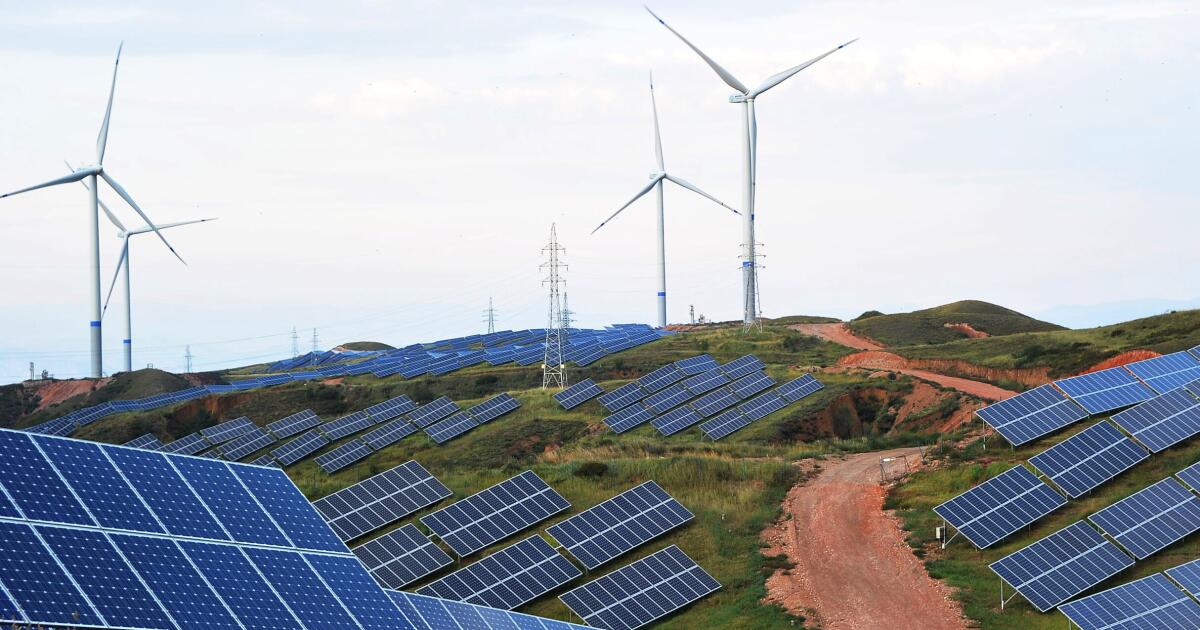
China, the world’s largest source of climate-warming greenhouse gases, plans to more deeply integrate its massive renewable power fleet into factories, data centers and transport in a new plan that lays out more detail on its emissions-cutting strategy through 2030.
The five-year climate plan, published Thursdayafter the broad direction was confirmed at the nation’s annual political meeting in March, signals that the country is moving away from an era of just building out clean energy capacity and toward a greater focus on ensuring it gets used through storage, transmission, electrification, green hydrogen, and low-carbon industrial parks and data centers.
Details from the plan largely hew to China’s existing approach of setting relatively loose targets and planning for growth in clean technologies to drive a decline in emissions. That’s likely to disappoint advocates of faster climate action. The core climate targets are the same as China published in its broader five-year plan in March.
The country will advance renewable power sources, such as solar and wind, to boost the electrification of conventional oil and gas exploration, according to a separate work plan for the energy sector that was released Friday. The plan, which covers 2026 to 2028, also promotes the inclusion of nuclear power in China’s green power trading and green electricity certificate programs, two key elements of the country’s decarbonization strategy.
China’s carbon dioxide emissions, which make up the bulk of its climate footprint, declined slightly last year, driven by further advances in renewable energy deployments and electric vehicles, including long-distance trucks.
While President Xi Jinping has pledged to hit carbon neutrality by 2060, officials have only committed to emissions peaking before 2030, which could allow for a carbon rebound in the coming years. China is grappling with an economic slowdown and has energy security concerns following the Iran war, all of which complicate its climate campaign in the short-term.
A five-year plan for the energy sector, published in June, also emphasized an ongoing role of coal as the backstop for the country’s energy system.
The climate plan doesn’t seek to rein in the country’s fast-growing coal-to-chemicals industry, but calls for low-carbon retrofits, reductions in coal consumption per unit of output and a gradual substitution of some fossil-based feedstocks and energy inputs with renewable power and green hydrogen.
Action over the next five years will be crucial in determining whether China meets Xi’s carbon emissions deadline and gets on track to hit net zero by 2060. How quickly and aggressively the country can begin to reduce its outsized climate footprint is also critical to the world’s prospects of limiting the impacts of global warming.
China accounted for about 29% of greenhouse gas pollution in 2024, compared to the 11% contributed by the U.S. — the second-ranked nation. Since then, the U.S. has revoked climate policies under President Trump and seen emissions edge up in the last year, according to an analysis by Rhodium Group.
Pike writes for Bloomberg. Dan Murtaugh and Ocean Hou of Bloomberg contributed.