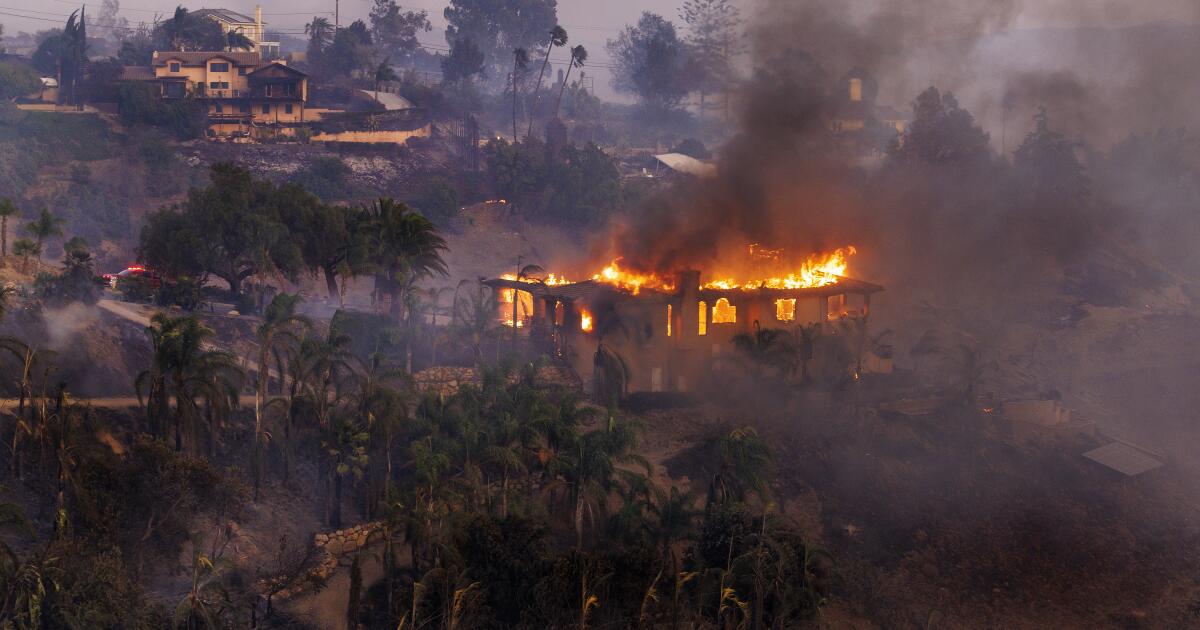
At the turn of the century, wildfires destroyed only about 3% of the California homes they came into contact with. By 2020, the rate had risen to 18%, according to a new study from UC Merced.
It’s an indication that decades of efforts to clear flammable plants around homes and fortify their exteriors against flames, heat and embers are being outpaced by increasingly extreme wildfire behavior and construction in fire-prone areas.
“Fires will continue to grow, because climate change has already occurred,” said Mukesh Kumar, a postdoctoral scientist at UC Merced who led the study. “The encouraging message is that we have identified the factors associated with higher survivability — even in California.”
While the entire American West saw a decrease in the percentage of homes surviving wildfire, California saw a particularly pronounced drop. The findings add to a growing body of research showing the rising number of destroyed homes across the Western U.S. is driven not only by wildfires reaching more properties. but also by homes faring worse when wildfire reaches them.
“That’s really kind of disheartening — that we’ve tried our best to mitigate fires … yet fires are destroying more homes,” said Amanda Carlson, a research scientist with the U.S. Geological Survey who was not involved in the study, but has found similar drops in the percentage of homes surviving in much of the American West.
California has taken significant steps to increase the odds of homes surviving wildfires in recent decades, in response to increasingly destructive wildfires fueled partly by global warming and a history of forest mismanagement.
In 2006, the state expanded fire-safe landscaping rules that require property owners to create separation between trees and shrubs and remove dead vegetation. The rules, which previously applied within 30 feet of homes, were extended out to 100 feet.
Two years later, California adopted a set of wildfire building codes for all new construction, including the use of fire-resistant materials for the outer walls and roof, multi-paned windows that are less likely to shatter in extreme heat and vent covers to prevent embers from sneaking into homes.
Now, the state is developing even stricter landscaping requirements within five feet of homes.
By virtually all accounts, these precautions have meaningfully protected homes. One recent study found that 48% homes with these precautions survived some of California’s largest fires. Out of homes with no precautions, only 20% survived.
Yet, fires fanned by increasingly extreme weather have stress-tested these measures more than ever before.
Carlson’s Geological Survey team found fires are burning more intensely as a result of dry conditions and are getting carried by stronger winds — both of which decreased the odds of homes surviving. Meanwhile, Kumar’s UC Merced team found that increasingly large fires lowered survival odds.
The scientists hypothesized that faster-moving fires might reach homes before firefighters can, and large blazes can threaten more homes than firefighters can defend at once. Without firefighters nearby, homes are left entirely to their own devices.
Even though home hardening efforts can help protect structures, some of California’s building practices are hurting those efforts.
Some regions have significantly increased residential development in wildlands, creating a dangerous combination of flammable plants, vulnerable homes and residents capable of sparking fires — on purpose or by accident.
Of the new properties built between 2020 and 2022 in California, 80% were in high fire-risk areas, compared with just 28% built in the 1920s, according to the for-profit research company ClimateCheck (which is heavily staffed by University of California scientists).
A home’s location can often override the steps residents take to protect their properties.
As one 2017 study concluded about wildfires in San Diego County, “homeowners could do everything correctly to prepare their house for fire safety, but if the structure is located in a hazardous setting, none of these actions may be enough.”