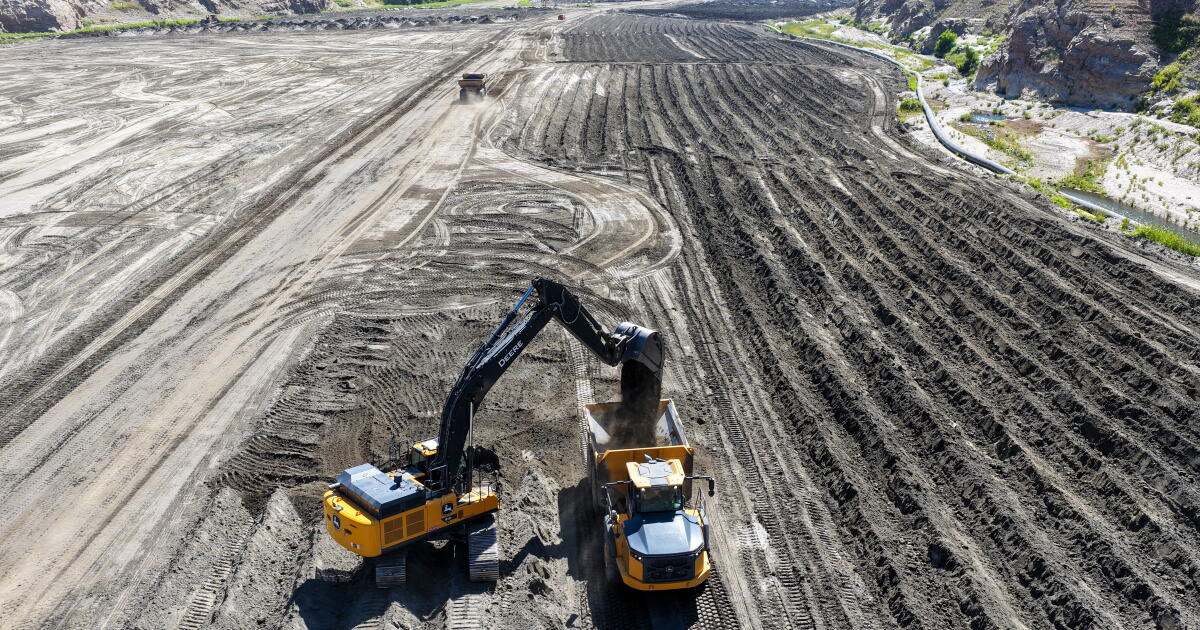
The strong El Niño this year increases the odds of drenching rainstorms hitting Southern California, and L.A. County is preparing by digging out massive amounts of accumulated mud, sand and debris from reservoirs that protect communities below from floods.
Crews with excavators are scooping loads of sediment onto trucks to increase the water-catching capacity of mountainside reservoirs including San Gabriel, Eaton Wash and Devil’s Gate.
In all, the county estimates its teams this year are removing as much as 1.3 million cubic yards of sediment to free up space for floodwaters and debris at the dams and in smaller catchment basins — enough to fill the Rose Bowl three times. In thousands of trips, trucks haul the material to old gravel pits. At one reservoir, a conveyor moves it to a nearby canyon.
Crews remove accumulated sediment at the Devil’s Gate Dam in Pasadena.
(Eric Thayer/Los Angeles Times)
This massive effort takes place each year during the dry season, from April 15 to Oct. 15. But this year it has taken on added importance as officials at the L.A. County Public Works Department and other agencies prepare for possible heavy storms, floods and debris flows.
“Our system’s going to be ready for the storms that come our way,” Assistant Deputy Public Works Director Sterling Klippel said. “It’s really critical that our dams and our debris basins have capacity to hold back water and debris.”
Los Angeles County has one of the nation’s largest urban flood control systems, including 14 dams in the foothills and mountains, about 180 debris-catching basins, and nearly 500 miles of channels, plus an astonishing 3,330 miles of underground storm drains.
Built after devastating floods in the 1930s, the system is designed to catch rainwater flowing down the mountains and send it down concrete channels to the ocean.

Workers use machinery to dig out sediment from Devil’s Gate Dam to restore its capacity to catch floodwaters ahead of possible storms during a strong El Niño.
(Eric Thayer/Los Angeles Times)
The system also has 27 so-called spreading grounds with man-made ponds where runoff soaks into the gravelly soil and replenishes groundwater.
El Niño, the climate pattern of ocean waters warming up in the central and eastern Pacific, tilts the chances in favor of wet winters in Southern California.
Hazardous floods could occur if back-to-back storms dump heavy rains over several days, saturating the soil in the mountains and filling reservoirs.
During the 2004-2005 El Niño, storms filled the county’s dams and they spilled over.
The work of clearing out reservoirs and basins to make space for water helps ensure they provide as much protection as possible during storms, said Brett Sanders, a UC Irvine professor of civil and environmental engineering.
“That’s really important because the more storage you can create in the system, the more capacity you will have to reduce flooding,” he said.
Still, experts have projected that the L.A. region’s engineered waterways wouldn’t be capable of containing the biggest floods. In a 2022 study, Sanders and other researchers estimated that a severe flood of the sort that happens once a century would threaten the homes of hundreds of thousands of people.
“We still have vulnerabilities,” he said.
L.A. County Supervisor Lindsay Horvath said during a recent meeting that the possibility of major storms is particularly concerning for communities near wildfire burn scars in Altadena and the Santa Monica mountains, where the 2025 firestorms left charred hillsides that could be vulnerable to floodwaters and landslides.
In an email, Horvath said this El Niño will be “a test of how seriously L.A. County has prepared for a more extreme, changing climate.”
County officials are holding a virtual meeting on Sept. 28 to discuss how they are preparing for storms and to take questions from residents.
More water news

A boat glides across Clear Lake in Northern California in 2024.
(Jason Armond/Los Angeles Times)
In Northern California’s Clear Lake, the native fish are threatened by mercury contamination, toxic algal blooms and predatory invasive fish. My L.A. Times colleague Noah Haggerty covered the signing of an agreement formalizing an arrangement in which seven Native tribes co-manage the watershed with local governments in an effort to save the fish.
I reported for The Times on a significant new development in the political wrangling over California’s plan for managing how much water is taken out of the Sacramento-San Joaquin River Delta with giant pumps. The Trump administration is denouncing the plan as “unworkable,” and Westlands Water District, the biggest irrigation agency in the Central Valley, is also calling for changes to the plan. The State Water Resources Control Board considers the plan next month.
The state of Nevada recently sued to challenge the Trump administration’s plan for imposing water cutbacks along the Colorado River. And now the agency that brings Colorado River water to Arizona cities has taken a step toward a possible lawsuit of its own, Alex Hager reports for KJZZ.
More climate and environment news
The Trump administration is abandoning federal limits on planet-heating pollution from coal and gas power plants, dismantling most Biden-era climate rules, Hayley Smith and Blanca Begert report for The Times.
My colleague Susanne Rust obtained internal documents from an industry group that reveal a coordinated push to dismantle California’s single use plastic law. The documents show how a group called the Print Creative Alliance and its allies plan to kneecap that law as well as the state’s Truth in Recycling law.
California Atty. Gen. Rob Bonta has filed suits to challenge the Trump administration’s changes to the Endangered Species Act, which state leaders say would threaten habitat, Rachel Becker reports for CalMatters.
The two domes that once housed the San Onofre nuclear reactor cores will start coming down early next year. But as my colleague Blanca Begert explains, the question of what should happen to the 3.6 million pounds of nuclear waste is generating debate.
Since last fall, dead and emaciated seabirds have been washing up on many California beaches. In the latest case, Haggerty and Caroline Petrow-Cohen report for The Times, dozens of dead cormorants washed ashore on Venice Beach. The cause hasn’t been determined, but wildlife experts say many of the recent bird deaths may be linked to extremely warm ocean waters.
This is the latest edition of Boiling Point, a newsletter about climate change and the environment in the American West. Sign up here to get it in your inbox.
And catch the latest episode of the Boiling Point Podcast: This week host Miranda Green speaks with reporter Noah Haggerty about new landscaping rules in California to ameliorate fire. Then she’ll talk with CEO and founder of Megafire Action Matt Weiner about California’s efforts on fire resilience.
For more news on water issues and climate change, follow Ian James @ianjames.bsky.social on Bluesky and @ByIanJames on X.