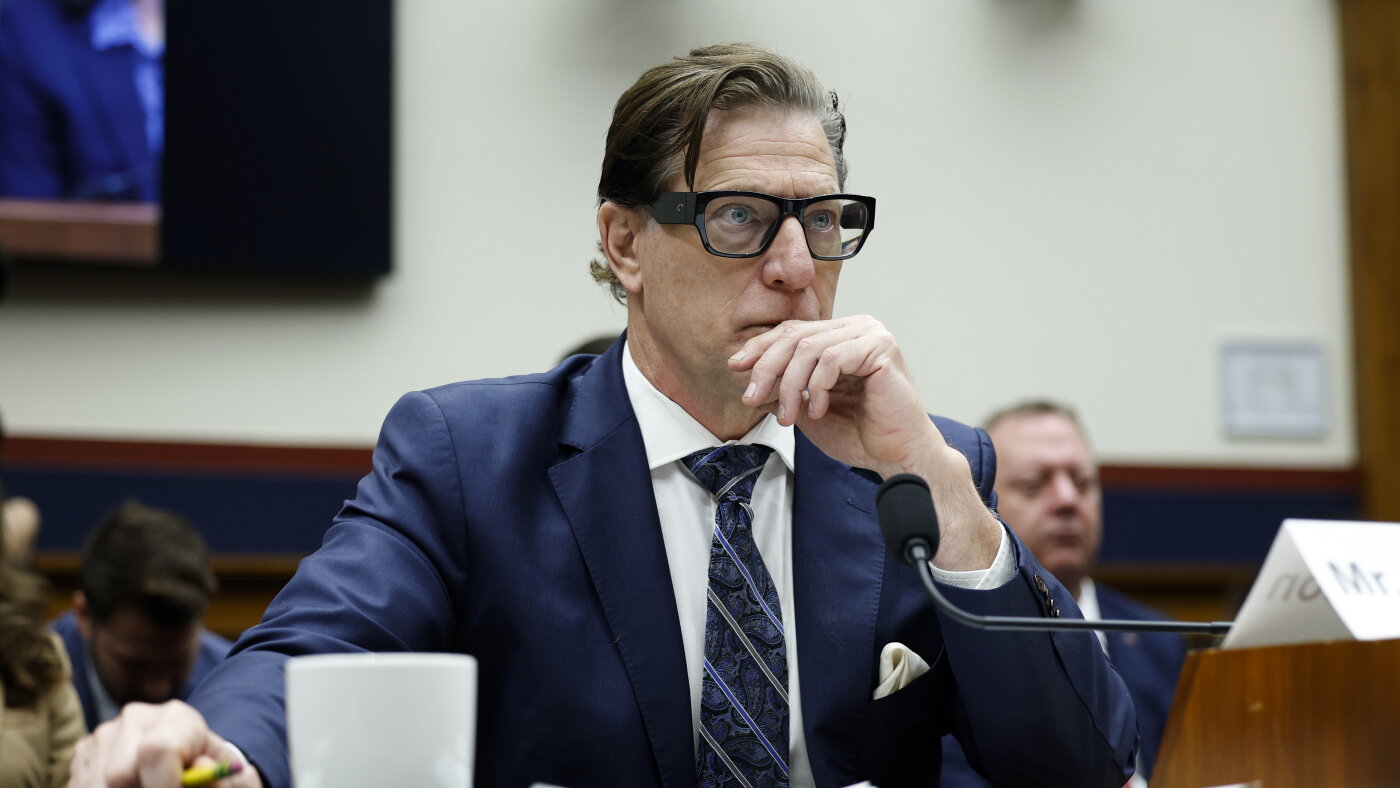
David Richardson testifies before Congress in 2025, when he was leading the Federal Emergency Management Agency (FEMA). In a new book, he describes his efforts to dramatically reduce the agency’s size. “I quickly realized that I would not be the one to transform FEMA or shut it down,” he says.
Kevin Dietsch/Getty Images
hide caption
toggle caption
Kevin Dietsch/Getty Images
The Federal Emergency Management Agency is no longer in the Trump administration’s crosshairs, according to its former leader.
President Trump has made no secret of his disdain for the country’s top disaster agency. In the first week of his second term, he attacked FEMA, saying, “I think, frankly, FEMA is not good,” arguing that the agency should be eliminated. That rhetoric was echoed by top administration officials, including then-Department of Homeland Security (DHS) Secretary Kristi Noem, who controlled the agency’s budget.
Other federal agencies have since been stripped down or even eliminated, including the Department of Education, Voice of America and USAID.
But despite his own significant efforts to dismantle FEMA, the man who ran the agency at the time says FEMA isn’t going anywhere.
“I think they’re probably in a go-along-to-get-along kind of mode,” says David Richardson, who led FEMA as acting administrator for much of 2025 and has since left the federal government. “I don’t see there being a whole lot of change.”
That shift is apparent inside the agency. In recent months, the fear of wholesale agency abolition or mass layoffs has dissipated among FEMA workers, according to multiple current FEMA employees who requested anonymity because they fear retaliation for speaking to a journalist. But the attempts to kill it have compounded some of FEMA’s longstanding problems, like understaffing, and delays in getting disaster recovery money to survivors.

Rescue workers are seen on land and on a boat as they search for missing people near Camp Mystic in Hunt, Texas, along the Guadalupe River after a deadly flash flood swept through the area in July 2025.
Julio Cortez/AP
hide caption
toggle caption
Julio Cortez/AP
“Looking back, I think what we saw was an ill-advised attempt to reduce the size of FEMA without fully understanding all the different functions that the agency has,” says Andrew Rumbach, who studies disaster policy at the nonprofit Urban Institute.
A recent report from the Government Accountability Office raised concerns about whether the agency is adequately staffed. Parts of the agency that handle disaster recovery are still understaffed and struggling to get long-delayed money to disaster-stricken states, according to the FEMA employees who spoke to NPR.
It’s only now that “serious reform efforts” are potentially on the horizon for the agency, Rumbach says, and those efforts no longer include eliminating it.
In response to questions from NPR about whether the agency’s goals have changed since the president took office, a FEMA spokesperson wrote in an email, “FEMA remains fully operational and focused on its core mission of helping people before, during, and after disasters. As a matter of policy, we do not comment on accounts in forthcoming books, internal operational deliberations, or personnel matters.” The White House declined to comment.
An inside account of the mission to eliminate FEMA
In one of his first interviews since leaving the agency late last year, Richardson sat down with NPR to talk about his time at FEMA and what he saw as his mission while he was there.
Richardson, who served as an artillery officer in the U.S. Marines for more than 20 years, arrived in FEMA’s top job “reluctantly” and with no experience with disaster management. “FEMA’s not my thing,” he says.
Still, he says he was ready to take on the job because he had previously led efforts to cut the Countering Weapons of Mass Destruction office within DHS.
“There was resentment towards FEMA. The president’s intent was to shut it down or drastically reform it, and my predecessor wasn’t moving fast enough in that direction,” he says. “I went there for three things: to get FEMA through hurricane season, either shut it down or drastically reduce its size, and get it ready for rebranding.”
Richardson says he arrived at FEMA in May 2025 with a plan to cut the number of employees at FEMA headquarters from about 6,000 to no more than 2,000 by November 2025.
“I always think that you can do more with less people, to a degree. At some point it’s self-defeating. But it’s definitely self-defeating to have too many people,” says Richardson. “I’m a small-government person.”

Deanne Criswell, who ran FEMA during the Biden administration, speaks about Hurricane Helene at the White House in 2024.
Saul Loeb/AFP via Getty Images
hide caption
toggle caption
Saul Loeb/AFP via Getty Images
Deanne Criswell, who ran FEMA for four years under the Biden administration, says Richardson’s description of FEMA as bloated and in need of drastic cuts suggests he does not understand the agency he briefly ran. She agrees that there are personnel changes that could make FEMA more efficient and effective, but “you can’t just indiscriminately cut,” she says. “It’s only going to hurt the person who has the most need after a disaster.”
The Trump administration’s approach to cutting FEMA’s spending and staffing has also struggled in the face of court challenges. An early attempt by the Trump administration to end a major grant program for disaster preparedness failed after a court challenge, and temporary workers who were terminated earlier this year are suing the agency. This summer, FEMA started rehiring many of those who were terminated.
“Dave, things have changed”
Within months of taking over the agency, Richardson realized that, as he puts it, “the focus was quickly shifting.”
He says DHS leadership did not approve a plan he shared to downsize FEMA starting at the end of October 2025, one month before the end of the Atlantic hurricane season. Meanwhile, the president appointed a council of emergency experts to make recommendations about how to reform the agency, and Richardson says he started to wonder if the administration’s goals had changed.
In July 2025, he says, he got his answer. As he recounts in a new book Texas Flood: Power, Money, Politics, History, Bureaucracy and Tragedy, a DHS deputy chief of staff told him, “Dave, things have changed,” before explaining that the president’s council, not Richardson, would decide the future of FEMA.

Richardson resigned from FEMA late last year and recently wrote a book about the deadly floods in Texas during his time at the agency.
Rebecca Hersher/NPR
hide caption
toggle caption
Rebecca Hersher/NPR
Indeed, at public meetings of the council that summer, members discussed a variety of recommendations for whether and how to cut FEMA’s workforce. At those meetings, emergency managers from powerful states led by Republican governors, including Texas and Florida, discussed the importance of reforming FEMA, but did not publicly advocate for eliminating it.
“I think that’s where we started to see the rhetoric start to change about FEMA,” says Criswell. “There are so many communities, and many Republican communities, that depend on the aid that you couldn’t just get rid of it without having a negative impact.”
The politics began to look more complicated, says Richardson. He writes that he supported the work of the council, and continued to advocate for major cuts to FEMA but “over the next few months, each time I received a call from DHS HQ complaining about the size of FEMA, I reminded them I could cut the size of the agency’s HQ in half the next day; I only needed the green light.”
Richardson says he never got the green light to make major cuts to FEMA staff.
New leadership and new reforms
Richardson resigned from FEMA in late 2025, and Noem was fired in March of this year.
Noem’s replacement at DHS, Markwayne Mullin, was previously a Senator from Oklahoma, and has extensive experience working with FEMA after major disasters in the state, Rumbach points out. Last month, the Senate confirmed Cameron Hamilton to lead FEMA. Hamilton had previously served as the agency’s acting administrator before Richardson took over, but Richardson felt he “wasn’t moving fast enough.”

Homeland Security Secretary Markwayne Mullin speaks at the Eisenhower Executive Office Building earlier this summer. The former Senator from Oklahoma replaced Kristi Noem at DHS in March.
Julia Demaree Nikhinson/AP
hide caption
toggle caption
Julia Demaree Nikhinson/AP
In his introductory email to FEMA staff, obtained by NPR, Hamilton wrote that he looks forward to “strengthening the agency for the future.”
Meanwhile, the president’s FEMA Review Council submitted its recommendations earlier this year and called for states to take more responsibility for disasters. During his Senate confirmation hearing, Hamilton promised to come up with a plan to implement some of those recommendations. Just this week, the agency announced a pilot program with the state of Indiana aimed at getting disaster relief money to the state more quickly for flood repairs.
Rumbach says that approach is very different from Richardson’s. “Those are the kind of improvements I’d hope to see in the coming years,” he says. “Compared to some of the more dramatic and draconian cuts that were being recommended.”
But many of the most sweeping FEMA reforms, such as making the agency report directly to the president and overhauling the system for getting money to individual disaster survivors, would require the White House and Congress to work together. That doesn’t appear to be a priority for the administration today. A bipartisan FEMA reform bill is waiting in committee, and President Trump has rarely spoken about FEMA this summer, even after major disasters, including floods and catastrophic wildfires.