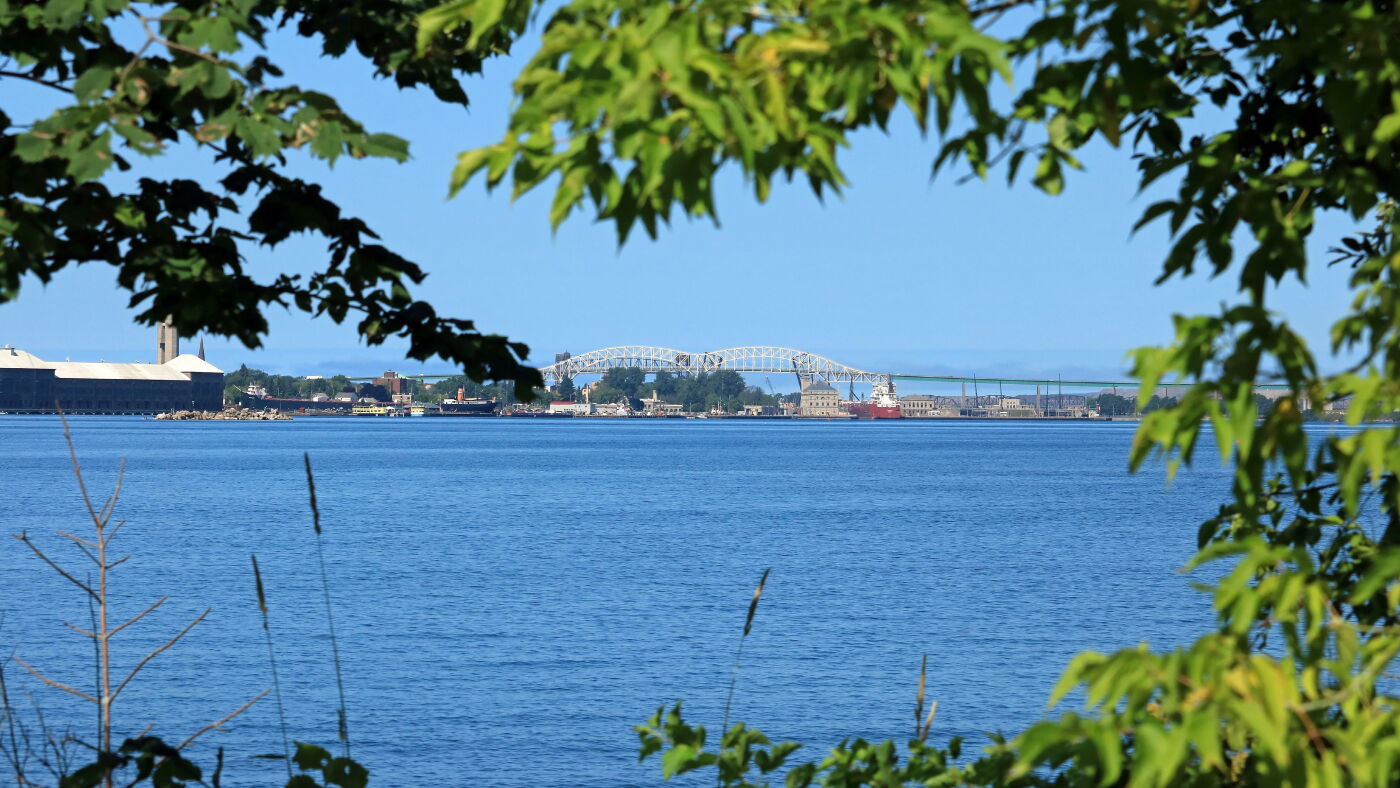
Sault Ste. Marie, Mich. is connected to its sister city, Sault Ste. Marie, Ontario by the International Bridge. Both cities are facing economic challenges due to Trump’s imposed tariffs.
Education Images/Universal Images Group via Getty Images
hide caption
toggle caption
Education Images/Universal Images Group via Getty Images
SAULT STE. MARIE, Mich. – The escalating trade war between the U.S. and Canada is particularly tangible in Michigan’s rural Upper Peninsula, regionally known as the UP, where many residents rely on the regular exchange of goods and tourists that cross over several times between the two countries.
While Michigan is home to a competitive U.S. Senate race, this region has most recently voted for Republicans. The last Democrat to represent the UP in Congress was Bart Stupak, who left office in 2011.
Now, President Trump’s decision to impose a 50% tariff on nearly $20 billion in Canadian goods could influence a race that could be pivotal to the balance of power come November.

UP residents – affectionately known as “Yoopers” – are already facing high costs on goods and groceries. Part of the problem is that the UP is difficult to get to – accessible by two bridges and a land border with Wisconsin. That also means higher shipping and transportation costs during a time of record high diesel fuel.
Ben Rahilly owns an appliance store, a gift shop, a furniture store and a concrete business in Newberry, a faded logging town about 60 miles west of the Canadian border. The village’s largest employers are a prison, a hospital and a mill that makes wood siding.
Rahilly says running a small business in a county that has around 5,300 people is tough work.

Downtown Newberry, Mich. The single-screen Tahqua Land Theater plays new movies, while the neighboring drug store has closed.
Russ McNamara/Michigan Public Radio
hide caption
toggle caption
Russ McNamara/Michigan Public Radio
“Prices are going up. Our shipping charges are getting more and more every day. The cost of just goods is going up, so it’s making it tougher on our profit margins,” Rahilly said. “Trying to keep it small town, small prices … so people can afford to keep shopping with us.”
Marquette, the largest town in the UP, has the big box stores that compete with a host of local businesses, but it’s 100 miles to the west.
Rahilly can feel the added costs throughout his businesses and is baffled by the trade war.
“You got, right now, our president in a pissing match with Canada. Well, we do a lot of business with Canada, surprising enough.”
Rahilly leans conservative but refuses to rule out voting for a Democrat.
“Yeah, I voted for him [President Trump], but I don’t think everything he’s making right on his decisions,” Rahilly said. “Yes, we need goods made in America, but we don’t have a workforce either, so we’re not going to get it. So we have to bring in some stuff. We just have to be able to work with them countries.”
Tony Haller is the executive director of the Sault Area Chamber of Commerce in Sault Ste. Marie, Mich. He has no choice but to work with its sister city, Sault Ste. Marie, Ontario.
“Yeah, I think there’s certainly a sense of frustration between both communities,” he said.
Haller thinks the local economy has been as steady as it can be.
“Basically, never at the highest of highs or lowest of lows,” Haller said.

The two sister cities are connected by the International Bridge, and commercial and passenger traffic is down by about a quarter since Trump’s second term. The International Bridge Administration, using per-trip estimates from the Canadian government, believes businesses on the Sault Michigan side are missing out on $62.7 million in lost revenue.
“Speaking from Sault Michigan’s point of view, you know we’re pretty solid all year round, but because of the bridge traffic being down, I know our businesses aren’t quite as busy as they should be, and so we’re hoping that when this all gets settled, that we’ll go back to some sort of normalcy,” Haller said.
The federal government says over a third of all Michigan exports go to Canada. That equaled to more than $21 billion last year. That makes the state uniquely susceptible to a trade war.
And tourists to the region are also weighing in. Todd Campbell and his wife Debbie were watching the Algoma Harvester, a Canadian carrier, make its way to Thunder Bay, Ontario, upstream through the Soo Locks, the shipping channel that allows freighters to bypass the rapids of the St. Marys River. He believes the president’s talk of making Canada the 51st state is just rhetoric, but he says he does not like the tit-for-tat tariffs.
“I’m not real happy about that. I’m a more conservative person, but I’m not happy with the way that’s going to be honest with you,” Campbell said.
Campbell owns a trucking company near Knoxville, Tenn. He says business is good and that he likes most of the GOP’s policies.

Todd and Debbie Campbell of Knoxville, Tenn., visit the Soo Locks in Sault Ste. Marie, Mich.
Russ McNamara/Michigan Public Radio
hide caption
toggle caption
Russ McNamara/Michigan Public Radio
“That doesn’t mean I’m lockstep with every decision they make, to be honest with you,” Campbell said. “I think both sides are really out for themselves, and we all get caught in the middle. And this is a good example of it.”
Despite his concerns over the Trump administration’s tariffs, Campbell insists he wouldn’t “vote blue,” saying he thinks the Democratic Party has been “hijacked” by the far left when it comes to other issues, like abortion rights.
Homer Coleman, who lives in Metro Detroit, is a trucker vacationing in the UP with his wife and friends. He’s an Independent voter and against abortion rights. He’s totally baffled by the president’s actions.
“I mean, Canada and the United States are sort of like I would say brothers, you know,” Coleman said. “He [Trump] seemed like he wants to pick a fight with everybody, and he shouldn’t be picking a fight with Canada of all people.”

Retired engineer Don Laban from the west Michigan town of Muskegon considers himself a middle-of-the-road voter. He applauds the president for evening out trade with Canada and is critical of the left for not being more policy-forward.
“What did the Democrats have to offer me, other than Orange Man bad? That’s all they could say last time. You know, don’t tell me who not to vote for. Tell me why I should vote for you,” Laban said.
Still, Coleman figures there’s not a lot he can do at the ballot box and that the record-high cost of diesel fuel he puts in his big rig is driving up costs for everyone.
“Just gotta just keep going, you know. Everybody gotta just work as hard as they can and just … try to get along with people, you know.”
Canada is set to impose counter tariffs on the U.S. later this month.

