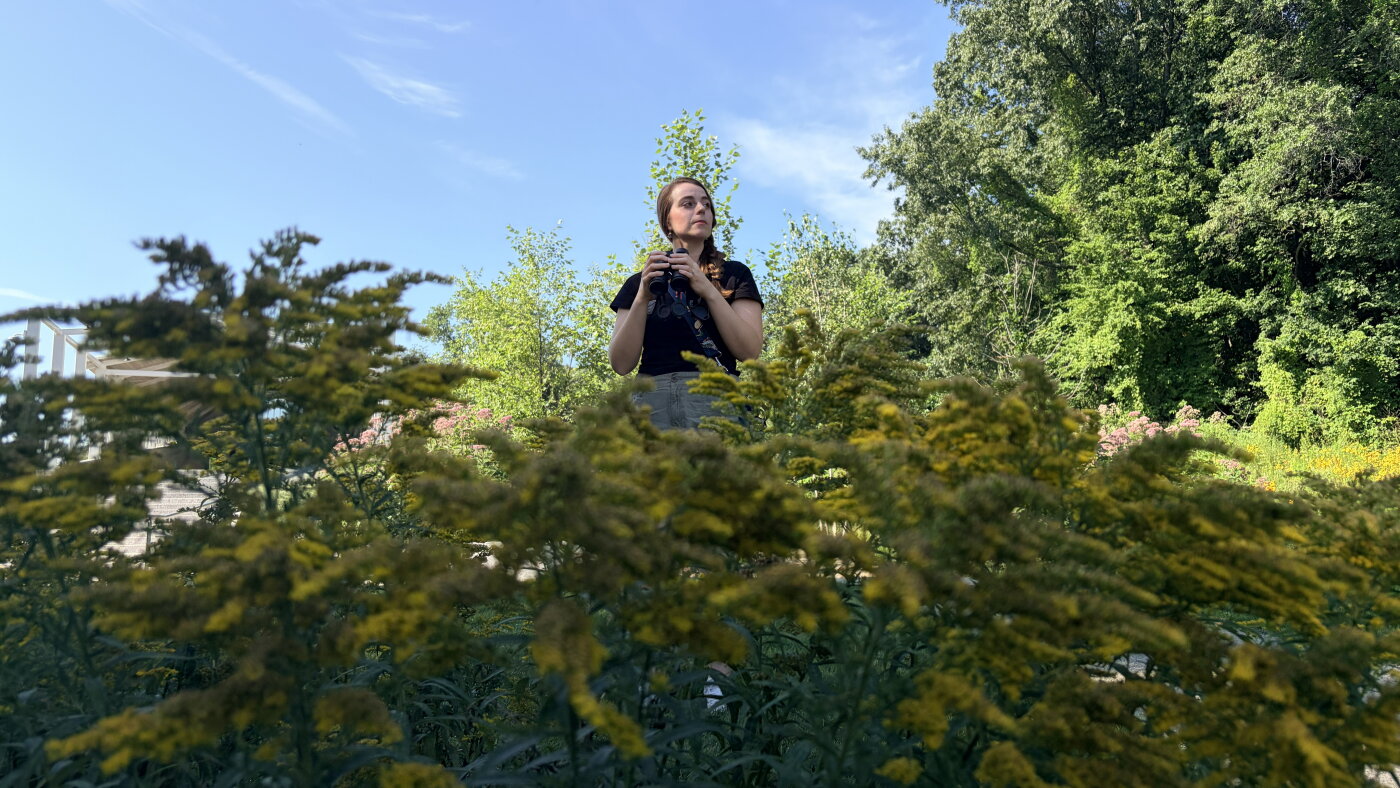
Olivia Sanderfoot of Cornell University is trying to understand how the smoke billowing off of wildfires is bothering birds — and what can be done to prevent that harm.
Ari Daniel/NPR
hide caption
Ari Daniel/NPR

Olivia Sanderfoot stands on a flower-freckled hillside in Amherst in Western Massachusetts. She listens for a moment — and a volley of birdsong flutters forth.
An Eastern Wood-Pewee. A goldfinch. A downy woodpecker.
“It’s just magical,” she says with an air of reverence. There are birds foraging among the flowers. Fluffy fledglings are darting about, learning the ways of the world.

“Every day that I get to start birding is a good day,” she says. “If you want to get the widest range of species and hear the most songs, you want to be out here in the morning.”
Sanderfoot, a global change ecologist at Cornell University, knows that for the birds that live here, not every morning is this idyllic. Over the summer, this area was suffused with toxic smoke from distant wildfires in Canada. It’s an increasingly common problem, even in places untouched by flames. Fire season is starting earlier, lasting later, burning more land — and as a result, producing far more smoke.

“Smoke can blow hundreds to thousands of miles away from that burn site,” Sanderfoot explains. “That means that the footprint of a smoke event greatly exceeds that of any fire. How do birds deal with that?”
This is the central question animating Sanderfoot’s desire to form a new field of study called “smoke ecology.” The goal, she says, is to understand how the smoke billowing off of wildfires may be disturbing wild places and creatures — and whether anything can be done to prevent possible harm.
Air today, gone tomorrow
Sanderfoot’s curiosity about how birds cope with smoke emerged in 2018 when she was living in Seattle and wildfires blazed in Eastern Washington. “The air smelled acrid,” she recalls. “The city was just blanketed in this sickly yellow, gray haze.”
She was told it was a one-time event — yet the same thing happened two years later.
“I remember walking outside and my eyes were just burning,” Sanderfoot says. “And I thought, ‘What on earth are animals doing? Are they OK?'”
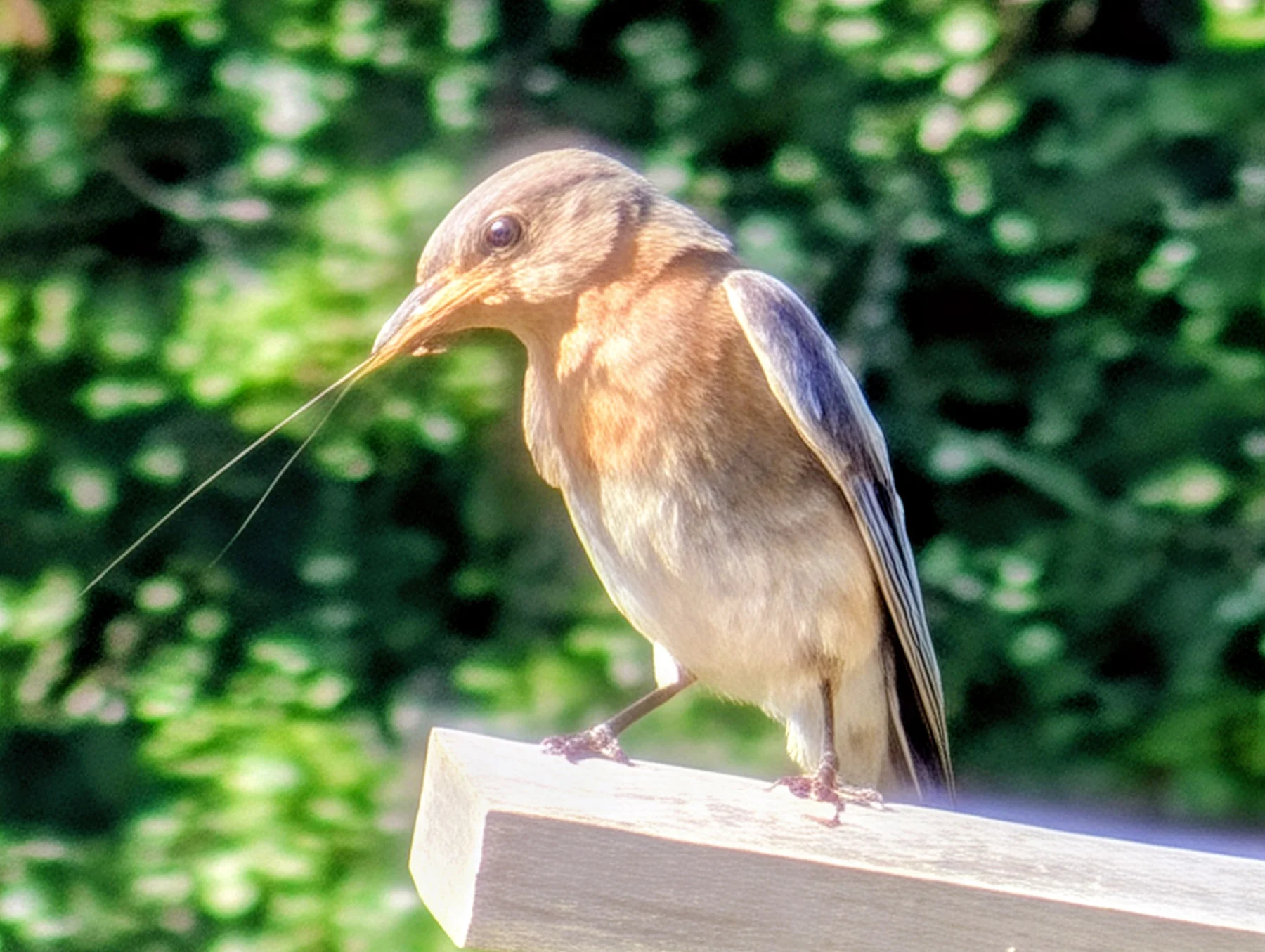
An adult bluebird sits atop a nesting box containing its chicks at the Mass Audubon’s Drumlin Farm Wildlife Sanctuary.
Aaron Gouveia/Mass Audubon
hide caption
Aaron Gouveia/Mass Audubon

Very little was known apart from anecdotes — like the absence of birdsong or the arrival of droves of birds to a backyard, famished and parched.
“Smoke is a toxic soup of substances,” she says. “It’s not just about what [birds are] inhaling, which is inevitably bad for them. It’s also about how the cues that they use to navigate their world are upended when it gets smoky outside.”
To puzzle out what was going on, Sanderfoot realized that she needed to collaborate with researchers from a range of other disciplines, including conservation biology, statistics, ecophysiology, and atmospheric chemistry.
“Real-world problems don’t map cleanly onto the same academic silos that have been set up for decades,” says Tracey Holloway, an atmospheric chemist at the University of Wisconsin-Madison, the lead of NASA’s Health and Air Quality Applied Sciences Team, and a colleague of Sanderfoot’s. “We need to be tackling new problems with new partnerships.”
For instance, in order to understand what birds are inhaling, one has to know what’s moving through the air in time and three-dimensional space. “It depends on which way the winds are blowing,” says Holloway, “what chemical processes are happening in the air, and also patterns of rainfall and where the emissions are coming from.” The science depends on air quality monitoring, satellite data, and evermore sophisticated computer modeling.
Birds are especially sensitive to smoke in large part because of how they breathe. A human being has soft lungs that allow inhalation and exhalation of air. By contrast, birds have rigid lungs surrounded by a collection of air sacs that act like bellows, pushing air continuously through the system.
“This allows birds to take up about twice as much oxygen with each breath that they inhale compared to us,” says Sanderfoot. “This means that they’re vulnerable to all the other things that are in the air, too.”
Morgan Tingley, an ecologist at UCLA, is another member of the burgeoning smoke ecology cohort. “What we’re trying to do is getting smoke to be recognized as a disturbance in and of itself distinct from fire that is worthy of our concentrated attention,” he says.
For much of his career, Tingley has studied wildfires — events with a clear start and stop, and defined borders. But the smoke produced by those wildfires can present its own unique set of problems, as it can spread far from the original blaze.
“Smoke is extremely hard to predict and it’s highly variable,” he says. “It can be there one day, one hour, and gone the next. Which means that it’s hard to actually disentangle what its impacts are because you can’t really control it.”
This means that it’s not possible to anticipate where smoke will appear, or when. Scientists also prefer not to subject animals to smoke intentionally.
So when it comes to studying wildfire smoke and birds, the trick is to gather data everywhere. To do so, the researchers rely on legions of amateur birders and professional conservationists and ornithologists across the country who are already on the ground collecting data when smoke happens to blow in.
Big army, little birds
One such individual is Pam Sowizral, the bird project coordinator at Mass Audubon’s Drumlin Farm Wildlife Sanctuary in Lincoln outside of Boston. On a sunny morning in late August, she walks up to a bluebird nest box and gently raps on the outside.

Pam Sowizral is one of the legions of birders and conservationists across the country who are already on the ground collecting data about birds when smoke happens to blow in.
Ari Daniel/NPR
hide caption
Ari Daniel/NPR
“Always give a little knock first,” she advises quietly. “Let them know you’re coming.” When she lifts the side panel, she reveals two feathery puffballs huddled on a bed of pine needles. These baby bluebirds are the last of the season here.
Sowizral says that nearly every year for the last 20 years, three times a week in spring and summer, she and her volunteers check the bird boxes here and count the nests and the eggs and how many chicks fledge. They check when the weather’s good, when it’s bad (within reason) — and when the smoke rolls in.
“Those periods of time when the smoke was here, the air somehow felt a little different,” she says. But “that didn’t stop us from doing our usual monitoring of our boxes.”
That’s key. Nationally, counts like this one, which is part of Cornell University’s NestWatch project, provide a portrait of bird activity and behavior before, during and after smoke events.

Two feathery puffballs huddle on a bed of pine needles in a nesting box. These baby bluebirds are the last of the season.
Ari Daniel/NPR
hide caption
Ari Daniel/NPR
Sanderfoot of Cornell University says she’s using these kinds of observations, alongside observations of breeding behavior, to help her understand how birds are coping with wildfire smoke in a variety of places.
She’s revealed three distinct strategies, depending on the species and the individual birds. They either hunker down and stay put, fly away, or shift their behavior — by not vocalizing as much or venturing out less often, say.
“This could be an attempt to mitigate their exposure,” says Sanderfoot. “It might also be how they are forced to respond if they feel unwell.”
In addition, she and her colleagues have observed that repeated exposure to smoke appears to impair the body condition of a variety of birds, leading to lower weight overall.
“They all respond in different ways,” she says. “And we need to figure out what those ways are and how effective they are in order to design effective conservation strategies for a rapidly changing world.”
This is one of Sanderfoot’s top priorities: determining what might constitute what she calls smoke refugia for birds — safer spots where they can hunker down until conditions improve. “I want to know where birds are going when it’s smoky,” she says, “what resources they’re seeking out, and what we could provide to help them during a risky time” — like water and perhaps shelter or food.
“I would like to be able to give people something they can do to help,” she says.
Sanderfoot’s personal experience with wildfires didn’t end in Seattle. “I almost feel like the smoke is following me,” she says.
In early 2025, she and her family fled the fires in Los Angeles where they were living at the time. And this summer, she watched as a blanket of smoke descended upon parts of the U.S., including Ithaca where she lives now, blowing off the remote Canadian infernos. She says she doesn’t think it’s a coincidence.
“Let’s put it this way,” she says: “We can expect that the future will be smokier.”
It’s a fact that’s true for birds and people, which means that what Sanderfoot and her colleagues learn about smoke ecology may reveal a clearer way forward — for us all.
“By learning more about birds,” she says, “I think we might learn something about how we can take care of ourselves and each other.”