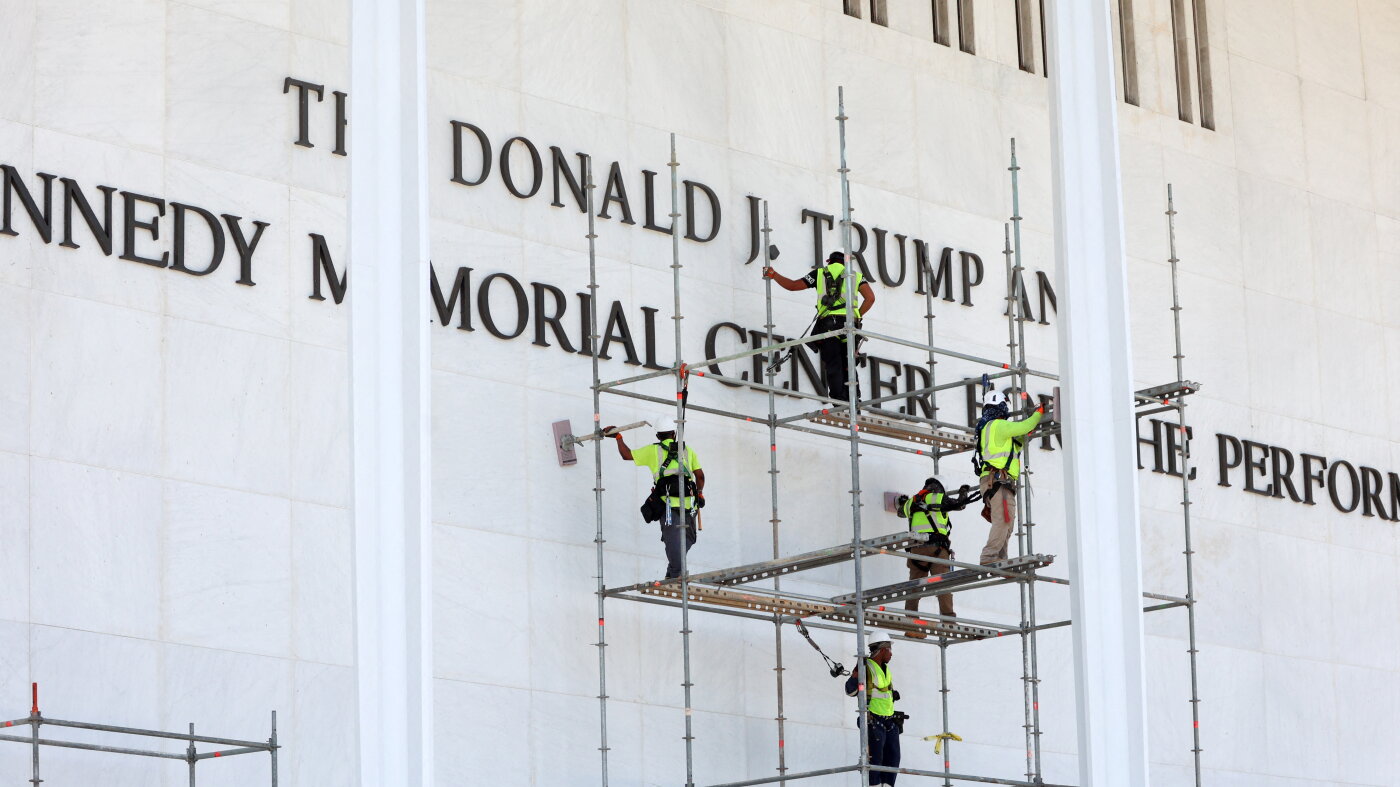
In December 2025, President Trump’s name was added to the exterior of the Kennedy Center in Washington, D.C. Less than six months later, it was removed, following a judge’s ruling that only Congress can change the name of the performing arts complex, which was established as a “living memorial” to John F. Kennedy. Above, workers stand on scaffolding outside the Kennedy Center in June.
Alex Wroblewski/AFP via Getty Images
hide caption
Alex Wroblewski/AFP via Getty Images
President Trump recently underscored his desire to have his name appear on the facade of the Kennedy Center with a threat. “Frankly, if we don’t do that, it’s going to close,” Trump told reporters. “It’ll end up being ripped down.”
Trump or his supporters have called for the president’s name to appear on everything from naval battleships to airports. It’s pretty rare for sitting presidents to stamp their identities on infrastructure, currency and other public assets — though history shows there are a few exceptions.
George Washington “didn’t want a lot of fuss”
Discussions regarding this issue go all the way back to the first presidential administration.

George Washington is now the face on $1 bills, but that didn’t happen until long after his presidency and his death. When Congress was figuring out what to put on the inaugural American coins, the House of Representatives said the president shouldn’t be on the currency because that’s something a monarchy would do.
Victoria Arocho/AP
hide caption
Victoria Arocho/AP
“They were trying to figure out what was the right balance between the prestige required to give this new office respect, but also recognizing that they were not trying to re-create a monarchy,” said Lindsay Chervinsky, executive director of the George Washington Presidential Library and author of The Cabinet: George Washington and the Creation of an American Institution.
Chervinsky said the issue first came up at the federal level during Washington’s presidency around the Coinage Act of 1792. Congress was figuring out what to put on the inaugural American coins, given the habit in Great Britain and other nations of plastering the reigning monarch all over theirs.
“The House of Representatives said that the president should not be on currency because of this monarchical tie,” Chervinsky said.
Chervinsky said Washington shared their concerns. The president usually shied away from ostentatious self-celebration. “He didn’t want a lot of fuss,” she said.
But sometimes, Washington didn’t seem to mind it. “They did name the federal city Washington to honor him while he was still in office,” Chervinsky said.
But what about the Hoover Dam?

Most administrations have generally kept the names and faces of sitting presidents off public assets since then, viewing it as unseemly.
On the few occasions when a sitting president’s name has appeared — such as on dams named for Teddy Roosevelt, Calvin Coolidge and Woodrow Wilson — it tended not to be the man in office pushing for it himself. “Usually it is political supporters,” Chervinsky said. And the history around the naming process can be fraught.
The most prominent example of this is the Hoover Dam.

The Hoover Dam on the Arizona-Nevada border was originally known as the Boulder Dam.
Keystone/Hulton Archives/Getty Images
hide caption
Keystone/Hulton Archives/Getty Images
The massive public works project located near the Boulder Canyon on the Arizona-Nevada border had been known in the early stages of its development as the Boulder Dam. Hoover’s secretary of the interior, Ray Lyman Wilbur, suggested rechristening the project in 1930 as the Hoover Dam, owing to the lead role Hoover had played in its planning. “Hoover negotiated the deal among the states known as the Colorado River Compact that allocated the river’s water among seven states,” said Kenneth Whyte, author of Hoover: An Extraordinary Life in Extraordinary Times. “So it was generally agreed that it was deserved.”
Apparently, the president thought so too. “Hoover, I think, was pleased about it,” said Whyte. “But he did not talk a lot about it at the time. He didn’t want to be seen to be doing self-aggrandizing things.”
But the Franklin D. Roosevelt administration was having none of it. After Roosevelt took office in 1933, his secretary of the interior, Harold Ickes, called for the dam to revert to its original moniker.

“Ickes based this argument on the fact that the original legislation that authorized Congress to fund the project was called the Boulder Canyon Project Act,” said Marist University’s David Woolner, a senior fellow and resident historian at the Roosevelt Institute, and the author of several books about the 32nd U.S. president. “And he did not like the politics of Herbert Hoover.”
Woolner said Roosevelt did not object to the change. He kept his political rival’s name out of his 1935 dedication speech, consistently referring to it as “Boulder Dam.”
The naming coup was short-lived.
Although there was some initial opposition from Democrats, in 1947, Congress voted unanimously to change the name back. Woolner said this happened “in recognition of Hoover’s early support for the project, and after the former president gained praise for his humanitarian work during and after the First and Second World Wars.”
There’s always the presidential library … or “library”
Roosevelt, for his part, wasn’t “particularly anxious to have things named after him,” Woolner said.
But that didn’t stop Roosevelt from lending his name to one major project during his presidency — the Franklin D. Roosevelt Presidential Library and Museum — “which of course he initiated,” said Woolner.

The bust of President Franklin D. Roosevelt stands in front of the Franklin D. Roosevelt Presidential Library and Museum in Hyde Park, N.Y.
Craig Ruttle/AP
hide caption
Craig Ruttle/AP
In keeping with this tradition, President Trump told reporters at a press briefing earlier this year he is planning to build himself a presidential library in Miami.
Except it probably won’t be a library. And presidential libraries are, technically speaking, public-private assets.

“I don’t believe in building libraries or museums,” Trump said. “But it’s most likely going to be a hotel with a beautiful building underneath and a 747 Air Force One in the lobby.”
One thing that seems certain, judging by a video rendering on the president’s social media channel promoting the project: Trump’s name will be prominently displayed on its facade.