Boys play in a stairwell in Cissie Gool House, an abandoned hospital now home to over 1,000 people. By painting, decorating and maintaining the building, its new residents have managed to turn it into a decent home for themselves and their families within striking distance of central Cape Town.
Tommy Trenchard for NPR
hide caption
toggle caption
Tommy Trenchard for NPR

Boys play in a stairwell in Cissie Gool House, an abandoned hospital now home to over 1,000 people. By painting, decorating and maintaining the building, its new residents have managed to turn it into a decent home for themselves and their families within striking distance of central Cape Town.
Tommy Trenchard for NPR
Under the cover of darkness on the night of March 27, 2017, housing activists snuck past the guards of two government-owned buildings in central Cape Town — a derelict hospital and an abandoned nursing home — and took up residence. The activists, who belong to a social movement called Reclaim the City, were protesting gentrification and what they saw as the government’s failure to provide affordable housing in what remains, nearly three decades after the end of apartheid, a deeply divided city.
Nearly six years later, they’re still there, and the occupations that started out as simple acts of political protest have grown into a large-scale community-building project that provides a home for some 2,000 people. The government says the buildings have been hijacked. The occupiers say they were left with no choice but to forcibly reclaim these spaces in a city that is gradually squeezing them out.

A light shines in a window of Ahmed Kathrada House, a former nursing home in inner-city Cape Town that is now home to a community of several hundred families. The building lacks electricity and running water, but residents say it is preferable to living on the edge of the city without access to jobs.
Tommy Trenchard for NPR
hide caption
toggle caption
Tommy Trenchard for NPR
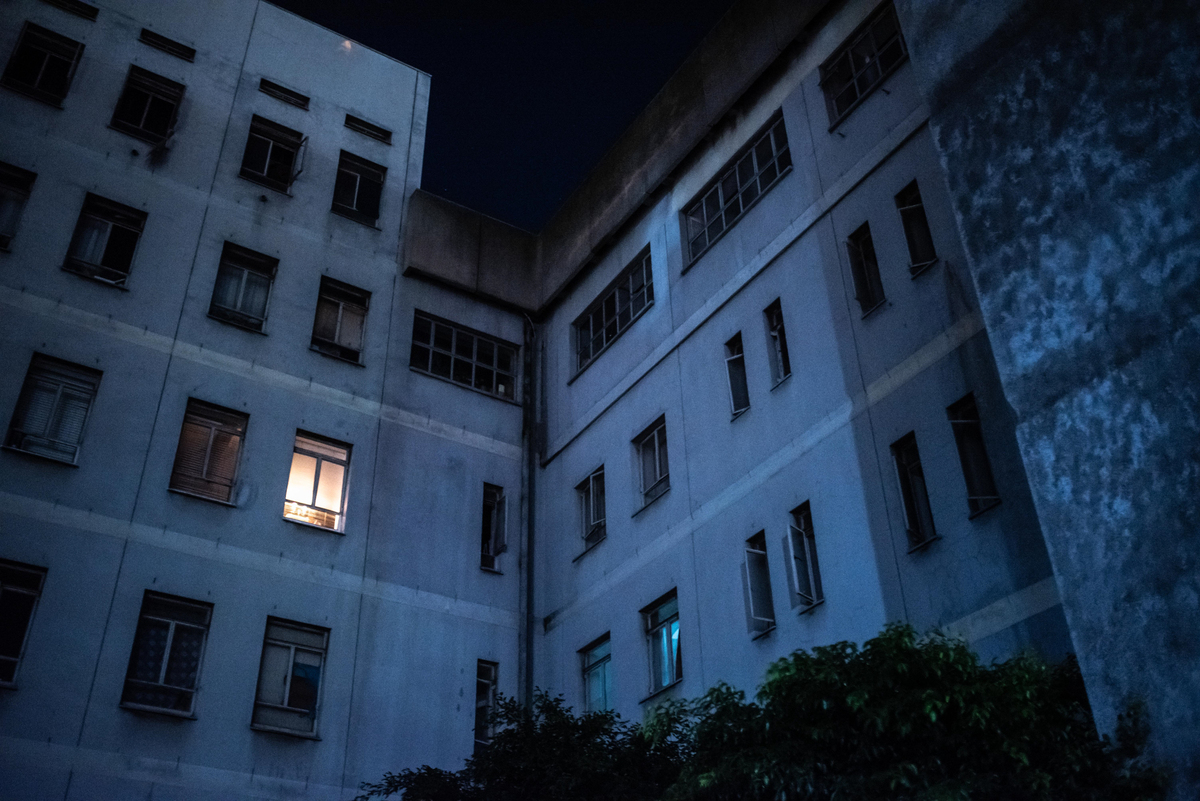
A light shines in a window of Ahmed Kathrada House, a former nursing home in inner-city Cape Town that is now home to a community of several hundred families. The building lacks electricity and running water, but residents say it is preferable to living on the edge of the city without access to jobs.
Tommy Trenchard for NPR

Denver Arendse, a community leader at Cissie Gool House, chats with the owner of a snack shop in a former doctor’s office. The building was once the Woodstock Hospital, but was occupied by housing activists and evictees after the hospital closed down.
Tommy Trenchard for NPR
hide caption
toggle caption
Tommy Trenchard for NPR

Denver Arendse, a community leader at Cissie Gool House, chats with the owner of a snack shop in a former doctor’s office. The building was once the Woodstock Hospital, but was occupied by housing activists and evictees after the hospital closed down.
Tommy Trenchard for NPR

Murals and bright colors adorn the walls of a former elevator lobby in Cissie Gool House, an abandoned hospital that now houses over 1,000 people in the Woodstock neighborhood of Cape Town.
Tommy Trenchard for NPR
hide caption
toggle caption
Tommy Trenchard for NPR

Murals and bright colors adorn the walls of a former elevator lobby in Cissie Gool House, an abandoned hospital that now houses over 1,000 people in the Woodstock neighborhood of Cape Town.
Tommy Trenchard for NPR
“I thank God I found this place,” says Elizabeth Daniels, who lives in what was once an inpatient ward in the former Woodstock Hospital, now re-named by residents as Cissie Gool House in honor of an anti-apartheid activist. “I was born and raised in Cape Town, and I really hope my grandchildren will be able to say the same.”
Since the occupation started, visible traces of the building’s former use have slowly faded and the place has begun to feel more residential. Satellite dishes dot the red brick facade; vibrant color schemes and murals cover the walls; laundry hangs in disused elevator lobbies and boys play soccer in the empty parking lot outside.
The building now houses several shops, a library, communal eating spaces and even a makeshift movie theatre where a resident cat spends its days curled up in a broken pleather armchair in the corner. The corridors and hallways are renamed after the city streets on which their occupants once lived: Bromwell Street, Albert Road, Darling Gardens.

A cat sits on a broken chair in a makeshift movie theatre at Cissie Gool House in Cape Town.
Tommy Trenchard for NPR
hide caption
toggle caption
Tommy Trenchard for NPR

A cat sits on a broken chair in a makeshift movie theatre at Cissie Gool House in Cape Town.
Tommy Trenchard for NPR

Auntie Sienna, a long-term resident of Cissie Gool House, distributes food donated to the occupants as a gift for Ramadan.
Tommy Trenchard for NPR
hide caption
toggle caption
Tommy Trenchard for NPR

Auntie Sienna, a long-term resident of Cissie Gool House, distributes food donated to the occupants as a gift for Ramadan.
Tommy Trenchard for NPR

Boys play soccer in the parking lot of Cissie Gool House, where occupants have been living for almost six years.
Tommy Trenchard for NPR
hide caption
toggle caption
Tommy Trenchard for NPR
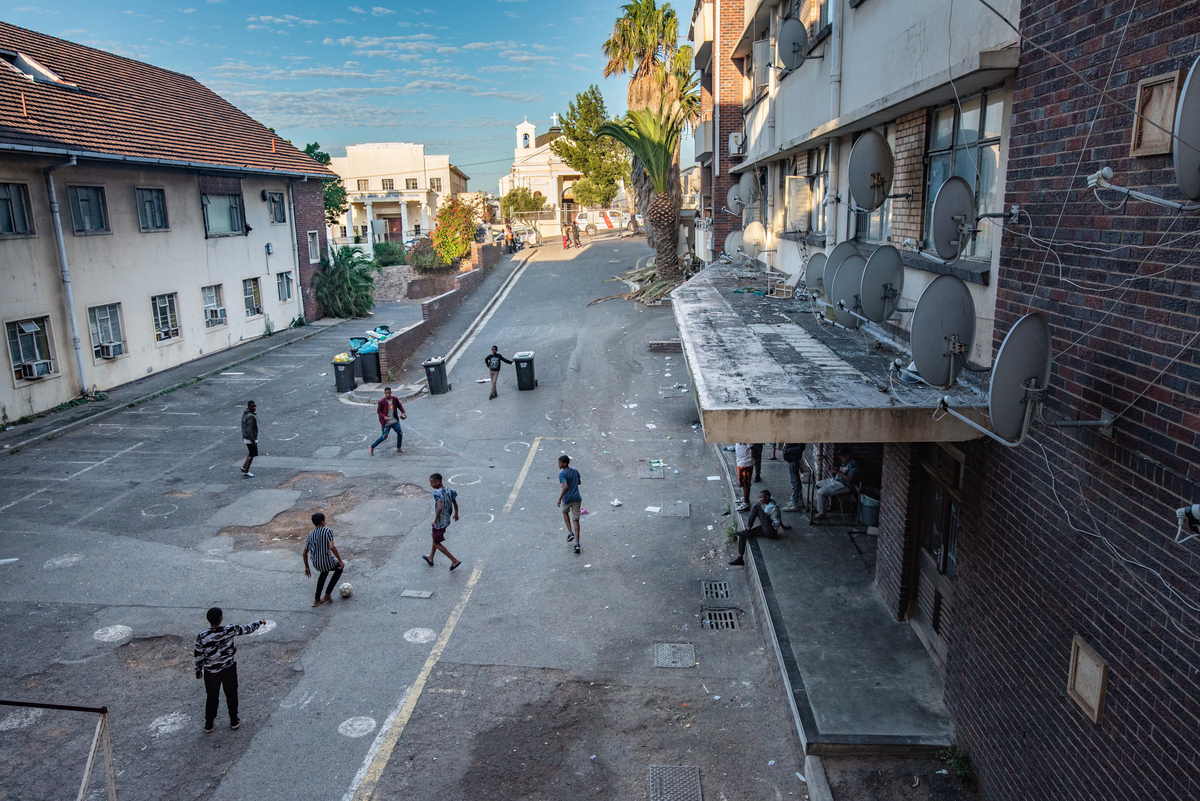
Boys play soccer in the parking lot of Cissie Gool House, where occupants have been living for almost six years.
Tommy Trenchard for NPR
Daniels’ family originally lived in District Six, a neighborhood on the slopes of Devil’s Peak that was forcibly emptied of its largely mixed-race community by the apartheid government in the late 1960s. During the years that followed, tens of thousands of Black and so-called “Cape colored” communities were evicted from their homes in central parts of Cape Town and resettled, mostly in distant housing projects in an area known as the Cape Flats.
Daniels’ family moved instead to Woodstock, one of the few multi-racial areas left near the city centre at the time. But in recent years, rising rents — fueled by gentrification — forced them to keep relocating. Eventually, Daniels says, there was nowhere left she could afford but here.
“Everything has changed and it’s so sad,” says the 52-year-old, who used plywood panels and fabric to divide up her room and make it feel more like a home for herself and her family. “Everything we knew has disappeared. It’s even worse than during apartheid.”
Luyanda Mtamzeli, a political campaigner for the housing rights group Ndifuna Ukwazi, which backs the occupations, says the combination of rampant gentrification and the city’s failure to build new affordable housing near the city centre is effectively reinforcing the divisive effects of apartheid urban planning.
“Apartheid is still happening in Cape Town,” he says. “It’s never been addressed. Every year the city is becoming more exclusive. More and more Black and colored people are getting forced out of the inner city. It’s like we’re good enough to work for them but not good enough to be their neighbors.”

Elizabeth Daniels, 52, photographed in her room at Cissie Gool House, has used plywood panels and fabric to divide up her room and make it feel more like a home.
Tommy Trenchard for NPR
hide caption
toggle caption
Tommy Trenchard for NPR

Elizabeth Daniels, 52, photographed in her room at Cissie Gool House, has used plywood panels and fabric to divide up her room and make it feel more like a home.
Tommy Trenchard for NPR

A sofa in the home of Elizabeth Daniels and her family in Cissie Gool House. Many residents have used furniture to create seperate living spaces in former in-patient accommodations and consulting rooms.
Tommy Trenchard for NPR
hide caption
toggle caption
Tommy Trenchard for NPR

A sofa in the home of Elizabeth Daniels and her family in Cissie Gool House. Many residents have used furniture to create seperate living spaces in former in-patient accommodations and consulting rooms.
Tommy Trenchard for NPR
In 2017, the city of Cape Town identified 11 sites, including the former Woodstock Hospital, for building affordable housing. But six years later, only a few dozen units have been completed, and Mtamzeli says he has lost faith in the government’s commitment to act.
“They talk a lot but they don’t take any action,” says Mtamzeli. “They don’t have a budget and they don’t have a plan. People in Cape Town have lost hope. And they see these occupations as the only way.”
Malusi Booi, the head of human settlements in the city government, acknowledged that reform is needed and that the government had been unable to meet the enormous demand for affordable housing. But he said unlawful occupations are not the answer.
“The buildings have been hijacked without the consent of the landowners and we condemn that to the highest degree,” said Booi. “There’s no doubt that the demand out there is huge. What’s important to me is that we’re on the right track in terms of making sure that we expedite the delivery of houses.”
Booi says the city is beginning to make headway on some of the sites it identified in 2017. In July 2022 a piece of public land in Salt River, a central neighborhood which has been heavily affected by gentrification, was released to a developer for the construction of affordable housing. And Booi said more sites are scheduled to be released in 2023.
Yet even when all of these projects are fully completed, they will accommodate only a tiny fraction of those in need. The waiting list for government-subsidized housing currently stands at more than 500,000 households, comprising over two million individuals.
As for Woodstock Hospital, Booi says the occupiers must leave in order for necessary construction work to take place and that any housing units built on the site should be made available to the highest priority applicants on the housing waiting list. The city government is currently in litigation to remove the building’s current residents, and Booi says he is hopeful they will be able to reach some kind of conclusion early in 2023.

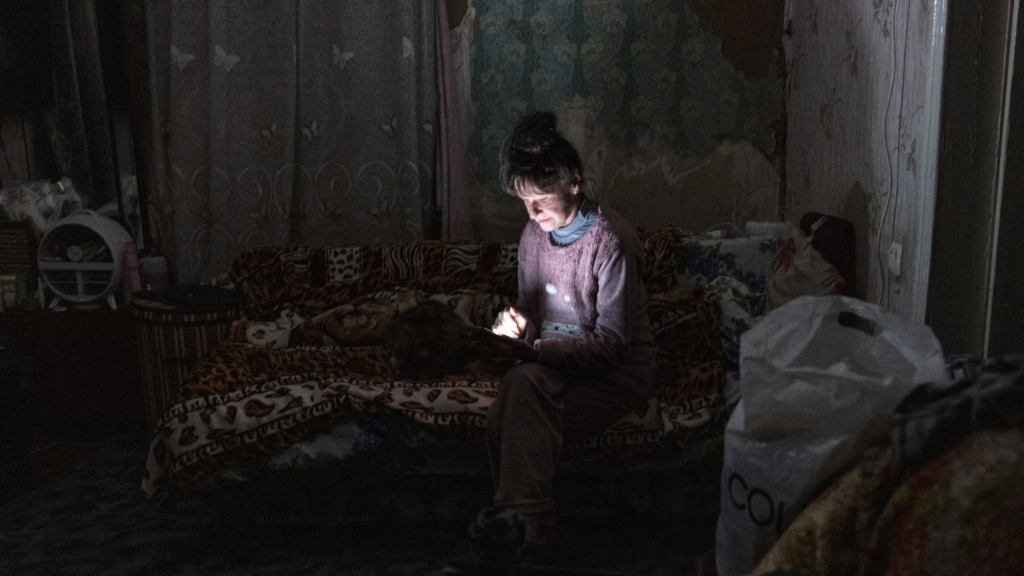
Community leader Shiela Madikane uses a battery-powered light to read through the agenda during a meeting at Ahmed Kathrada House, an abandoned nursing home in central Cape Town that has been occupied by a community of several hundred evictees and housing activists for nearly six years. The building’s electricity was cut off by the city soon after the occupation.
Tommy Trenchard for NPR
hide caption
toggle caption
Tommy Trenchard for NPR

Community leader Shiela Madikane uses a battery-powered light to read through the agenda during a meeting at Ahmed Kathrada House, an abandoned nursing home in central Cape Town that has been occupied by a community of several hundred evictees and housing activists for nearly six years. The building’s electricity was cut off by the city soon after the occupation.
Tommy Trenchard for NPR

Teddy bears lie on the bed of community leader Shiela Madikane in Ahmed Kathrada House.
Tommy Trenchard for NPR
hide caption
toggle caption
Tommy Trenchard for NPR

Teddy bears lie on the bed of community leader Shiela Madikane in Ahmed Kathrada House.
Tommy Trenchard for NPR

School clothes belonging to 14-year-old Akisha Arendse hang on a shelf in the room she shares with her father in Cissie Gool House.
Tommy Trenchard for NPR
hide caption
toggle caption
Tommy Trenchard for NPR

School clothes belonging to 14-year-old Akisha Arendse hang on a shelf in the room she shares with her father in Cissie Gool House.
Tommy Trenchard for NPR
“You have to go through the court process and that takes time,” said Booi. “People have rights and you can’t immediately evict them.”
Meanwhile, the residents, with the support of Ndifuna Ukwazi, are still hoping to be able to engage with the city to find a solution that allows them to remain. The building has been their home for nearly six years and for the children, many of whom go to nearby schools, it is often the only home they have ever known.
“The city characterizes this as a violent space full of criminals,” says Bevil Lucas, a community leader now living in what was once a doctor’s office on the ground floor of the building. “But if they’d only listen, they’d see what the community is capable of. We’re not just squatting. We moved in to rebuild a community of displaced people. It’s restored people’s dignity. It’s given them hope for a better future.”
Currently, almost all of the city’s affordable accommodation lies on the peripheries, where jobs and recreational facilities are scarce and crime rates are several times higher than in more central parts of the city. Cape Town has one of the highest murder rates in the world, with much of the violence linked to ongoing gang conflicts in the Cape Flats.
For street vendor Lillian Mvolontshi, the final straw that pushed her to leave her rented shack in an informal settlement in the Cape Flats was when it was hit by a stray bullet while she and her family were inside. Her daughter had also been robbed several times on the train between her home and the city. But on top of the crime risk, Mvolontshi was finding that the long commute to her job was making her financial situation unsustainable.

Lillian Mvolontshi and her granddaughter, Phawu, watch a video on a phone in the abandoned military warehouse where they now live in central Cape Town. While living in the Cape Flats, she was spending most of her income on transport, and was frequently faced with the threat of violence at home and on her daily commute.
Tommy Trenchard for NPR
hide caption
toggle caption
Tommy Trenchard for NPR

Lillian Mvolontshi and her granddaughter, Phawu, watch a video on a phone in the abandoned military warehouse where they now live in central Cape Town. While living in the Cape Flats, she was spending most of her income on transport, and was frequently faced with the threat of violence at home and on her daily commute.
Tommy Trenchard for NPR

Two girls push a shopping cart full of buckets of water to their families’ rooms in Ahmed Kathrada House.
Tommy Trenchard for NPR
hide caption
toggle caption
Tommy Trenchard for NPR
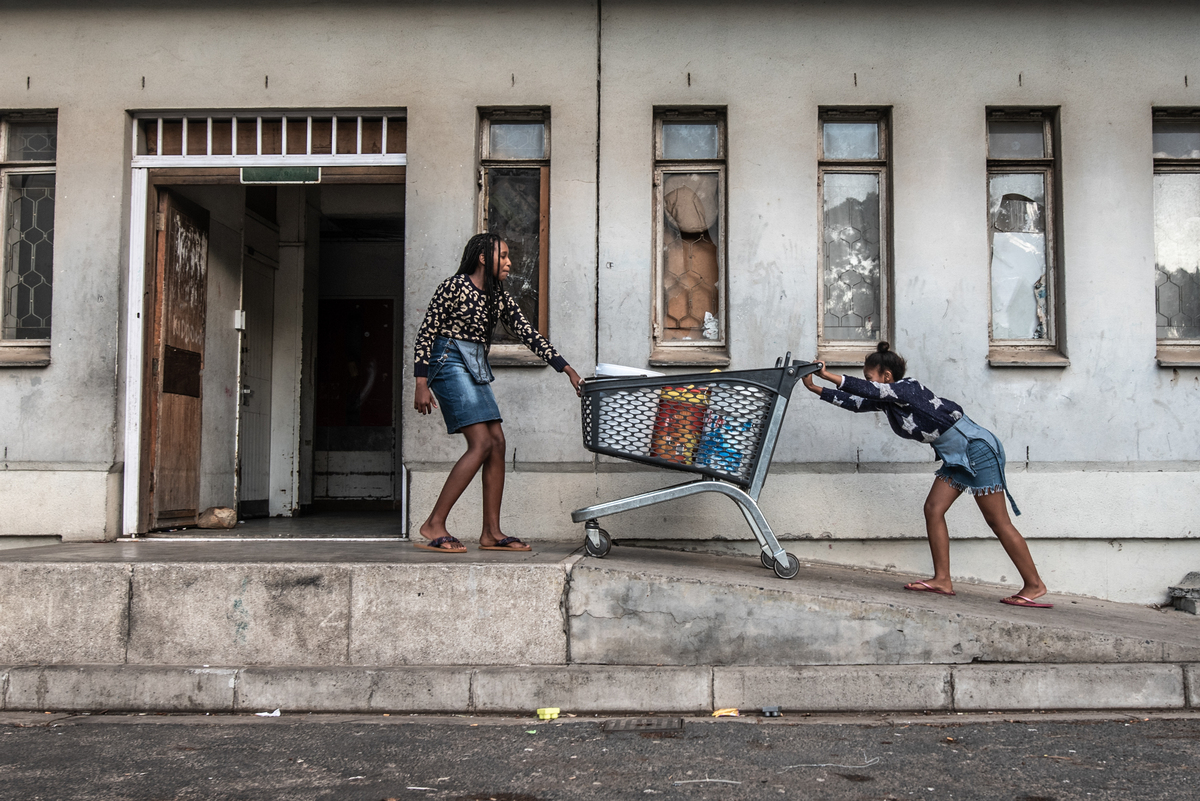
Two girls push a shopping cart full of buckets of water to their families’ rooms in Ahmed Kathrada House.
Tommy Trenchard for NPR

Laundry hangs on a line against a backdrop of Table Mountain in the back garden of Cissie Gool House.
Tommy Trenchard for NPR
hide caption
toggle caption
Tommy Trenchard for NPR

Laundry hangs on a line against a backdrop of Table Mountain in the back garden of Cissie Gool House.
Tommy Trenchard for NPR
“All the money used to go on taxi fares,” said Mvolontshi, who runs a stall selling hot drinks and chips to other commuters in the city centre. “Sometimes I didn’t have enough money to go home so I’d spend the whole night at the taxi rank.”
She now lives with her daughter and granddaughter in a derelict warehouse on an abandoned military base in the upmarket Tamboerskloof neighborhood of central Cape Town, one of several government-owned sites now occupied by Reclaim the City’s members. The building is bleak, with a leaky roof and no windows, heating, electricity or running water, but it offers Mvolontshi proximity to her workplace and a sense of security.
It also boasts what another occupier described as their “million-dollar view,” a panoramic vista of Table Mountain and Lion’s Head peak, with the lights of central Cape Town twinkling below — the kind of view generally reserved for the city’s ultra-wealthy.
A lack of electricity and water has also impacted the 800 occupiers of the Helen Bowden Nursing Home, which sits on prime real estate overlooking the Victoria and Albert Waterfront, one of the city’s top tourist attractions. Yet here, too, residents say it remains preferable to relocating to the Cape Flats. During a recent visit, girls used an old shopping cart to collect water for their families and teenagers smoked a hookah pipe in what used to be the morgue. After sundown, residents cooked their dinner by candlelight.
“It’s difficult to live here but at least I have a roof over my head,” said 53-year-old Linda Ewy, who moved in after her landlord hiked her rent by 1,500 Rand (about $85) overnight. “I worry every day that they’re going to come and chuck us out. There are already so many people on the streets,”
Whatever actions the city takes, residents of the occupied buildings said they won’t leave without a struggle.
“I’m willing to give everything to this fight,” says Daniels at Cissie Gool House. “I’d rather live in a tent than move out of the city. We don’t need mansions. All we want is a place to call home.”

A resident uses a flashlight to navigate along a dark corridor in Ahmed Kathrada House.
Tommy Trenchard for NPR
hide caption
toggle caption
Tommy Trenchard for NPR
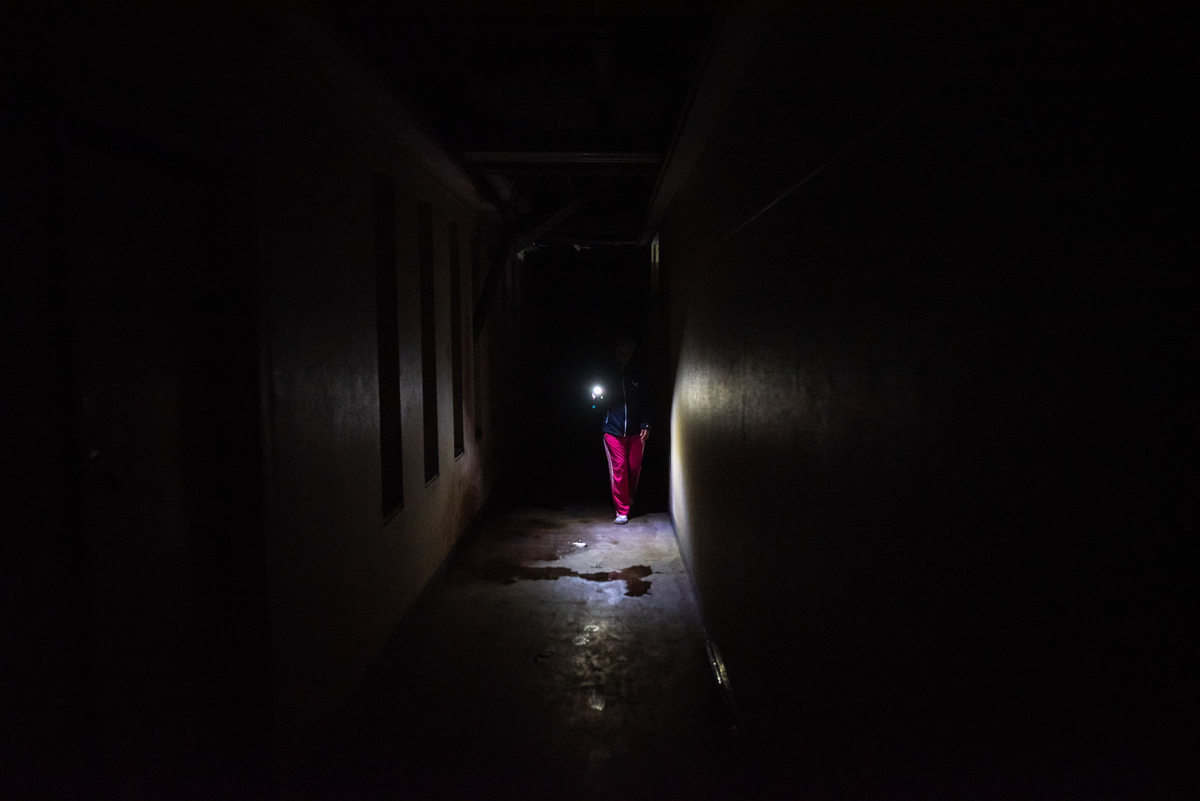
A resident uses a flashlight to navigate along a dark corridor in Ahmed Kathrada House.
Tommy Trenchard for NPR
Tommy Trenchard is an independent photojournalist based in Cape Town, South Africa. He has previously contributed photos and stories to NPR on the Mozambique cyclone of 2019, Indonesian death rituals and illegal miners\ in abandoned South African diamond mines.