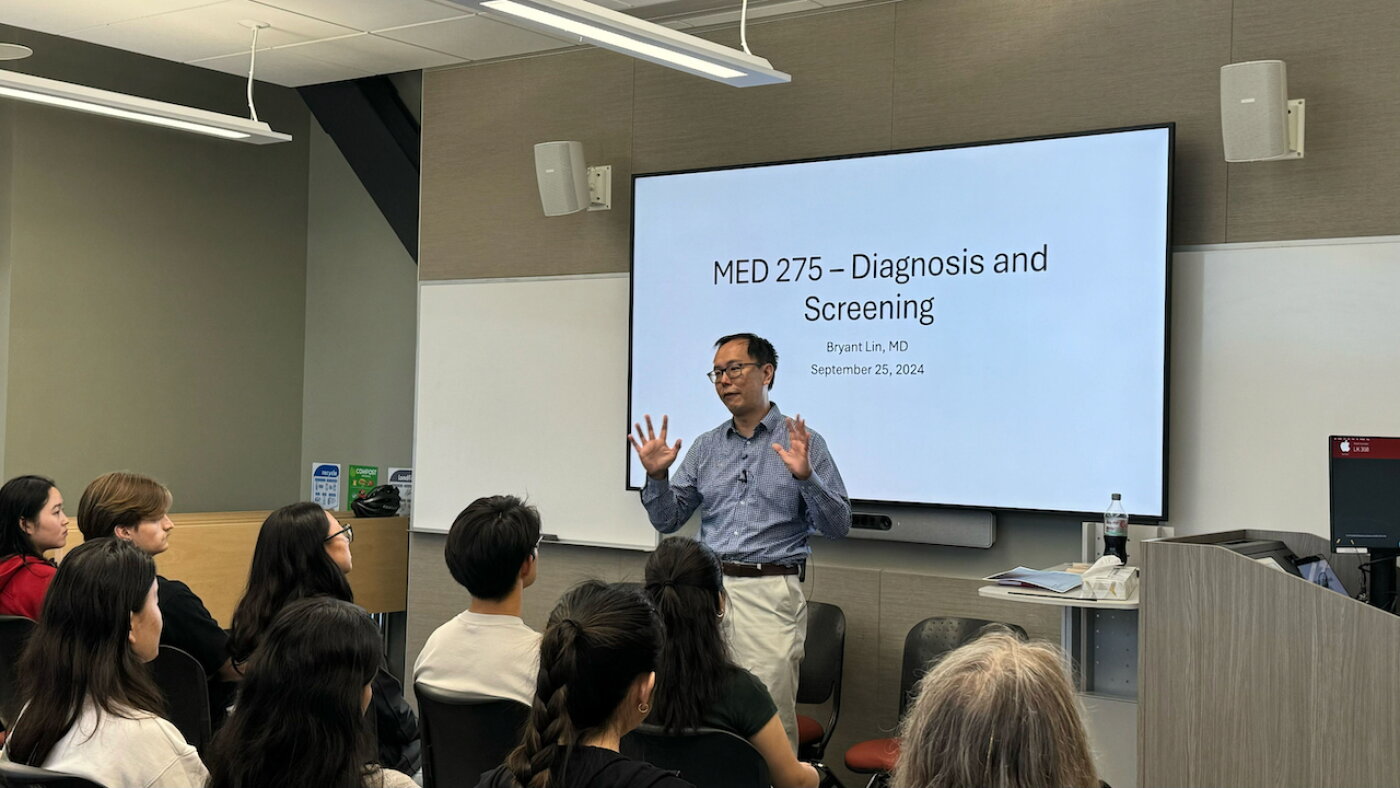
Dr. Bryant Lin teaches a lung cancer class in fall 2024. He says he was very nervous to teach the first class and share his story.
The Lin family
hide caption
toggle caption
The Lin family
Stanford medical professor Bryant Lin founded the school’s Center for Asian Health Research and Education, advocating for better lung cancer screening in particular. Then two years ago Lin became a Stage IV patient of the very disease he long crusaded against.
“Super ironic that I would be co-leading the center that supports research and education in this disease, and I get diagnosed myself,” he says.
Lin, who is a non-smoker, tells students he considers himself lucky — even hopeful: “I think the future is really bright, because we’re creating all of these personalized, specialized precision therapeutics for lung cancer,” he says.”My hope is if we’re not able to cure lung cancer, we can at least turn it into a chronic disease.”
Notable improvements are shifting the prognosis for a disease once considered a death sentence. Much of the recent progress is so new, it is only starting to shift the statistics on survival. While the five-year survival rate across all stages of lung cancer has doubled in three decades, it still remains at a low 30%. (Stage of disease makes a huge difference; early, localized cancer survival rates over 5 years was 67% between 2015 and 2021.)
Targeted treatment
The genetics of lung cancers are very diverse and complex relative to other cancers, making it historically tricky to treat. One key technological development underlying many new treatments is the ability to identify, through genetic testing, the specific mutation driving a person’s abnormal cell growth, according to UCLA oncologist and researcher Jonathan Goldman. “We can pick a drug that’s really been developed for that type of cancer,” he says.
Not only can that manage or even shrink tumors, because the drugs are better targeted, they also cause less collateral damage, making side effects typically more tolerable for patients.
“Survival used to be under a year, and now it’s often several years and sometimes many years,” Goldman says.
Whether it’s breast, liver or lung cancer, targeting treatments by genetic subtype is far more effective than generalized treatments of the past, Goldman says, because the medicines are designed to focus their attack on specific mutated cells driving the abnormal growth. Since the medicines are targeted, they also tend to have fewer harsh side effects compared to chemotherapy.
Want the latest stories on the science of healthy living? Subscribe to NPR’s Health newsletter.
Tests to identify a patient’s specific cancer subtype – a procedure called comprehensive genomic testing – are already available, and Goldman served as principal investigator on a recent study published in the New England Journal of Medicine, showing dramatic reductions in recurrence, when patients with rare subtypes receive targeted medicines as their first treatment.
However, access to such testing is spotty. Goldman says fewer than half of lung-cancer patients in the U.S. get their cancer genetically tested prior to treatment because that evaluation is not yet considered “standard of care.” Plus, doctors themselves may not be aware it exists; Goldman says treatment technology is changing so rapidly, general oncologists may not be up-to-date on some of the most recent developments specific to lung cancer.
“The next step is not just these scientific discoveries, but learning how to implement these findings,” he says. “We’ve proven time and time again how important and effective it is to get this testing done early so you can pick your best treatment first.”
It was one of those relatively new targeted drugs, a daily pill called Tagrisso (or osimertinib), that professor-patient Bryant Lin initially began taking when he was first diagnosed in May 2024. Just three months prior to that, the Food and Drug Administration approved its use in combination with chemotherapy, based on data showing it lengthened survival.
“I am a beneficiary of years – of decades – of research,” Lin says, noting how his treatment regimen has closely mapped with some of the most recent drug developments. “Since I’ve been diagnosed. It’s quite amazing how quick – how rapid – our advances have been occurring.”
Affordability
Treatment is one thing; affording them is another. Even Lin, a patient with the unusual privilege of being a nationally known expert at an elite medical center, faces battles with insurance to get some of these new, expensive treatments covered. Insurers almost always require prior authorization for the treatments, or deny coverage for new drugs that haven’t yet received expert endorsement as standard protocol. Lin says this happened for one of his $16,000 drugs, delaying his treatment at a critical time. He watches patients, too, fight similar battles over coverage.

“Oral drugs and the IV drugs — they’re hundreds of thousands of dollars,” he says. “I don’t know too many people who could afford to pay out of pocket.”
A year into his treatment, the initial targeted therapy Lin was taking stopped working. By then, regulators approved another drug combination – amivantamab and lazertinib – an antibody to activate the immune system, and a different pill targeting his specific mutation type, known as EGFR.

Dr. Bryant Lin receives a chemo infusion in the early days of his treatment in June 2024.
The Lin family
hide caption
toggle caption
The Lin family
Lin, who still teaches, travels, and advises the Susan Wojcicki Foundation for lung cancer, says these new therapies have given him both more life, and one of better quality. “My symptoms are really well controlled. I can live my life. I can speak. I don’t think I’ve coughed once in our conversation.”
What’s more, there’s a compounding effect with this kind of scientific progress, where recent breakthroughs with other genetically similar cancers may soon apply to lung cancer.
Personalized treatment
One promising area of potential crossover is with pancreatic cancer, which is driven by a gene in the same KRAS family that causes a sizable minority of lung cancers. One drug the FDA approved in August called Rasonque (generic name daraxonrasib), doubled survival for late-stage cancer patients to over 13 months in clinical trials – a rare victory against pancreatic cancer, a particularly stubborn form of the disease.
There are other promising drugs for pancreatic cancer that may eventually find application against lung cancer as well, including mRNA vaccines — custom designed to match the genetic profile of each individual’s cancer. Researchers and companies say those show promise re-enlisting the immune system into fighting tumors.
“I’ve been investigating that for myself – personalized mRNA vaccine,” Lin says.

Lin’s professional focus remains on advocating for better modes and rates of screening, which remains at a stubbornly 18% among the high-risk patients for whom annual, low-dose CT scan screening (image tests) is the standard recommendation. But with screening, too, there is progress: AI imaging and increasingly sensitive blood tests may help detect, or even predict, formation of disease even years earlier.
Just as colorectal cancers can now be screened for using blood, stool and colonoscopy tests, Lin wants to see options besides the CT scan for lung cancer. Expanding these kinds of surveillance technologies could ultimately do more to reduce lung cancer deaths.
Lin himself is like a trapeze artist, grabbing hold from one treatment to the next. A fellow cancer patient told him: All he needs is to do is hang on. “He says, ‘Hey, you only need to survive long enough until the next new treatment comes out’ – and that’s been the case for me,” Lin says. His life of limbo involves balancing acts – as doctor and patient, as optimist and realist. “I’m hopeful,” he says. “But, absolutely: The odds are against me.”

Dr. Bryant Lin with his sons at a San Francisco Giants baseball game in spring 2025. He says he loved going to Giants games with his sons before getting diagnosed. “Fortunately, we have been able to go again as a family in 2025 and 2026,” he says.
The Lin family
hide caption
toggle caption
The Lin family
Indeed, days after we spoke, Lin received disappointing news his latest scans showed progression of his cancer. So he now must consider switching to a different antibody drug approved last year, or the possibility of new clinical trials.
In the meantime, Lin also keeps his focus on catching San Francisco Giants games with his wife and teenage sons, or tinkering with an old-fashioned, seafoam-green Smith Corona manual typewriter he bought to commemorate his upcoming book, Sunshine: An exploration of living when you are dying.
“We stayed up late when we got the typewriter, just banging away, making the noises and writing crazy things on the paper.”
Life, he insists, still needs to be lived with a bit of silliness.