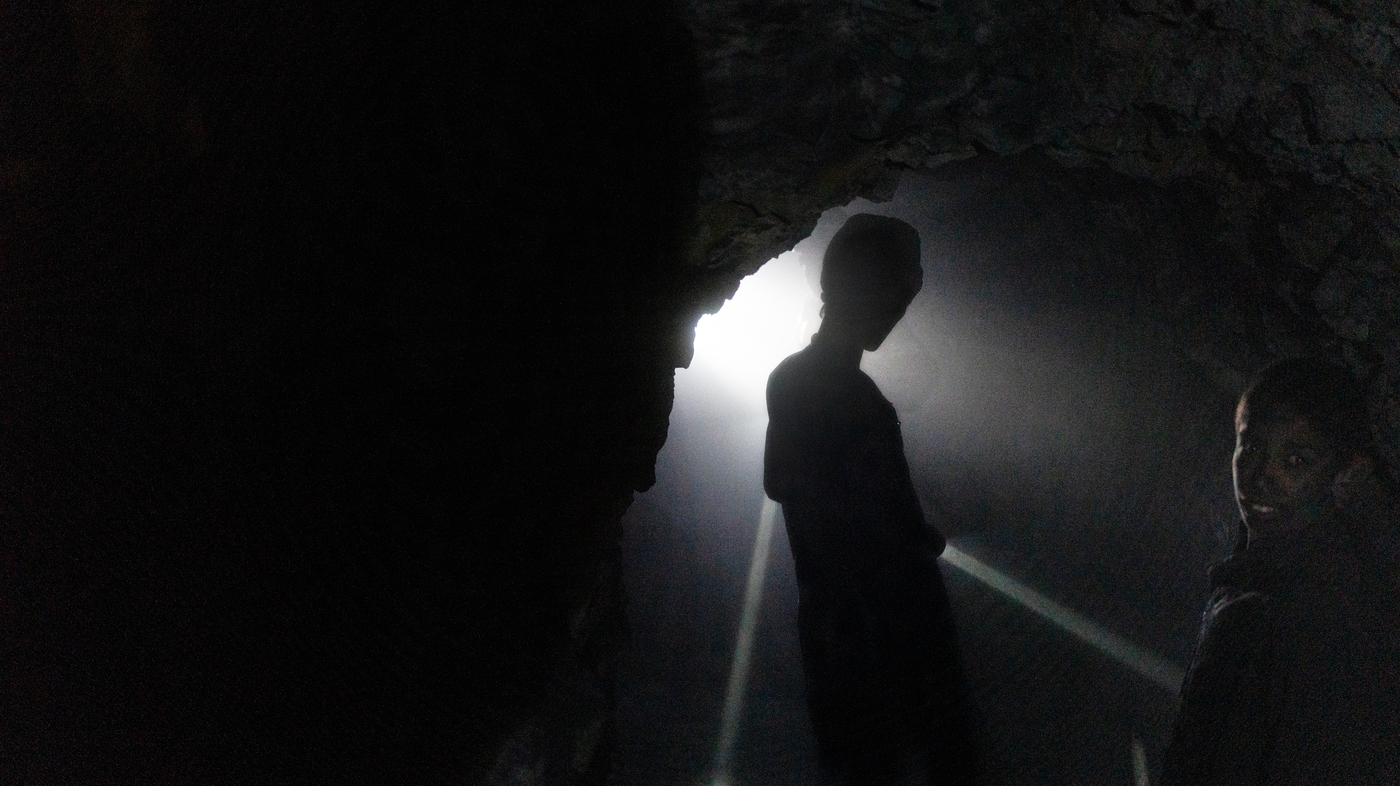
A boy works in a coal mine north of Kabul. Afghanistan’s state-run coal industry is going strong in an otherwise shattered economy. Many underage workers are the ones who are extracting the coal.
Claire Harbage/NPR
hide caption
toggle caption
Claire Harbage/NPR

A boy works in a coal mine north of Kabul. Afghanistan’s state-run coal industry is going strong in an otherwise shattered economy. Many underage workers are the ones who are extracting the coal.
Claire Harbage/NPR
NAHRIN, Afghanistan — On weekdays, when most kids around the world are at school, 12-year-old Mansour is in the middle of a grueling shift at the coal mines.
Deep inside a tunnel carved into the side of a blackened mountain, the young boy waits under the flickering glow of his headlamp as older boys pry coal out of the earth by pickaxe and hand, while others shovel the piles into sacks strapped onto the backs of donkeys.

From there, it is Mansour’s job — from dawn until dusk — to lead the coal-laden donkeys out of a labyrinth of crumbling tunnels down the mountain in this remote part of Baghlan province, 180 miles north of Kabul. Here, the so-called black gold is bagged and loaded onto trucks, mostly bound for neighboring countries.
“My family sent me to work here last year,” he says. He’s wearing no protective equipment — no mask, no goggles, just a pair of cheap rubber shoes he’s sliced open to let his feet breathe, with toes blackened by coal dust peeking out. “What they pay me goes directly to my family.”

Boys earn between $3 and $8 for a day’s work in the coal mines.
Claire Harbage/NPR
hide caption
toggle caption
Claire Harbage/NPR

Boys earn between $3 and $8 for a day’s work in the coal mines.
Claire Harbage/NPR
The boys earn between $3 and $8 for a day’s work, depending on how strenuous their assigned tasks are. Digging for coal, lining the brittle tunnel walls with rickety wood frames, loading the trucks all earn top dollar at the government-run mines.
They are enviable wages in cruel economic times.
Even in wealthy, developed nations with advanced technologies, heavy machinery and readily available protective equipment, mining can be a dangerous and sometimes deadly job. In Afghanistan, where much of the coal is mined by hand, every descent into the bowels of this mountain is a gamble.

Miners take a break with their donkeys and drink tea near the end of a shift.
Claire Harbage/NPR
hide caption
toggle caption
Claire Harbage/NPR

Miners take a break with their donkeys and drink tea near the end of a shift.
Claire Harbage/NPR
A dozen workers were killed in January, after one of the mines collapsed due to heavy rains. No one, from the young miners to mining officials and labor and humanitarian groups, seems to know or is willing to say whether any of those who perished were kids. But the accident was enough to inspire a new ritual among the boys working here.
Whenever one of them emerges from the tunnels, the others greet him with a tune from a toy flute the boys pass around during breaks — a humble celebration for making it out alive.

Top left: Bags of coal ready to be loaded onto trucks. Top right: A boy puts a guiding hand on the neck of a coal-laden donkey. Bottom: A man runs, urging donkeys to quicken their pace up the hill to a mine entrance.
Claire Harbage/NPR
hide caption
toggle caption
Claire Harbage/NPR

Top left: Bags of coal ready to be loaded onto trucks. Top right: A boy puts a guiding hand on the neck of a coal-laden donkey. Bottom: A man runs, urging donkeys to quicken their pace up the hill to a mine entrance.
Claire Harbage/NPR
Coal production is increasing — and so is the number of child miners
Afghanistan’s state-run coal industry is a rare bright spot in an otherwise shattered economy.
When the Taliban returned to power last year, donor governments and international institutions withdrew billions of dollars in assistance, triggering an economic and humanitarian crisis. Months of isolation prompted the cash-strapped Taliban government to ramp up production and export of one of Afghanistan’s more abundant commodities to countries like Pakistan to help resuscitate the economy, which contracted last year by about 20%.
Coal exports increased by nearly as much in the first year under Taliban rule, according to the Ministry of Finance. Approximately 10,000 tons of coal are exported daily, according to the Ministry of Mining and Petroleum.

Left: Abdul Salaam, 17, has been working at the mine since he was 9 years old. Right: Mansour, 12, began working at the mine last year, after his parents sent him. Impoverished families are sending their children to work in the one industry that offers jobs and a steady wage. Children are more easily able than grown men to squeeze into the narrow mining tunnels and shafts.
Claire Harbage/NPR
hide caption
toggle caption
Claire Harbage/NPR

Left: Abdul Salaam, 17, has been working at the mine since he was 9 years old. Right: Mansour, 12, began working at the mine last year, after his parents sent him. Impoverished families are sending their children to work in the one industry that offers jobs and a steady wage. Children are more easily able than grown men to squeeze into the narrow mining tunnels and shafts.
Claire Harbage/NPR
The Taliban government also got an unexpected boost earlier this year from Russia’s war in Ukraine. Disruptions in gas and supplies sent global demand for coal surging, bringing consumption to levels not seen since a decade ago, according to the International Energy Agency.
This cleared the way for the Taliban to significantly increase duties on exports as well as the price of coal — “from what used to be $90 per ton under the previous government to $200 now,” says Esmatullah Burhan, spokesman for the Ministry of Mining and Petroleum.
Not only does the government have plans to build new roads for better access to China’s markets, it’s also eager to welcome foreign investment in the mining sector — for coal and especially rare minerals and metals, including lithium.

A boy unloads a bag from the back of a donkey after coming out of a mine.
Claire Harbage/NPR
hide caption
toggle caption
Claire Harbage/NPR

A boy unloads a bag from the back of a donkey after coming out of a mine.
Claire Harbage/NPR

Left to right: Mohammed Asif Faisel, 22, Amir Mohammad Sharin, 33, and Shamsurrahman Mirzada, 32, have all worked in the mines since they were underage.
Claire Harbage/NPR
hide caption
toggle caption
Claire Harbage/NPR

Left to right: Mohammed Asif Faisel, 22, Amir Mohammad Sharin, 33, and Shamsurrahman Mirzada, 32, have all worked in the mines since they were underage.
Claire Harbage/NPR
“Our doors are open, especially for American and European companies,” says Burhan. “The one condition we have: If a foreign company comes here, they must have an Afghan partnership.”
The investment has been slow to materialize. But with more than 90% of Afghans lacking enough to eat, many impoverished families are seizing the opportunity to send their children to work in the one industry that can still offer jobs and a steady wage. Children are more easily able than grown men to squeeze into the narrow mining tunnels and shafts.

A boy guides a loaded donkey over paths on the steep mountain where the coal mine is located.
Claire Harbage/NPR
hide caption
toggle caption
Claire Harbage/NPR

A boy guides a loaded donkey over paths on the steep mountain where the coal mine is located.
Claire Harbage/NPR
“Business is very good, it’s growing,” says Jawad Jahed, the head engineer who started managing the coal mines under the previous government.
Other than the increase in production, the only change he’s noticed since the return of the Taliban is the number of minors who’ve been sent to work.
“Kids under 18 aren’t supposed to work here, but our people are so poor, families have no choice,” he says. “They send their children to work because they need the money and it’s hard for us to turn them away.”
The Taliban say they want to eliminate child labor, but it’s risen since they returned to power
In Kabul, an old banner from the previous government declaring a mission to end child labor still hangs in the entrance of the Ministry of Labor.
Ramin Behzad, the International Labor Organization’s Kabul-based senior coordinator for Afghanistan, says it’s a mission the Taliban government has inherited and now supports, even though the group has a past record of recruiting child soldiers.

A group sits outside the mine after a day’s shift is over.
Claire Harbage/NPR
hide caption
toggle caption
Claire Harbage/NPR

A group sits outside the mine after a day’s shift is over.
Claire Harbage/NPR
“They highlight that the elimination of child labor is very important and they want to continue to work on that,” says Behzad. “It’s come up in all the conversations we’ve had.”
But under both the current and previous authorities, action and enforcement have lagged. A U.S. Labor Department report published in 2021 found that “Afghanistan made no advancement in efforts to eliminate the worst forms of child labor.”
While it’s unclear how many children currently work in Afghanistan’s mining industry, what is known is that child labor overall has grown significantly in the last year. A survey of more than 10,000 households by a coalition of aid organizations found that the number of Afghan families with male heads of household reporting at least one child working jumped from 13% in 2021 to 21% in 2022. For families with female heads of household, those figures increased from 19% in 2021 to 29% in 2022.
Some children have ended up at the coal mines, working around the clock with no protection or promise for a different life ahead.
Several of the older boys at the Baghlan mine say they have come to terms with whatever fate awaits them.

Mansour plays in the dirt on the edge of the mountain where the mine entrance is located.
Claire Harbage/NPR
hide caption
toggle caption
Claire Harbage/NPR

Mansour plays in the dirt on the edge of the mountain where the mine entrance is located.
Claire Harbage/NPR

Donkeys dot the mountains near the entrances to the coal mine.
Claire Harbage/NPR
hide caption
toggle caption
Claire Harbage/NPR

Donkeys dot the mountains near the entrances to the coal mine.
Claire Harbage/NPR
“It is the work of destiny,” says 17-year-old Abdul Salaam. He’s been working here since he was 9. “If it is my destiny to die in these mines, then so be it.”
But that destiny has already started taking shape.
At the end of a 10-hour work day, a few young miners sit on a ledge overlooking this vast, blackened landscape. One of them pulls out the flute.
He plays a mellifluous trill for a few seconds, then stops.

Boys sit on the mountain after a 10-hour work day and play the flute.
Claire Harbage/NPR
hide caption
toggle caption
Claire Harbage/NPR

Boys sit on the mountain after a 10-hour work day and play the flute.
Claire Harbage/NPR
“Carry on!” the other boys urge him, but he can’t.
He doesn’t have the breath to go on.