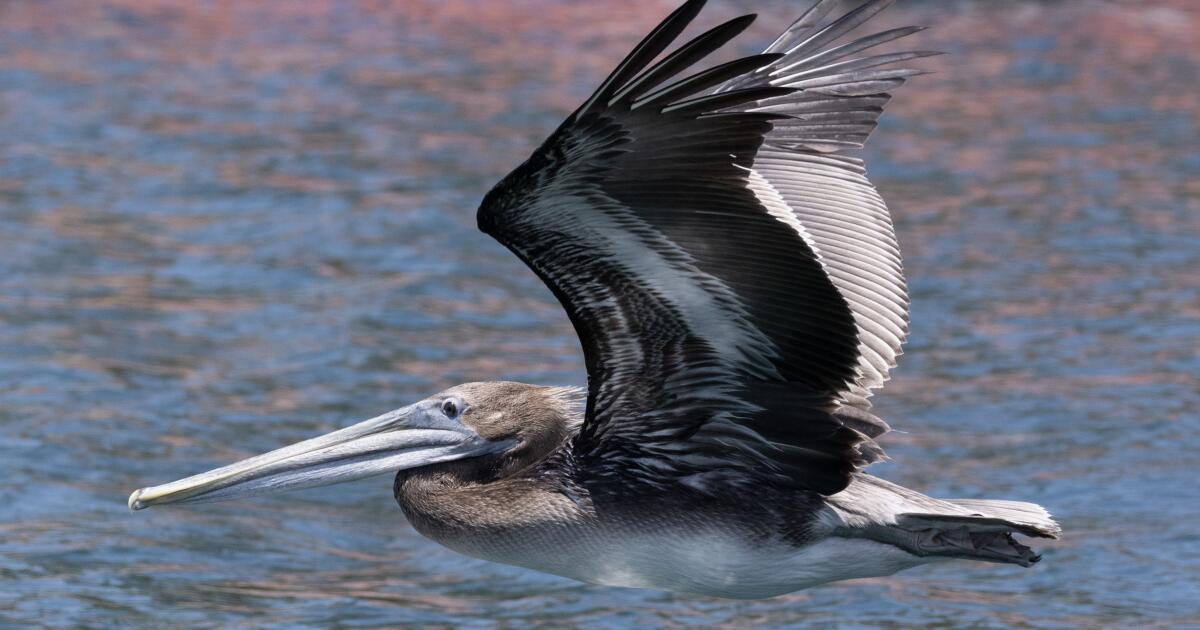
For the last several months, wildlife experts have been alarmed by a large influx of dead and emaciated seabirds washing up on California beaches.
While experts had been recording high mortality rates for brown pelicans for several years now — the result of harmful algal blooms, or “red tides” — this die off appears different.
Now it’s not just pelicans that are being impacted, it includes other water birds, such as Brandt cormorants, loons, common murres, and grebes.
The suspected culprit in this case is subtler and more insidious than the algal neurotoxin known as domoic acid. Experts say these recent deaths are likely tied to an extreme marine heat wave that is causing deadly changes in food availability.
Up and down the California coast this spring, ocean temperatures have skyrocketed. In some places, temperatures have climbed 4 to 8 degrees higher than average, breaking all kinds of historical records. For instance, in La Jolla, nearly 30% of the readings taken off the Scripps Pier this year have exceeded previous temperature records.
“If the ocean is warmer than normal, it can impact the food web in multiple ways,” said Tamara Russell, a marine ornithologist at UC San Diego’s Scripps Institution of Oceanography.
She said fish and other organisms that require cooler waters to survive may swim north or dive deeper in the water column — making them less available for the birds that feed on them. In addition, warmer conditions can stifle the amount of nutrients rising to the water’s surface, resulting in “cascading impacts on the entire food web.”
She said the number of birds coming into rescue centers has increased in tandem with warmer than average ocean temperatures. The marine heat wave, according to researchers, spans from roughly San Francisco to the Mexican border.
Not all experts agree the spike in bird deaths is due solely to increased water temperature.
Krysta Rogers, the lead for bird investigations at the California Fish and Wildlife Department, said she began receiving reports of dead and weakened birds beginning as far back as last summer.
Most of the affected birds were youngsters that had been born that year, following a robust breeding season, she said. The department identified starvation as the primary cause of death. Some birds also suffered from gastrointestinal parasites or fungal respiratory infection, issues wrought by a weakened immune system.
Living at sea isn’t easy. “They have to keep warm, they have to swim after their prey,” Rogers said. “It’s very energetically demanding. And so if they miss a meal or two, that can kind of tip them over the edge. Then it just kind of spirals from there.”
From January through April, the department received 295 reports of dead birds submitted through its website: 193 for Brandt’s cormorants, 68 for common murres and the remaining 34 for a combination of brown pelicans, grebes and loons.
Of 50 cormorants submitted to the lab for necropsies from May of 2025 to April 2026, 46 were juvenile, one was an adult and the rest were in a condition too poor to determine. Of the 35 murres submitted between July 2025 and April 2026, 24 were juveniles, 9 were adults and two were undetermined.
According to Rogers, it’s not uncommon for a population boom to lead to an uptick in deaths — translating to more juveniles that simply don’t survive as they dodge predators, contend with storms and compete with other hungry birds for food. Winter is a particularly challenging time for the inexperienced hunters.
The marine heatwave that has gripped the waters off California may play a role in the bird’s survival, but it’s likely not the only factor, she said.
Rebecca Duerr, a veterinarian at the rescue clinic, said she and other wildlife officials started seeing a “tremendous” influx of dead birds washing up on California beaches in March and April.
She said reports from the Channel Islands suggested breeding colonies of pelicans and cormorants were collapsing. “Like thousands of dead babies,” she said.
She said while a third of the pelicans she’s seen could rightly be considered starving, many of the others have come in with injuries — which, she said, also suggest a food availability problem.
“It’s my subjective impression, but when the pickings get slim out on the ocean, the pelicans take more risks… and more likely to be hanging around public fishing piers or begging at Redondo Beach,” Duerr said “That’s like last resort feeding opportunity.”
She’s seen scores of birds maimed and injured by fishing gear, along with injuries she classifies as “malicious,” such as stab wounds.
Duerr and Jaret Davey, a volunteer coordinator at Wetlands & Wildlife Care Center in Huntington Beach, said several birds have also come in with raging fungal infections in their lungs — the type of infection an animal only gets when its immune system has been suppressed by disease or malnutrition.
“When sea birds become emaciated, they pretty much don’t have any energy to put towards immune function, and their air spaces are a nice, warm, moist location. They become super susceptible to aspergillosis,” she said, naming the fungus the care centers are finding.
So far, sea mammals don’t seem to be impacted.
“We’re seeing conditions in our monitored populations that are typical for this time of year,” said Krista Maloney, with the Sausalito-based Marine Mammals Center.