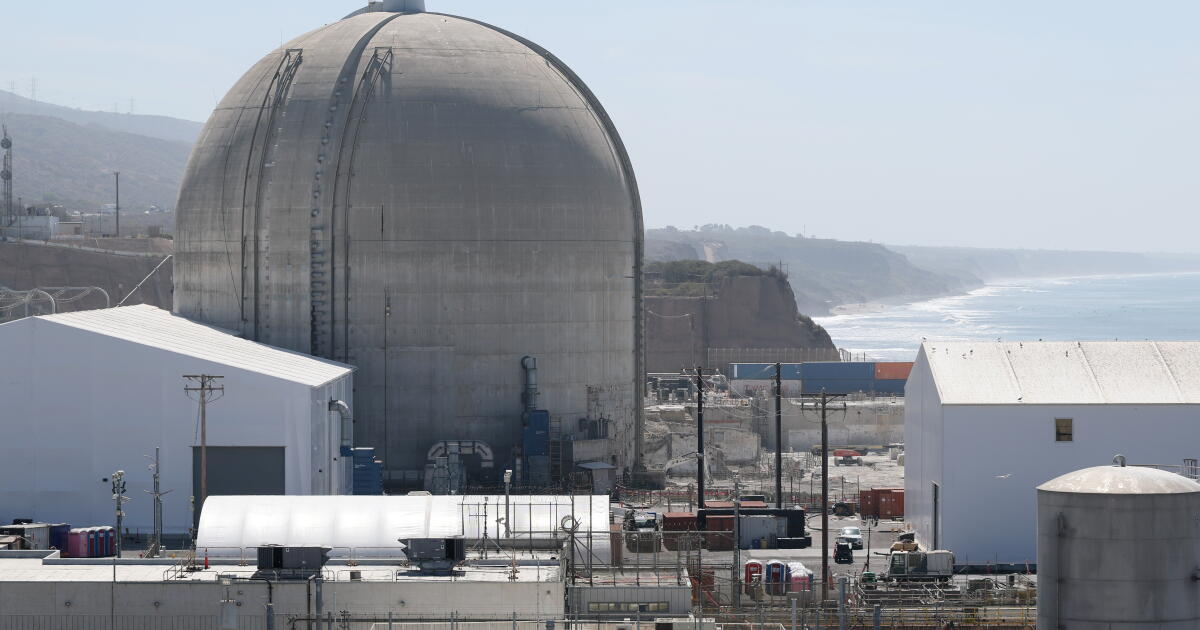
As parts of the Southern California coastline crumbled into the sea, slammed by intense waves and flooding in recent days, oceanographer Kim McCoy had one thing on his mind: the nuclear waste set in concrete on the beach near San Clemente at the shuttered San Onofre nuclear power plant.
“Rising sea levels, storm waves, El Niño which increases wave height … these could wash away a section of the walkway that protects the San Onofre seawall and the waste canisters are just 100 feet away from that,” the former wave dynamics researcher and longtime advocate against beach storage of nuclear waste said.
Most experts agree the risk of erosion damaging the nuclear waste storage system is extremely low, in the near term. The plant’s owner, Southern California Edison, has promised the California Coastal Commission to move the waste to higher elevation on site if modeling shows sea level rise and erosion will start to pose a challenge.
But the recent waves, fueled by Hurricane Marie far away in the Pacific, re-surfaced the issue of the ultimate fate of the highly radioactive spent fuel that used to power the reactors.
“At the moment, it is under control, I think it’s essential to say that,” said James Day, a geology professor at UC San Diego. “But geologically we must be thinking long term. The waste lasts for hundreds, if not thousands of generations.”


1. Rows of round concrete vaults, each holding a canister of used nuclear fuel, sit underground at the Independent Spent Fuel Storage Installation at the former San Onofre Nuclear Generating Station. 2. Independent Spent Fuel Storage Installation (ISFSI) where dry cask storage of used nuclear fuel is stored horizontally at the decommissioning San Onofre Nuclear Generating Station. 3. A photograph above the San Onofre Nuclear Generating Station hangs on the wall of a conference room at the facility.
Seen from I-5, the twin domes of San Onofre look like they’re part of an operating facility. Red lights flash at the top of each sphere, visible from afar, amid the chaparral and military buildings of Marine Corps Base Camp Pendleton.
But go behind the security checkpoint and you see a demolition site. Trailers and tents now sit where acres of office buildings, steam turbines, diesel generators, control rooms, cooling pools and water treatment plants have been knocked down and hauled away, since a scandal involving faulty steam generators shut the plant down in 2013.
Most of the rubble, which is only mildly radioactive or not at all, has already been sent to sites in Utah, Texas and Arizona.
The iconic twin domes that once housed the reactor cores will start coming down early next year. But the 3.6 million pounds of high-level waste will stay in the coastal community indefinitely.
How much of a safety hazard that is depends on whom you ask.
“San Onofre is sitting on some fairly young rocks in a seismically active region,” Day said at a recent symposium at the Scripps Seaside Forum in La Jolla, hosted by the Samuel Lawrence Foundation. “This is not the sort of place you would leave nuclear waste.”
Others noted that collapse of beach slopes could make the site more vulnerable to tsunamis. They spoke of the corrosive effects of the ocean air on the steel canisters that hold the waste.

Manuel Camargo, principal manager, strategic planning, San Onofre Nuclear Generating Station, talks about nuclear waste storage with a model of a nuclear fuel assembly in the background on Aug. 21 in San Clemente.
(Allen J. Schaben / Los Angeles Times)
“They could be doing more monitoring,” Greg Jaczko, former head of Nuclear Regulatory Commission, said of Edison. The utility tracks air temperature and radioactivity, checks canisters for cracks on the outside and inspects test canisters that mimic the active waste ones for signs of degradation.
They say their system will be safe for decades to come.
“The maximum credible tsunami here would not even overtake the seawall,” said Manuel Camargo, principal manager of decommissioning for Edison, standing on the concrete pad that holds the steel waste storage canisters. “The maximum credible earthquake, somewhere around a 7.0 magnitude, would produce something about half of what this system is designed to withstand.”
As he spoke, just in front of the plant, surfers were catching waves. He pointed out where Edison is bolstering a path below the sea wall. Based on state data from the California Ocean Protection Council, the sea wall would not be inundated before 2050, Camargo said. “It’s an extremely robust system.”

Rows of round concrete vaults, each holding a canister of used nuclear fuel. The system, built into the bluff above the Pacific Ocean, holds dozens of canisters of radioactive waste and is designed to withstand fire, flood and tsunami.
Yet despite confidence in its protective measures, even the utility wants the waste out of there as soon as possible. Because this status quo is expensive.
From 1982 through 2014, Edison customers, like many ratepayers around the country, paid into a federal fund for a promised permanent nuclear waste storage site. But plans for a deep geological repository beneath Yucca Mountain in Nevada crumbled in the face of local pushback in 2011.
Utilities around the U.S. now sue the federal government every year to recoup their storage expenses because the Department of Energy has not come through on its promise. The lawsuits cost taxpayers $2 million a day, according to Camargo.
“It’s so safe that it’s almost a problem,” Camargo said. “It’s not a priority to a lot of folks to move it.”


1. A caution: radioactive material sign is posted as Kevin Sheek, senior advisor for Emergency Planning, San Onofre Nuclear Generating Station, gives a tour of the Independent Spent Fuel Storage Installation (ISFSI) . 2. An estimated 5,000 rail cars wait to be loaded to haul away dismantled plant materials. 3. The plant is located on an 84-acre site on the Pacific coast within the boundaries of the Marine Corps Base Camp Pendleton in San Diego County.
Camargo, like so many in the nuclear power industry, is hanging his hopes on a new idea. The Trump administration’s Department of Energy wants to create “campuses” in several states to store waste, and in exchange, give local jurisdictions funding to develop different aspects of the nuclear cycle — like fuel creation, power generation and potentially fuel recycling.
The administration wants to address the fact that waste is sitting at 80 reactor sites around the country. It also needs places for waste from new reactors it wants to build. Several states including California have bans on new nuclear power until there is permanent federal storage. Some state leaders are trying to make an exception for small modular reactors such as the one the Port of Long Beach wants to build on a floating barge offshore.
The Energy Department announced in July that it had signed memoranda of understanding with Utah, Tennessee, Oklahoma, Idaho and Indiana to explore their potential as campus hosts. Congressman Scott Peters and Mike Levin, whose district includes San Onofre, support this idea, and Camargo said Edison was in discussions with Utah and Tennessee about how it can help.
Other efforts to create nuclear waste storage facilities since Yucca Mountain have floundered. But boosters of the campus idea say this will be different, since the plan draws on principles of “consent-based siting” developed under the Obama administration and offers money and jobs.
“The community engagement piece has been central to our entire strategy, and we’re giving the community these options and funding to win,” said Tim Kowalchik, research director at Utah’s Office of Energy Development.
Others in Utah disagree, indicating it could be a long road to community buy-in. “What we’re seeing still is very limited community engagement and transparency about these proposed plans,” said Carmen Valdez, radioactive program manager with the nonprofit Heal Utah. “Our communities have always said no to becoming a waste site. We don’t want to be the toilet bowl of the nation.”

Kevin Sheek points to decommissioning work around reactor containment domes during a tour of the nuclear waste storage facility.
(Allen J. Schaben / Los Angeles Times)
Finland is the country furthest along in building a deep, permanent geological storage for nuclear fuel. It will soon place canisters thousands of feet underground in stable rock formations and seal them off forever. Sweden has also broken ground on a facility, and Switzerland and Canada have chosen sites.
Camacho and lawmakers are optimistic that the U.S. can create something similar, and remove the waste from San Onfre in 10 to 15 years. If not, in 2103, when the site’s earliest canisters’ approach their intended 100-year lifespans, the utility may have to start transferring the fuel into new ones.