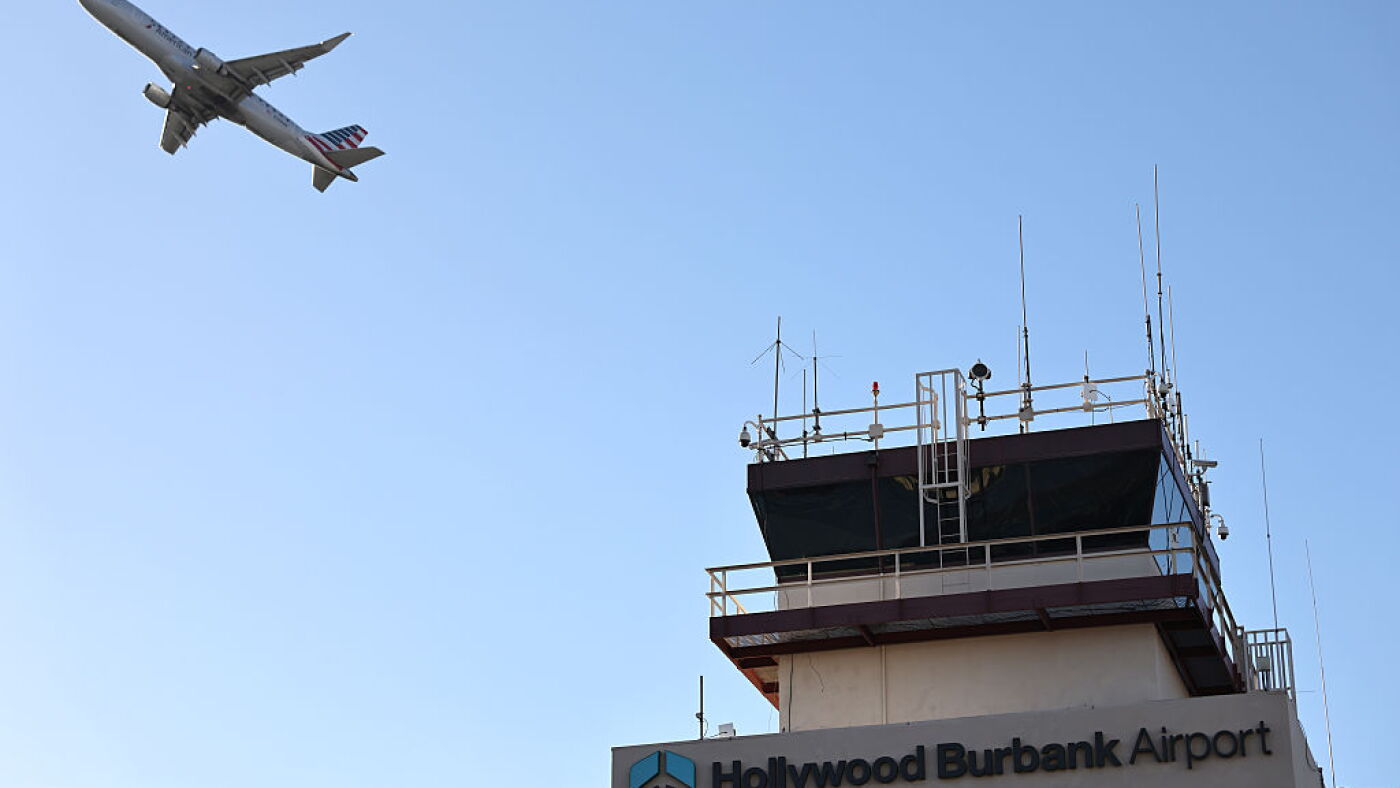
An American Eagle plane takes off from Hollywood Burbank Airport in October 2025 in Burbank, California.
Mario Tama/Getty Images
hide caption
toggle caption
Mario Tama/Getty Images
WASHINGTON — The federal agency in charge of air traffic control is turning to artificial intelligence to help manage the nation’s airspace.
The Federal Aviation Administration officially launched its ambitious $875-million-dollar software overhaul on Monday, announcing the rollout would begin at three major airports that serve the Washington, D.C. region.
The new system is known as Strategic Management of Airspace, Routes and Trajectories, or SMART for short.
“By fundamentally reshaping how we manage our airspace and preventing problems before they happen, SMART will slash those frustrating delays, reduce stress on air traffic controllers, and lower travel prices,” Transportation Secretary Sean Duffy said in a statement.

The long-awaited rollout, however, was upstaged by an equipment outage that snarled air traffic at major airports on the East Coast.
The FAA said the problems began with a blown circuit at its air traffic control facility in Philadelphia, which also handles traffic at Newark Liberty International Airport. Aviation officials tried to switch to a backup line, but found it had been accidentally cut by an Amtrak construction crew in New Jersey, Duffy said in a social media post.
The cut fiber optic line caused a telecom outage and forced the FAA to pause flights in the Northeast, including at John F. Kennedy and LaGuardia Airports in New York City.
FAA administrator Bryan Bedford told reporters the equipment failure underscored the need to replace outdated infrastructure. The new software is part of a broader $12.5 billion push to modernize the nation’s air traffic control system.
Regulators and airlines hope the AI-enhanced tool will make flying more efficient, though critics warn that it won’t solve bigger problems with the air traffic control system.
FAA and DOT leaders emphasize that the new technology is not intended as a replacement for human air traffic controllers. They describe it as a tool that’s supposed to make controllers’ jobs easier by reducing congestion and conflicts in the air before they happen.
“The way we manage traffic today is chaotic and we can do better,” said FAA administrator Bryan Bedford during a Senate hearing earlier this year. “We need to manage that at the FAA, rather than rely on commercial airlines to simply schedule however they want.”

FAA leaders say the SMART system will help optimize the nation’s airspace by considering all planned airline flights, as well as weather, wind, and other variables, and tweaking those flight schedules to reduce congestion.
The FAA tapped a relatively small company called Air Space Intelligence to build the system. The company has previously made AI-enhanced software for dispatchers at Alaska Airlines and other carriers, but this project presents a significantly bigger and higher-profile test.
Skeptics question whether the SMART system will be the game-changer FAA leaders have promised.
“It won’t replace humans. It’ll be another tool in the toolbox,” said Dave Riley, a former air traffic controller who retired in 2020 after more than 20 years at the FAA. “But of course, when you call it AI, it gets a lot of attention.”
Riley downplayed concerns of the AI tool going rogue because human air traffic controllers will still be in charge of keeping planes safely separated.
“The fears of AI killing us all in the next 10 years, I don’t think this platform is going to be about that,” he said.

But Riley doubts the tool will do much to solve the bigger problems in the air traffic control system — particularly the staffing shortage. The FAA is still thousands of certified air traffic controllers short of full staffing, forcing many controllers to work mandatory overtime and grueling schedules.
The National Air Traffic Controllers Association, the union that represents controllers, distanced itself from the new system.
“NATCA has not been involved in the design, testing, or implementation of SMART and therefore cannot speak to its effect on the air traffic control workforce at this time,” the union said in a statement.
Airlines for America, the trade association that represents the major airlines in Washington, praised the FAA’s push to modernize the nation’s flight management tools.
“Its potential to strengthen safety, increase capacity and improve efficiency will have a direct positive effect on American travelers,” the group said in a statement. “We’re just in the initial stages, but it’s one of the most exciting and bold initiatives taken on by the FAA in decades.”