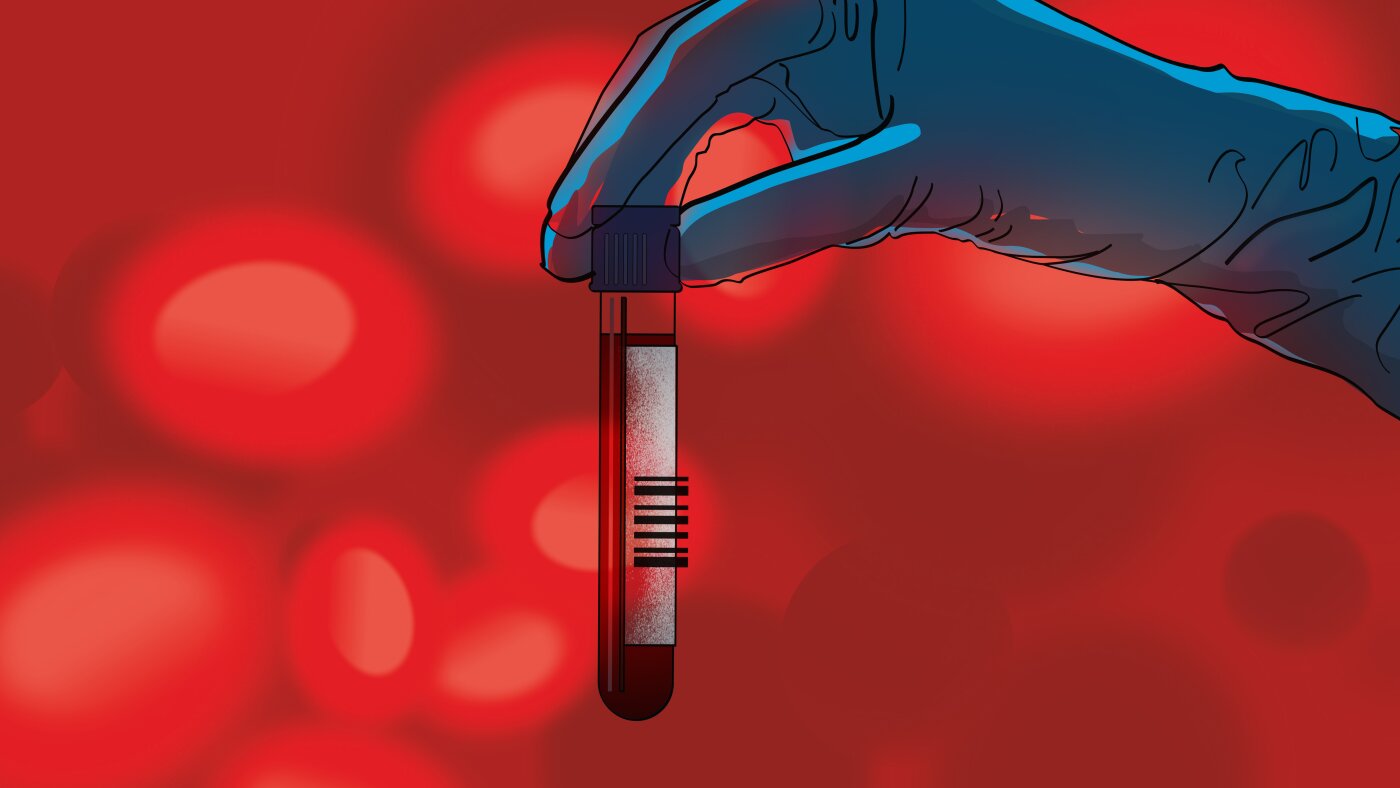
The new tests can look for traces of 50 different kinds of cancer in one vial of blood. While they do not diagnose cancer, the tests tell doctors where to look more closely.
Anand Purohit/Moment RF/Getty Images
hide caption
toggle caption
Anand Purohit/Moment RF/Getty Images
Blood tests on the horizon, and under federal regulatory view, may be about to transform cancer care — and survival.
The Food and Drug Administration has been evaluating a blood test called Galleri (pronounced like “gallery”) as a breakthrough device that can detect many different types of cancer in one test. FDA could approve it later this year, clearing the way for such testing to become broadly available.
For the latest stories on the science of healthy living, subscribe to NPR’s Health newsletter.
If that happens, experts say such tools have the power to revolutionize cancer screening as it exists today — making it far easier, more comprehensive, and more accessible to a greater number of people.
Relatively few screening tests now
Currently, in the U.S. it’s common to screen for five cancers — breast, colon, cervical, prostate, and lung — each requiring its own scan, like a CT test, or exam, like a Pap smear. By comparison, the Galleri test can detect small amounts of DNA or other cancer markers for up to 50 cancers in a single vial of blood.
Galleri and another test called Cancerguard by Abbott are both multi-cancer early detection tests that already can be ordered in the U.S. under a special FDA designation. A more rigorous FDA approval process will be necessary for the tests to be covered by Medicare and other insurance.
Still, the stage is set for a new paradigm.
“It’s a real fundamental shift in how we think about cancer screening,” says Megan Hall, vice president of medical affairs for Grail, a research company founded to bring Galleri to market. “Instead of screening for individual cancers, we can now screen an individual for multiple cancers simultaneously.”

A pathway for Medicare coverage
The testing industry, and cancer advocates, successfully pushed for government insurance to cover multi-cancer early detection, known as MCED, after the category gets the more thorough FDA vetting.
As part of its spending package passed in February, Congress voted to allow Medicare to reimburse the cost of multicancer detection tests starting in 2028. Grail sets the retail price for the Galleri test at $950. Cancerguard’s price is $659. It is unknown how much the companies will charge commercial insurers if the FDA grants them full approval.
Grail is doing two large-scale population studies of people over 50 on the Galleri test. One study is looking at more than 142,000 patients in the U.K. through the National Health Service, or NHS. Another study, called the Pathfinder 2, involves 35,000 patients in North America.
The NHS study did not meet a primary goal of seeing a significant reduction in incidence of Stage 3 and 4 cancers over time, Grail announced in February. In late May, at the American Society of Clinical Oncology meeting, the company released research that says that the two studies, taken together, nevertheless, show a promising trend.
“The third year alone, we saw a 26% reduction in Stage IV cancers — pancreatic cancer, liver cancer, lung cancer, gastric cancer and a handful of others,” says Hall.
Grail is promoting the idea that the Galleri test should be used in conjunction with other screening tests, not as a replacement to any done now. The legislation passed by congress that may eventually allow Medicare to cover the test also specifies that Galleri should not replace other screening tests.
What the future may hold
So: What does that mean for people who fear cancer, or live with it?
At the moment, only a handful of common cancers have a screening test that can detect disease before a person has symptoms, when it may be at a more curable stage.
Oncologist Arif Kamal, chief patient officer at the American Cancer Society, says Grail is one of hundreds of companies pursuing the promise of blood tests — competing over levels of sensitivity, accuracy, and reliability. He says if implemented well, the simplicity of such tests could make routine screening easier and more accessible.
The science is sound and the technology is solid, Kamal says, so the only question is how quickly the technology will evolve. Blood tests, whether they detect one cancer or many, “are all getting at this idea that you can find, in the blood, early signals of a cancer’s presence or its evolving resistance to existing therapy,” he says.
Similar technology has already changed the way UCLA lung-cancer specialist Jonathan Goldman treats patients. Oncologists use blood tests, sometimes called “liquid biopsies” to monitor patients who already have a cancer diagnosis to see if treatment is working or if cancer may be returning. They also use it to identify a cancer’s specific genetic type, which in turn can allow physicians to choose more effective treatments when available.
“Blood-based testing has become central to the way that we think about lung cancer and other cancers because the systems have become so sensitive,” says Goldman.
The future, he says, are blood tests that may be able to predict if a person is likely to contract the disease.
“It’s possible that at some point our blood testing could become so sensitive that you could find that very small number of cells that would be at risk for causing cancer occurrence years later — but we’re not there yet,” Goldman says.
Indeed, Grail medical advisor Hall says the Galleri test is not a diagnostic tool; rather, by identifying the volume and type of DNA fragments and other cancer markers in the blood, the test results offer what are essentially predictions about the source of the cancer.
Catching more before Stage 4
A diagnosis will always require a follow-up exam, but the test offers solid guidance for doctors, Hall says.
“That cancer signal origin prediction is a really important feature of the technology because it directs your physician on where to go to look to confirm the presence or absence of that cancer,” she says.
Improvements in blood tests, meanwhile, dovetail with rapid developments in treatments for various cancers, making the disease ever more survivable or even curable.

Therefore, the ability to catch cancer at Stage 3 versus Stage 4 has never been more significant for survival, Hall says. “The treatment landscape has evolved so much over the past five to 10 years, that there are now a lot of treatments even for Stage 3 … and that’s a really big deal.”