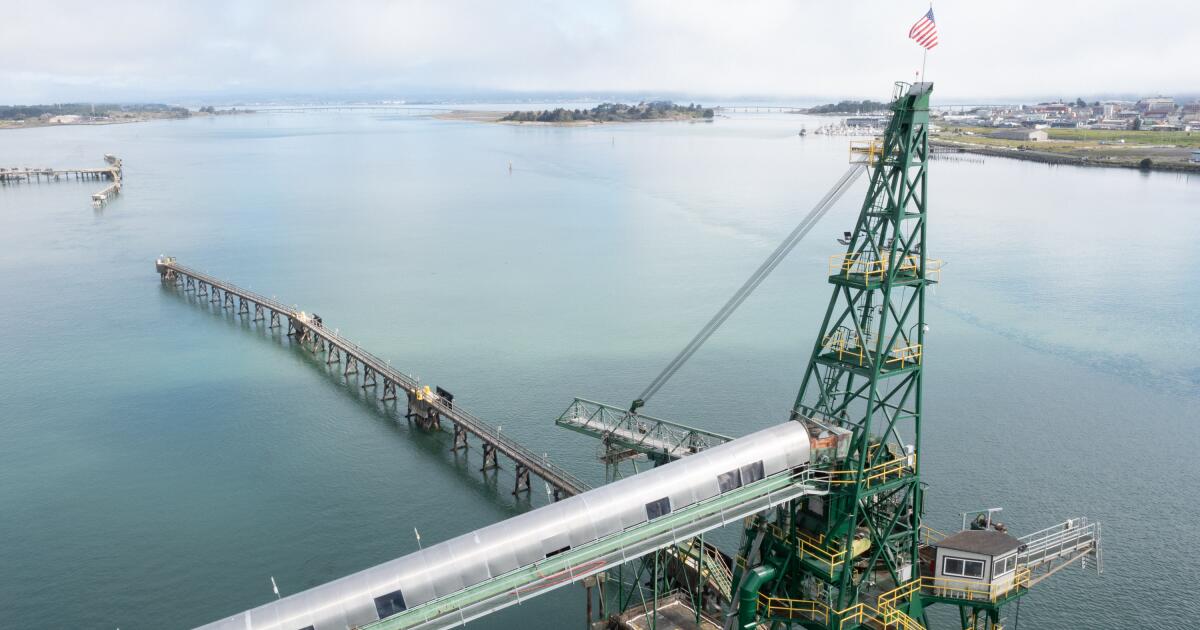
EUREKA, Calif. — Here along the rugged North Coast of California, there’s little to suggest that Humboldt Bay, with its eelgrass, oysters and osprey nests, will soon become a launchpad for one of the most ambitious clean energy projects in state history: a hub for floating offshore wind.
The plan is for major private players to erect hundreds of wind turbines in the bay — each rising as high as L.A.’s tallest skyscrapers — then tow them out to the ocean.
Some experts believe the wind project is critical to California’s goal of 100% carbon neutrality by 2045 and represents a key climate change solution. The state has a target of 25 gigawatts of offshore wind energy by that year — enough to power about 25 million homes — and nearly all of it would come from five lease areas in federal waters near Humboldt and Morro bays.
Yet the technology for wind power that floats — as opposed to standard towers permanently attached to the sea floor — is just emerging, and has never been attempted in waters as deep as the Pacific off Northern California.
It will require innovative engineering even as the state contends with objections from local residents and a federal administration strikingly hostile to offshore wind. President Trump canceled nearly half-a-billion dollars in federal funds for Humboldt Bay’s port project, and has repeatedly tried to block wind projects along the East Coast.
Officials say pulling it off will require a perfect concert of major port upgrades, hundreds of miles of new transmission lines and hundreds of wind turbines. If it succeeds, offshore wind could make up 10% to 15% of California’s clean energy production, complementing solar during key hours when the sun doesn’t shine.

This is the first in an occasional series on the state of the energy transition in California amid opposition from the Trump administration.

It hasn’t been done before
The project is still in its early stages, so most of the action is with the Humboldt Bay Harbor District, which must transform its historic logging port before any work begins out on the ocean.

The plans for the terminal include new wharves, cranes and barges for the assembly of hundreds of wind turbines. Some locals say they’re worried about how the project will transform the area and its fragile estuary.
On a recent boat tour of the harbor, a seal poked its head from the glassy water as the district’s executive director Chris Mikkelsen and development director Rob Holmlund explained that very few places meet the criteria for assembling floating turbines. Those include a protected bay with deep channels, an entrance wide enough for ships, land for laying out the giant blades and steel towers, and access to heavy machinery to piece them together.
Humboldt Harbor is one of two places in California that fits the bill, they said — the other is the Port of Long Beach, which is also being built out to support the assembly of turbines. But the waters off of Humboldt have faster and more reliable wind. Faster wind produces much more electricity than slower wind.
“It’s only Humboldt and Long Beach,” Holmlund said. “So it’s a super bonus that we have great wind out our back door.”
The construction, once it begins, will change the skyline of the harbor. New cranes will help assemble the turbines on a floating barge until they are ready to be towed some 20 to 60 miles offshore.

The tiny town of Samoa sits feet away from a proposed new terminal for the assembly of offshore wind turbines in Humboldt Bay near Eureka. California hopes to reach 25 gigawatts of offshore wind power by 2045.
It would take about 10 years to assemble all the turbines, Holmlund said, but locals could feel their presence for decades: Unlike regular offshore wind, which uses special ships that visit the towers for maintenance, the floating turbines would be towed back to shore when they need work.
Federal efforts to kill the project
California must also contend with a federal government antagonistic toward offshore wind. The Trump administration last year described the technology as “doomed.”
Along the East Coast, the president has repeatedly ordered halts to wind developments that were fully permitted and under construction, including some that were near completion. One was being built by Vineyard Offshore, a major developer that also is a lease holder off Humboldt.
Just last month, the Trump administration struck a deal to pay the French company TotalEnergies $1 billion to walk away from two U.S. offshore wind leases and instead invest in fossil fuel projects, further escalating its campaign against renewable energy in favor of oil and gas.
California’s strategy so far has been to focus on onshore preparations within its jurisdiction. The hope is a new administration more favorable to offshore wind will be in place by the time turbines are ready to touch federal waters.
Where the money will come from
Funding remains a concern. Local officials will have to replace the loss of $427 million in federal grants. A California climate bond approved by voters in 2024 carved out $475 million for offshore wind development, but there is stiff competition for that money.
Private investors could be hesitant to put billions into an industry that relies so heavily on the whims of whomever is in the White House, said Arne Jacobson, director of the Schatz Energy Research Center at California State Polytechnic University in Humboldt.
“It needs to be a partnership between the state, the federal government and the private sector to be able to do those kinds of projects,” Jacobson said. “And if one of those three doesn’t want to do it, it’s not here.”

Chris Mikkelsen is executive director of the Humboldt Bay Harbor District, which recently lost nearly half a billion in federal funding for its project to support offshore wind.
California appears to be proceeding with caution. Last year, officials told The Times the state “isn’t backing down” on its plans. Now, the California Energy Commission said it is “carefully monitoring” federal decisions to block wind projects on the East Coast.
Mikkelson, the Harbor District’s executive director, said the loss of federal funding has “made us want it all that more.”
“One administration can’t change the need the country has for energy,” he said. “We have great energy demands, and we know we have to do it in a cleaner way than we’ve done it to date. Why wouldn’t we want to work on it? Why wouldn’t we want to see success in the project? It’s incredibly important.”
Bringing the clean power ashore
Other nations, including Norway and Scotland, have successfully deployed floating wind platforms, but the seafloor off the coast of California drops very quickly, and the planned lease areas here are between 1,600 and 4,200 feet, as much as 10 times deeper than the few existing floating wind farms in other parts of the world.
Though the platforms will float, they still must be tethered to the seafloor. Like all offshore wind arrays, they also need to deliver the electricity back to land, requiring long floating cables, loose enough to withstand ocean currents.

Railroad tracks lead toward the historic Samoa Fire Station, near where they are proposing to build turbines for offshore wind power.
Once these cables meet land, they’ll connect to a new substation near Humboldt Harbor. From there, two new 500-kilovolt transmission lines will connect to the state’s electric grid — some 400 miles of new line total.
The California Independent System Operator awarded that work to Chicago-based Viridon, which won out in a competitive bid against other companies including Pacific Gas & Electric. When asked whether the company is factoring in Trump’s opposition to offshore wind in its plans, Viridon officials said it is “committed to moving this project forward.”
Vineyard Offshore and RWE Offshore Wind, the two developers that will build and operate the wind farms, declined or did not respond to requests for interviews. Both are major players in the offshore wind space.
Local headwinds
Humboldt Bay and the neighboring town of Eureka are home to aquaculture businesses, fisheries, environmental justice organizations, local tribes and many other residents and stakeholders whose opinions on the project differ.
A recent survey from Oregon State University and the Schatz Energy Research Center found 37% of Humboldt residents in favor of offshore wind, 44% unsure and 19% opposed.
Eureka has a long history of boom-and-bust cycles — ranging from gold to lumber to marijuana — and some communities are still reeling from the fallout from those industries.
“There are a lot of people who say we are going to be the sacrifice zone again,” said Jennifer Kalt, executive director of the Humboldt Bay Waterkeeper, an environmental nonprofit. “This whole community is dealing with the ramifications of what was left behind from all that mess.”

Wood pilings are stacked near the marine terminal in Humboldt Bay.
A draft environmental report is expected next year, and it will include plans to address potential harm to the ecosystem. Kalt worries some species, such as the eelgrass, will be destroyed by the regular dredging required to maintain a water depth of 40 feet to accommodate the ships for the new terminal.
Ruth Wortman, a cultural practitioner for one of the Native American tribes in the area, the Bear River Band of the Rohnerville Rancheria, said she’s concerned about the effect on salmon, whales, kelp, abalone and other marine life. The ocean off Humboldt is “everything” to the tribe, she said.
“This is just another battle to fight,” Wortman said. “We just got the dams removed on the Klamath, and now you want to put another destructive life cycle interrupter in our ocean.”
But officials with another tribe, the Blue Lake Rancheria, see the development as an opportunity for co-ownership and co-management.
“Blue Lake Rancheria acknowledges the importance of transitioning to renewable energy sources — including offshore wind — as part of addressing climate change,” said Heidi Moore-Guynup, director of tribal and government affairs. However, she also noted that any clean energy project should respect Tribal sovereignty, protect cultural and natural resources and ensure equitable benefits.

A view of Tuluwat Island in Humboldt Bay. The island is located directly across from the planned staging and integration terminal for the construction of offshore wind turbines.
She and many locals noted that dredging and erosion could affect Tuluwat, a 280-acre island in Humboldt Bay sacred to the Wiyot Tribe, which only recently won back full ownership of the island from the city of Eureka.
The biggest immediate impact is likely to fall on the approximately 300 residents of Samoa, a town that sits on the tiny spit of land that protects the bay. The windswept community is home to historic mill houses and a new low-income housing complex right next to where the turbine components will be stacked and assembled.
The 1,000-foot turbines will tower over these homes as they are being erected. Some locals worry about noise, light and air pollution during what could be a decade of construction.

A view of the marine terminal as seen from Eureka.
One resident mentioned the sound will drown out the music of the frogs she hears each evening. Others are concerned the turbines might be abandoned, leaving them with ocean “tombstones.”
Vanessa Coolidge, 40, said she’s worried about osprey nests that would need to be relocated for the work, but doesn’t believe anyone is listening. She hasn’t attended any community meetings “because I know nothing I say will make a difference.”
Tina Manos, 69, said she is concerned about the effect on the area’s economy, including oyster farms, the aquaculture industry and tourism.
“I do want clean air and I do want clean water, and I recognize that we need solutions,” Manos said. “Wind, I think, will have a place. The question is, is this the best place for it?”