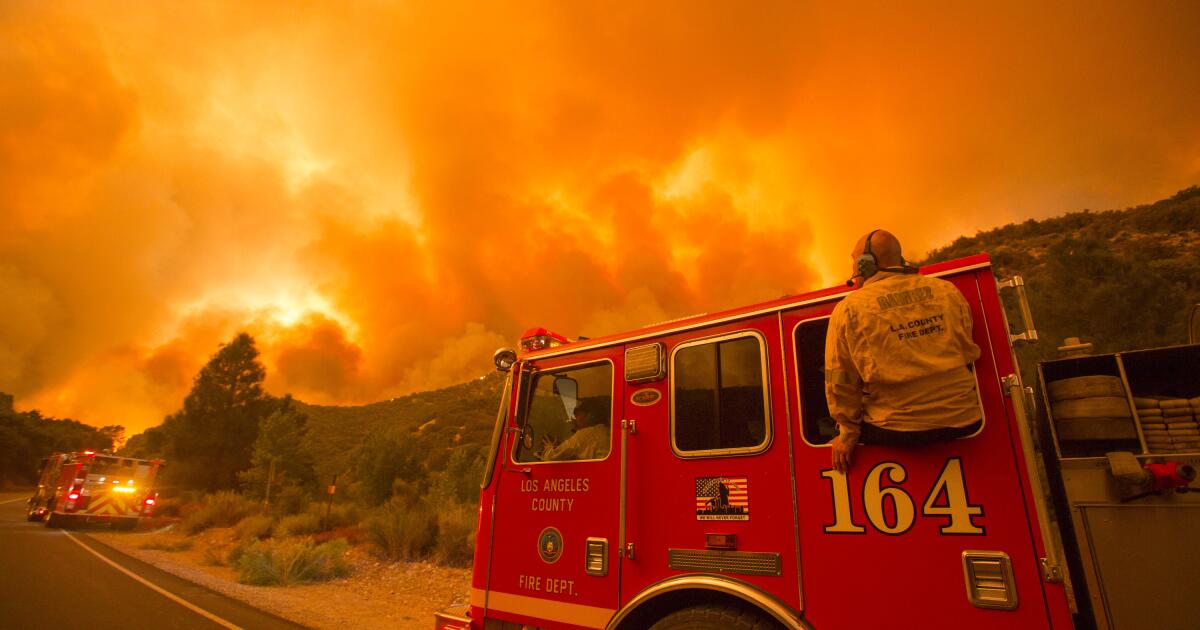
State and federal wildfire officials have spent the past five years rapidly expanding efforts to thin out hundreds of thousands of acres of dense fire-prone forests, reduce the number of human-caused ignitions and fortify millions of homes against flames, heat and embers.
On Friday, those officials unveiled a draft plan to ramp up the work and turn a flurry of projects and funding into a long-term strategy — even as the state expects to lose hundreds of millions of dollars from its annual wildfire prevention budget in the coming years.
The new plan “is going to enable us to go bigger, smarter, and faster,” said Patrick Wright, director of the California Wildfire and Forest Resilience Task Force, a joint effort between the state and federal government that created the draft plan. “We’ve built that capacity, we’ve built that science, we’ve built that network. … Now, we’re ready to take everything to the next level.”
Under the new framework, officials hope to increase landscape-wide vegetation thinning from about 750,000 acres a year to upward of 1 million acres a year, build up “aggressive” ignition-reduction programs and get millions of Californians in compliance with new home landscaping requirements.
Right now, the Task Force is playing catch-up. Well over a century of misguided land management and development practices have left the state increasingly vulnerable to frequent and severe fire that risks destroying communities and ecosystems.
In California’s forested areas, which historically experienced frequent, low-intensity ground fires, the state and federal government worked aggressively to suppress all fire. That policy owed largely to the belief that fire damaged “pristine wilderness,” and a perceived need to protect valuable trees for logging. Without frequent fire to clear out the understory of a forest, California woodlands have grown five to six times denser.
Now, when a fire occurs, it has enough fuel to kill the majority of a forest. What grows back afterward is often shrubland, not forest.
Meanwhile, native shrublands like those around Los Angeles have historically experienced fire every 30 to 130 years. But as humans moved into the wildlands, they brought greater potential for fire. Electrical equipment, unattended camp fires, cigarette butts and arson have rapidly increased the interval of fire.
Now, some areas in the Santa Monica Mountains experience fire every five to eight years — too frequent for native vegetation to recover. In its absence, invasive grasses take cover.
In 2021 — following a devastating fire season and mounting scientific evidence that land management and building practices are partly to blame — Gov. Gavin Newsom and the state legislature revamped a forest management task force to focus on the wildfire problem.
That same year, the Task Force released its first five-year plan to tackle the crisis. Friday’s plan is the first update to that plan.
The new plan is more ambitious, but California will likely have to do it with less money than it’s had in recent years.
The state is losing two key funding sources. Officials recently altered a program that charges polluters, which analysts estimate will result in a cut of $200 million for California’s annual wildfire prevention budget. Meanwhile, the state is quickly spending a $1.5-billion pot from a voter-approved climate bond, leaving little for future years.
On the federal side, the Trump administration has proposed, for the second year in a row, dramatically slashing the budget of the Forest Service, which oversees and funds much of the work in California, in favor of consolidating federal fire services under the Department of Interior.
Last year, the administration proposed cutting the Forest Service budget by 65%, which Congress largely rejected. This year, the administration proposed cutting it by 75%. Both times, the administration proposed significantly expanding funding for forest thinning in the Department of Interior to compensate.
Wright is nonetheless confident the state can make significant progress in the coming years.
The Task Force is hoping to prioritize the highest-risk areas in the state and find outside sources of funding, including from electrical utilities looking to reduce their chance of sparking fires, CalTrans looking to reduce fire starts along roadways and companies willing to buy the wood that is removed through forest-thinning projects.
Wright also anticipates doing this work will get cheaper over time. After a dangerously dense forest is cleared out with hands and heavy machinery, it’s much safer to return a few years later with prescribed fire instead, which is much cheaper.
“The science is really clear that we can achieve our goals with fewer acres and fewer dollars if we prioritize better than we have done,” he said.