CANNES, France — Cannes is technically half over and the hunt for a masterpiece continues. Critics on the Croisette are starting to resemble that classic comic-strip panel in which an explorer crawls desperately across the sand toward an oasis that’s only a mirage.
This far into an underwhelming festival, good films have a way of looking like great ones, such as James Gray’s “Paper Tiger,” a grimy thriller with Adam Driver and Miles Teller playing brothers in 1980s New York who get mired in a scheme to sanitize the Gowanus Canal. Driver’s ex-cop knows the codes of cutting deals with the Russian mob; Teller’s engineer is the square who can’t grasp how doing things the right way just makes the situation worse. As the normies, Teller and his naive wife, portrayed by Scarlett Johansson, feel like kids playing dress-up. (Johansson’s perm is a bit much.) Still, the script is tense and tight — and at this point, I’m happy to see anything with a plot.
Rodrigo Sorogoyen’s “The Beloved” has two of them: It’s a film within a film about a famous director (Javier Bardem) who casts his estranged actor daughter (Victoria Luengo) in his latest project. The fictional movie he’s making looks stiff, a period epic about Spain’s colonialist withdrawal from the Sahara in the 1930s, which doubles as a metaphor for the father’s destructive absence from his now-adult child’s life. A boozer, she’s not stable enough to stand up to the scrutiny of his sudden attention. Luengo herself holds the camera splendidly even in her character’s weaker moments, turning her charisma off whenever her father needs her to turn it on.
Consider it a shot and chaser to “Garance,” which stars a vibrantly sloppy Adèle Exarchopoulos as another alcoholic actress. Sharp, smartly paced and entertaining, it’s fantastic until the last stretch, which peters out and then abruptly stops.
One of the festival’s big themes seems to be connection: that we’re all stuck on this rock together and, ultimately, the difference between human and android, man and woman, is moot. At least three movies have someone saying, “That’s life,” with a shrug. The films themselves, however, are lifeless. Worse, they’re long. I can roll with movies that are mostly vibes, but only to a limit — say, 85 minutes.
Sophie Thatcher in the movie “Her Private Hell.”
(Neon)
Nicolas Winding Refn’s “Her Private Hell” is longer than that and the inertia is excruciating. The Danish director of “Drive” hasn’t made a feature film since “Neon Demon” premiered at Cannes in 2016 and this grim fairy tale feels more like a feint than a comeback. A sulky daughter (Sophie Thatcher) skulks around a misty skyscraper with her hot young stepmother (Havana Rose Liu) idly fretting about a murderer named the Leather Man. Down below, an Army private (Charles Melton) hunts the killer. Little happens other than chain-smoking, costume changes and interminable shots of color-shifting strobe lighting splaying across the cast’s cheekbones. Thankfully, Kristine Froseth adds pep as a bimbo who hasn’t yet learned how to talk as leadenly as everyone else.
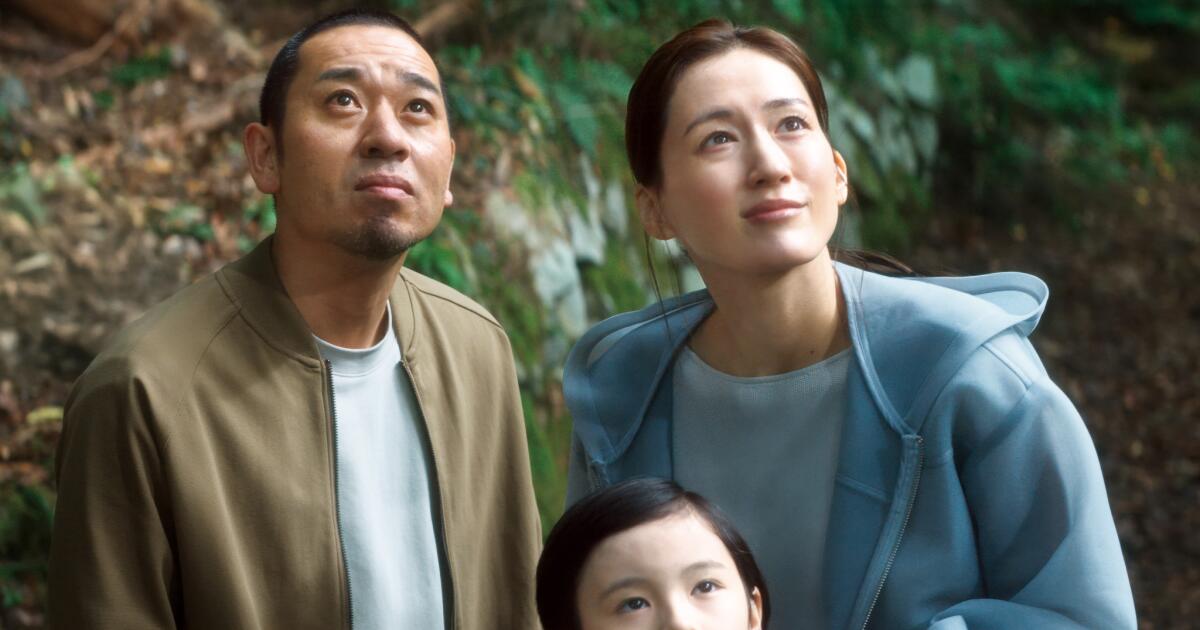
Too much of the program is made up of tedious movies by beloved Cannes veterans — essentially affirmative action for auteurs. Eight years ago, Hirokazu Kore-eda won the Palme d’Or for “Shoplifters,” a chaotically enchanting portrait of a family of fraudsters. Now, he’s returned with “Sheep in the Box,” a slick and dull story about two grieving parents who adopt a clone of their dead son. “Sheep” aspires for Spielbergian catharsis — one scene seems to consider itself an art-house take on “A.I. Artificial Intelligence” — but the human characters come off as mechanical as the little robot boy. Between the musty setup and saccharine score, it’s the film equivalent of a bowl of stale candies.
Arthur Harari, who co-wrote 2023’s Palme- and Oscar-winning “Anatomy of a Fall,” is here as the director of “The Unknown,” a stilted drama about a sulky male photographer who wakes up in the body of Léa Seydoux after a nameless, wordless one-night stand. You can imagine Brian De Palma running with the sex-contagion idea (or “It Follows” director David Robert Mitchell grumbling that he deserved an inspired-by writing credit). But “The Unknown’s” shape-shifting intrigue stalls out once you realize that none of the characters have a personality to begin with. Who cares what soul is inside each shell if they’re all monotonously slack-faced? “Face/Off” it isn’t.

Léa Seydoux in the movie “The Unknown.”
(Festival de Cannes)
On that note, one emotional highlight to date was the presentation of an unannounced honorary Palme to John Travolta. (Yes, his face-swapping 1997 thriller with Nicolas Cage was in the celebratory montage.) Already bursting with passion to be world-premiering his directorial debut, “Propeller One-Way Night Coach,” Travolta was moved to tears. “Surprise complète!” Travolta gasped, kissing his trophy and blurting, “I was just happy to be here.” Indeed he was, as evident by the jaunty white beret he’d worn for the occasion, which quickly went viral on social media.
Travolta’s infectious enthusiasm carried over into the movie itself, a semi-autobiographical trifle about his childhood love of air travel. Set in 1962, a boy roughly Travolta’s age voyages from New York to Los Angeles on a series of hopping flights with his mother, who is hoping to land a rich husband or a good Hollywood role in that order. The kid’s joy is as stratospheric as the plane; he adores everything but the airline’s chicken cordon bleu. As a nostalgia piece, it’s “A Christmas Story” with a third of the jokes, none of the cynicism and not quite the length to justify itself as a movie. At barely an hour, it skedaddles in time to leave you with a sheepish smile.
Given the choice, I’d prefer to see a truly terrible movie over one that’s merely bland and mediocre. With that context, I’ve been literally raving over “Butterfly Jam,” a film so fundamentally misguided it could almost be the cineaste version of “The Room.”
Set in New Jersey, “Butterfly Jam” is a tale of toxic masculinity among braggadocious Circassian immigrants played by Barry Keoghan, Harry Melling and Riley Keough — actors who, despite their talent and effort here, are too notoriously Irish, English and Graceland-ian to be convincingly a part of a subculture this specific. It’s filmmaker Kantemir Balagov’s fault more than theirs. Despite supposedly arriving to the States as teenagers, the cast don’t even have accents, just dyed jet-black hair. While adamantly miserabilist, it does have a plot or at least one shocking plot point that’s so ghastly it made me giddy. A few scenes later, a pelican switches on a cotton candy machine with its bill, sending hot sugar whirring through the air — seriously — and I nearly applauded in delight.

Woody Harrelson and Kristen Stewart in the movie “Full Phil.”
(Festival de Cannes)
Likewise, a friend warned me against staying up through 2 a.m. for the premiere of Quentin Dupieux’s “Full Phil,” cautioning that it was the worst film they’d ever seen at Cannes in over a decade. But there was no way I’d miss watching Woody Harrelson and Kristen Stewart play a miserable father and daughter on a Parisian vacation, directed by a French oddball who rarely fails to entertain — although this time, he comes close.
The story is simple: The dad flusters, fidgets and whines; the girl gobbles room service as though aspiring to become human foie gras. “Full Phil” took about an hour to reveal its point — that parenthood makes you a glutton for punishment — and the jokes are more gestures at where a joke should be. Still, I support Harrelson and Stewart signing on to a project this cuckoo. Better still, it boasted something in short supply: a satisfying ending. Here’s hoping the festival itself ends stronger too.