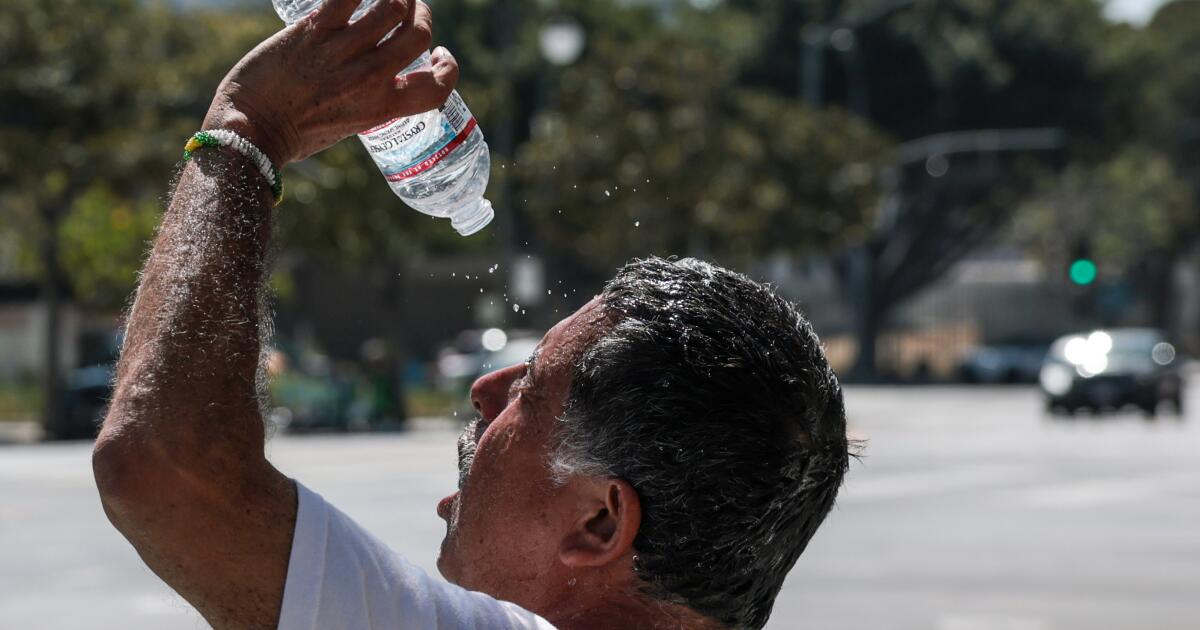
Much of the U.S. just sweltered through intense heat waves, putting strain on power grids and prompting the cancellation of many events. In Europe, punishing temperatures pushed thermometers as high as 111 degrees Fahrenheit in France, as wildfire tears through swaths of the country.
A troubling pattern has emerged in this summer’s heat: Not only has it broken records, it’s done so often by margins far above the previous all-time highs.
These heat jumps are part of a larger shift. Sea levels are rising and polar ice is melting faster than before, while new records for daily rainfall are being set at a rapid clip. The pace of global warming itself has quickened in recent years.
Although scientists have long braced for climate change, the growing severity of its impacts is shocking them.
Today’s climate can “seem like an unexpected step change” from that of a few years ago, said atmospheric scientist Katharine Hayhoe of Texas Tech University.
Climate models from decades ago have proved prescient, closely aligning with what the mercury later showed: heat increasing around the planet, caused primarily by humans burning fossil fuels.
A man and a girl cool off in a fountain in a park during a heat wave in Madrid in August 2021.
(Andrea Comas / Associated Press)
As the global average temperature rises gradually, changes on the ground can be abrupt and dramatic, hurting people and damaging property. Especially during El Niño weather phases, one of which began in June and is set to bring months of misbehaving weather.
El Niños exacerbate the heating brought about by greenhouse gas pollution and can cause billions of dollars in direct economic damage, from flooding, crop losses, wildfires and civil unrest. The indirect costs reach trillions in lost gross domestic product.
Some models suggest this El Niño could push warming briefly as high as 2 degrees Celsius. The world is currently at 1.4 degrees Celsius above pre-industrial levels.
Scientists have long warned that change will not be smooth.
“Far from being self-stabilizing, the Earth’s climate system is an ornery beast which overreacts even to small nudges,” wrote the late Wallace Broecker in 1995, two decades after he coined the term “global warming.”
One of the most dramatic spikes came in September 2023. The monthly average temperature worldwide overshot the previous September record by 0.5 degrees Celsius — the biggest such margin ever and extreme, even for an El Niño year.
Satellites can see heat building up. They take a very direct and useful measurement of global warming: How much sunlight is entering the atmosphere, and how much heat is radiating out to space? The deficit between those two things is a measure of the warming, and it has doubled in recent years. “An anomaly which has clearly caught us off guard,” wrote the authors of a May 2025 estimate of the Earth’s energy imbalance.
The extra energy trapped in the system seems to be the result of the planet reflecting less sunlight back to space. That’s partly the result of bright-white ice turning into darker, heat-absorbing sea water. But the bigger concern is that reflective, low-lying clouds may not be going missing.
The energy imbalance “suggests that the models may also be under-predicting future warming,” said Phil Duffy, chief scientist of Spark Climate Solutions, a nonprofit that identifies and helps limit climate risks. “We don’t know that to be true, but we need to get to the bottom of what’s going on.”
A sure sign of unprecedented weather is that people get creative when they’re dealing with it or describing it.
Pavements and building surfaces in Paris became so blistering in late June that locals reported cooking crêpes canicules (“heat-wave crepes”) on their window ledges. Arctic wildfires that churn all winter long and reignite in the spring have been christened “zombie fires.” September 2023’s heat was dubbed “absolutely gobsmackingly bananas” by Berkeley Earth’s Zeke Hausfather.
“We could call them super-extremes or mega-extremes,” said Tim Lenton, chair in climate change and Earth system science at the University of Exeter in Britain. “We’re starting to see extremes on a spatial scale and a magnitude that’s really surprising.”
There were four times as many heat records set from 2016 to 2024 as there would have been without climate change. Unprecedented rainfall occurs 40% more often than it otherwise might, and record dryness, 10% more. Meanwhile, record cold is on an extinction pathway, according to a 2025 review of extreme weather.
“Extreme events are so far outside anything we have expected,” said Friederike Otto, an Imperial College London climate scientist and co-founder of World Weather Attribution.
.
A recent paper shows that even at 2 degrees Celsius of warming — less than the world is on track for by 2100 — some areas can experience extremes of heat, rain, drought and wildfire that are worse than average impacts that were expected at 3 or 4 degrees Celsius.
“That warmer world, where it’s all risk all the time, that transition to that world — that’s what we’re in right now,” said Justin Mankin, a climate scientist at Dartmouth College who didn’t work on the paper.
The potential future of harbors in New York, London and Shanghai is locked away, at least temporarily, in Greenland and Antarctic ice sheets and mountaintop glaciers. As they melt, the water joins the global ocean that’s lapping up to ports and coasts worldwide.
Difficulty modeling how ice sheets melt meant years of scientists underestimating sea level rise. Today, projections are rising because ice sheet dynamics are better understood — and because they’re melting faster.
Water takes up more volume as it warms. This “thermal expansion” is one of the main contributors to higher seas. The world’s average sea level has risen more than 8 inches since 1880 and could rise up to 6.5 feet by the end of the century.
Another major contributor is ice melting and flowing to the ocean. Melted ice makes up more than half of the higher sea level. The rate of melting has more than doubled from the period 1976-1995 to 2006-2025, according to an annual report on climate indicators.
Greenhouse gas emissions are “the main driver,” stated the most recent IPCC science report. The future rate of emissions will determine the amount of melt and sea level rise for millennia.
Greenland has steadily lost ice at the rate of 264 gigatons every year since 2002, with mountain glaciers in ranges such as the Himalayas and the Andes losing slightly more.

Large icebergs float away as the sun rises near Kulusuk, Greenland, on Aug. 16, 2019.
(Felipe Dana / Associated Press)
West Antarctica loses ice as warming water melts glaciers at the ocean floor. Other parts of the continent, mostly the northeastern coast, still gain ice from snow but not enough to compensate for the shrinking ice sheets. The place that may draw the most concern is the Thwaites Glacier. Rolling Stone magazine in 2017 dubbed it the “Doomsday glacier” for its potential contribution to sea level rise, both directly and because it’s an ice cork holding back inland ice sheets.
The Thwaites already contributes 4% of sea level rise and is melting five times faster than it was in the 1990s. It would take a few centuries for all of it to melt, but that alone could add several centimeters to seas by 2100.
One of the planet’s major ocean currents, the Atlantic Meridional Overturning Circulation, conveys warm, salty surface water northward, where it cools, sinks in northern seas bounded by lands from Canada to Norway, and begins the southbound leg of its circuit.
The AMOC not only keeps rising waters in check along the U.S. East Coast. It delivers an enormous amount of heat to the North Atlantic, and consequently to northern Europe, which draws from the AMOC about a third as much heat as it receives from the Sun. The current also helps stabilize precipitation around the world.
All that could be in jeopardy if the slowdown in the AMOC — measured by the UK National Oceanography Centre — were to lead to collapse, a growing concern among some experts.
As recently as 2021, the IPCC expected the conveyor to weaken this century as freshwater accumulates in the North Atlantic amid warmer water, but called a shutdown by 2100 “very unlikely.” Studies since then have largely borne out the conclusions, with one line of research flagging the potential for change much sooner.
There’s no consensus yet on if or when the AMOC might halt, and scientists are investigating whether parts of the system may make it more resilient than some projections suggest.
Stefan Rahmstorf of the Potsdam Institute launched his career in the 1990s researching the North Atlantic currents. In the last five years, he said, his estimate of the chance that the AMOC would weaken dramatically this century rose from 5% to more than 50%.
“In all other areas in society, we have a very different approach to risk,” he said. “If you want to build a bridge or a nuclear power plant, you accept maybe a one-in-10,000 risk of a bad accident happening. Whereas with the AMOC, I’ve for decades warned that a 5% risk, as we saw it then, is too high. And now we’re talking more like 50% or more.”
Carbon dioxide emissions have stayed fairly flat since 2013. They’ll need to drop to zero before the CO2 in the atmosphere stabilizes, but if that happens, warming will stop too. Key to driving them down is a global shift to carbon-free energy sources — and in recent years, these have become cost-competitive with fossil fuels. Combined solar and battery systems can now supply electricity more affordably than gas in many places.
Solar is the fastest-growing power source worldwide, making up 75% of new demand growth last year. BloombergNEF expects solar to produce more power than any other source by 2032. Solar and wind power, batteries, electric vehicles and heat pumps are gradually making regions and countries less dependent on oil, gas and coal. Price spikes from the wars in Ukraine and Iran are helping to make the case.
The data suggest a global energy transition with strong momentum, although not without headwinds. A solar supply glut combined with trade barriers means panel production has fallen for the first time in 20 years. The Trump administration has reversed policies that supported renewable power and EV adoption and is cracking down on climate observation and research as well.
Even with more ability to tame warming than ever before, a hotter, more extreme future is guaranteed, and the next phase of climate change is likely to be marked by learning how best to respond.
“That’s the hard part for managing climate change today,” said JPMorgan’s Kapnick. “People are grappling with how to translate the science into usable information for decision-making in their personal life, in their work life, for their community,” she said. “And that is I think where we’ll see the growth of knowledge and capability in the coming years.”
Roston and Warren write for Bloomberg.

