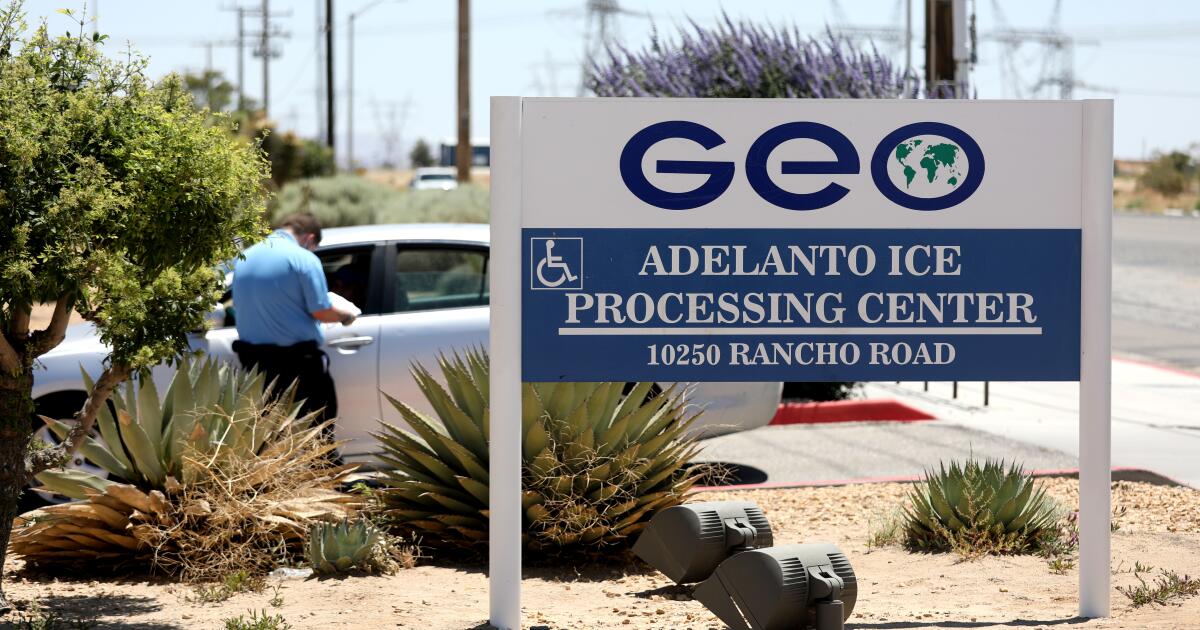
WASHINGTON — Immigration and Customs Enforcement is taking more and more steps to avoid oversight by local and state authorities of immigration detention centers amid growing complaints alleging unsanitary and unsafe conditions at the facilities.
The efforts to sidestep laws in California and elsewhere take many forms. In some instances, contracts have been changed to declare that the centers are simply not subject to certain local or state laws.
In other instances, ICE has purchased facilities owned and operated by private companies. Though the companies continue to run the centers holding thousands of detainees, federal ownership could aid their defense in the event of legal action.
George Zoley, the chief executive of GEO Group, which contracts with ICE to run detention centers in California and across the country, said as much to company shareholders this year. In an earnings call in May, he said that ownership bolsters the facilities’ protection from “unwarranted litigation” around medical care and other detention conditions.
The federal ownership strategy has become particularly crucial, he said, “as some blue states are considering more active involvement in oversight of facilities.”
Local oversight has taken on greater significance since the Trump administration hollowed out federal offices that were charged with investigating civil rights and safety issues at detention centers and began restricting visits by members of Congress. A recent analysis by the Project on Government Oversight found detention center inspections under the second Trump administration have increasingly resulted in “superior” grades.
Eunice Cho, a former American Civil Liberties Union attorney and an expert in immigration detention, called ICE’s efforts a “naked strategy” to evade local scrutiny of detention centers.
“This is a huge sea change in the way that immigration detention is expanding and hardening in the United States,” she said, adding that “this was every advocate’s nightmare scenario.”
In California, state leaders once attempted to shut down privately run detention centers and, after losing, resorted instead to proposing other oversight measures. California is home to eight ICE detention centers with a combined capacity of nearly 9,000 people.
State laws allow monitoring and investigation of the facilities by the California Department of Justice and local health authorities.
A 2021 law allows people to sue for damages when private detention center operators fail to follow the care standards laid out in their contracts. Starting in January, another law will require independent medical investigations into deaths in law enforcement custody, including in immigrant detention facilities.
Several bills are being considered by the California Legislature that would further regulate detention centers. Among them are bills that would authorize the California attorney general to bring civil action and impose fines to protect detainees’ constitutional rights and require the disclosure of public records, such as 911 calls from the facilities.
Recent attempts to limit California’s oversight actions haven’t been successful. CoreCivic turned San Diego health inspectors away from the Otay Mesa Detention Center in February, but after legal action the visit took place in June.
Another oversight battle concerns the rights of detainees who work at a facility, perhaps as a janitor, for $1 per day.
GEO Group recently settled with California regulators after a years-long fight over workplace health and safety violations. The settlement affirmed that immigrants who perform work while detained are considered employees.
Weeks earlier, ICE released new detention standards in June declaring that detainees who participate in the voluntary work program aren’t employees “and are not entitled to wages or benefits under applicable wage laws or labor regulations.”
Because the new standards will take effect as contracts are established or modified, the rules don’t yet apply to existing facilities in California, though they were implemented at a new facility in Minnesota.
An ICE spokesperson did not respond to questions but said the agency consulted with a variety of stakeholders, including facility operators, while revising its standards. The spokesperson, who did not provide their name in an emailed statement, said the agency consistently looks for ways to improve detention facilities to ensure they provide detainees the best care.
“ICE is regularly audited and inspected by external agencies to ensure that all ICE facilities comply with performance-based national detention standards,” the spokesperson wrote, adding that “ICE has higher detention standards than most U.S. prisons that hold actual U.S. citizens.”
An oversight battle involving changes to contracts is also playing out in other states.
For the last three years, GEO Group has blocked Washington health officials from inspecting the Northwest ICE Processing Center near Seattle despite 3,500 complaints from detainees about black mold, unsafe drinking water and substandard medical care.
A previous contract for the facility stated that services must comply with “federal, state and local laws and standards. Should a conflict exist between any of these standards, the most stringent shall apply.”
But in March, ICE and GEO Group established a new contract that says the opposite — that “applicable or more stringent state or local laws or regulations shall not apply.”
A federal district judge, rejecting that contract provision, ruled last month that GEO Group must let health inspectors in, writing that “GEO’s new contract cannot preempt state law, even if it purports to.” That decision is now paused under appeal.
But this week, GEO Group had a court victory in Colorado, where a federal judge prevented the state from enforcing a law that requires unannounced public health inspections of detention facilities and stiff penalties for refusal. Colorado health officials wanted to investigate a tuberculosis case at the Aurora ICE Processing Center near Denver, but have been refused entry and records.
The judge wrote that GEO Group’s contract with ICE “plausibly” requires the company to follow only state laws that existed when the contract was signed. At GEO Group’s suggestion, the judge’s order remains in effect until Oct. 15, when the contract expires.
Meanwhile, ICE appears to be trying a different route to apply the same restrictive contract language to the facilities near Seattle and Denver, among others.
Last month, the agency posted a solicitation with draft contract terms seeking 5,500 detention beds in Colorado, Florida, Pennsylvania and Washington. The locations and requirements match four existing GEO-owned facilities where operating contracts are set to expire in the coming months. During a shareholder call earlier this month, Zoley, the GEO Group CEO, indicated that the four facilities could also be sold off to the federal government while the company would continue to operate them.
The facilities would be governed by the new 2026 detention standards and include terms that mirror those from the Northwest facility’s contract, that stricter state or local laws “shall not apply.”
Zoley said ICE is contemplating buying more than 10 facilities, and that number “could continue to grow.”
GEO Group’s main competitor, CoreCivic, recently sold four detention centers to ICE — two of them in California — for a combined $2.2 billion. Spokesman Ryan Gustin said the facilities were valuated using independent appraisers and federal acquisition standards “to determine objective fair market value.”
ICE paid for them using $45 billion approved by Congress for ICE detention last year, enough for the agency to meet the administration’s goal of 100,000 detention beds. ICE is about 30,000 beds shy of meeting that goal.
Among more than 200 facilities ICE now relies on nationwide (most being local jails) are 36 privately owned detention centers. Those facilities hold the vast majority of detainees.
A Homeland Security spokesperson previously told The Times that it’s crucial for ICE to own detention centers on the West Coast so the agency can maintain the detention capacity it needs.
“Unlike in states like Florida and Oklahoma, ICE can not rely on local state and county partners for detention space in California,” the spokesperson said last month. “The state’s sanctuary politicians continue to push legislation to outlaw or make private prisons financially [unfeasible].”
GEO Group didn’t respond to a request for comment. Gustin, of CoreCivic, said its facilities operate under substantial government oversight, including “on-site government personnel, regular audits and inspections, detention-standard reviews, independent accreditation processes, and routine visits by government officials, attorneys, families and community representatives.”
How much power the federal government would be required to grant states is an open question if more facilities become federally owned, even if private companies continue to run the day-to-day operations.
Claire Trickler-McNulty, a former Homeland Security official who led efforts to reform detention standards, said federal ownership of detention facilities isn’t, on its face, a bad idea. If the goal was to own facilities that would be needed long term, she said, the agency could slowly transition to staffing those facilities with its own employees and cut out the need for private contractors.
Trickler-McNulty said federal ownership of detention centers could make state oversight “slightly more complicated.” But that doesn’t mean the centers can be operated without any review.
“I don’t think it shields the government from liability in total,” she said. “If the government owns a facility whose negligence causes harm or death in the government’s custody, I don’t think you can just buy away liability.”

