For those of us in love with the past, libraries are magnetic. These quiet temples attract grown-ups hungry for books that preserve our childhood worlds. They also draw kids curious about places lost to time. When 11-year-old Guadalupe Rosales needed somewhere to escape, she hid at the East Los Angeles Library. As the long-haired tomboy wandered the stacks, the library’s spirits recognized that she was an old soul with a taste for nostalgia. Using their invisible arms, they ushered the girl to shelves lined with art, history and photography books, teaching Rosales how to appreciate the eerie, the tragic, the mysterious, the romantic, the ephemeral and the hard-to-find. These ghosts developed her artistic and archival instincts.
The Midcentury Modern library where Rosales first inhaled the aroma of old books has changed. It’s still in East L.A., but its Maya-inspired replacement looks different. It’s also bigger. The Lorena Street Elementary student who once haunted the stacks has also undergone big transformations — the former high school dropout now has an MFA from the School of the Art Institute of Chicago. The 46-year-old builds sculptures, art installations, archives and community. When she throws a party, tastemakers describe it in the pages of Vogue. When she’s one of several artists chosen to take over the Instagram account of the New Yorker, she’s voted best at it. She’s shown her photographs at the Whitney Biennial and at this year’s Venice Biennale. She’s perhaps best-known for her Instagram page @veteranas_and_rucas, a crowd-sourced digital archive where homegirls from California reminisce, share stories and see themselves represented with dignity and pride. As Rosales racks up her accomplishments, the social media genius shares pictures of these milestones on her various Instagram pages. The intimacy with which she curates these digital mementos makes it feel like we’ve gone with her. Rosales knows that the world is watching her and learning. She now does for us what the library’s spirits did for her, teaching anyone who’s interested how to see.
Since 2021, Rosales has been working on a memoir, an assignment that she initially resisted. After talking it through with her family and editor Elizabeth Méndez Berry, she warmed to the idea, realizing that the book didn’t have to just focus on her, that biography could also narrate community. To write, Rosales went off the grid, holing up in a cabin in the woods. Once the words came, they flowed cinematically, telling a coast-to-coast coming-of-age story fit for the big screen. Out this month, “East of the River: A Memoir of Los Angeles Girlhood” is a genre-complicating art object that nearly throbbed in my hands. Its bare bones prose and electrifying pictures preserve, honor and celebrate the people, places and ideas responsible for Rosales’ sentimental education. Part photo album, part teen bedroom, part house party, part altar and part art gallery, “East of the River” never sacrifices style to content.

“East of the River: A Memoir of Los Angeles Girlhood” by Guadalupe Rosales.
(Guadalupe Rosales; One World)

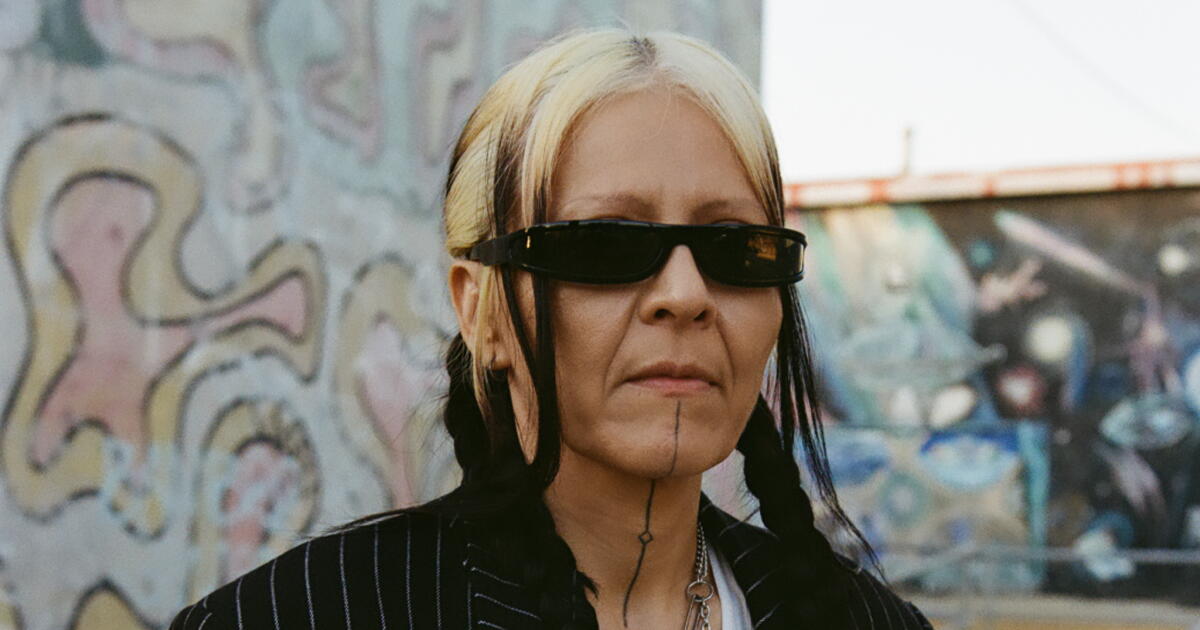
Guadalupe Rosales wears Max Mara suit, Rick Owens sunglasses, Margiela shoes and Vitaly jewelry.
The book’s storytelling starts with the picture on its cover. Taken at a gangster party in City Terrace in 1996, the author and her big sister Maria stare stone-faced, as if daring us to read. Standing close enough to touch, their pose radiates loyalty. Born 10 months apart, these Irish twins are the yin to the other’s yang. Maria wears a lavender bra, striped purple shorts and an amethyst beaded belt. Rosales dons a dark blue nylon windbreaker. A long tendril of brown hair curls down the side of her powdered face. The first few pages of “East of the River” pulse with fuchsia. I know this hue. I’ve admired it on a Lisa Frank binder, a Betsey Johnson shoe, swap meet acrylics, and a Savage X Fenty thong. This is a loud girl shade, a wild girl color. A cheeky but heartfelt epigram sets the book’s tone: “Yo no pedí ser Mexicana, solo tuve suerte.” (I didn’t ask to be Mexican. I just got lucky.) Fans of Rosales’ art and archival Instagram accounts will be pleased to find that her rasquache sensibility is present from glossy cover to glossy cover. While her work has caught the eye of celebrities like actors Jessica Alba and Christina Ricci, Rosales remains consistent in her vision, aesthetic and commitment to brown collectivity and liberation. She enjoys recognition but doesn’t pander to the Hollywood gaze.
Rosales is a bold writer and a shy person. Interviews are challenging for her. When I spoke to her through Zoom, she was backlit by a shade-drawn window, her face weaving in and out of California shadow, a bandanna covering her dark hair. The glow of her computer occasionally caught her sharp cheekbones and bounced off her chin, highlighting the thin tattooed line that bisects it. It sometimes seems that she’s a screen-generated hallucination, someone living inside of a machine that hums inside of another machine.
“I was an awkward teenage girl,” she confesses. “I was performing femininity, but these days, I don’t feel like I’m channeling someone or something. I just feel like I’m more myself.”
Rosales is as comfortable in Ben Davis as she is in Commes des Garçons, and she wistfully remembers the first time that she made enough money to buy a pair of Doc Martens. Once she worked her way up to owning three pairs, she felt rich. Rosales’ mom, Alicia, was able to provide her kids with the basics, but if they wanted more, they had to work for it. The sisters got creative and rummaged in thrift shops, looking for discarded treasure. Maria says, “We depended on secondhand stores. Our mom wouldn’t buy us all kinds of things. She couldn’t do that.” One luxury that the girls shared was a camera, and they were snapping selfies before the word was even coined.
“We have so many photos,” says Maria. “My sister and I are private but we have all these images that are out for people to see. These are not just for us. We’re showing the good and the bad. We share photos of the moment. They don’t have to be perfect.” Many pictures that the sisters took appear on @veteranas_and_rucas, which now has over 250,000 followers. “East of the River” traces the page’s origins, collaging screenshots of the young account when it had just 61 posts and 900 followers. Its original tagline was “A Herstoric Homegirl imagery. Dedicated to all the old school cholas, rucas & veteranas from CALI. Dip into our world. Follow N share!” When I first came across @veteranas_and_rucas, my jaw dropped. I’d never seen a page that featured girls and women so familiar to me, people like my prima hermana Desiree, a veterana who got jumped into a gang on the patio of a first-story apartment just off Whittier Boulevard and McBride Avenue. The page’s focus on oft-overlooked geography also hooked me. It takes us to places like Estrada Courts, the public housing project in Boyle Heights where my dad first lived when he came to L.A. from Mexico.
Famed for its Chicano murals, Estrada Courts is one of Rosales’ muses; her photos of it appear in “East of the River.” These housing projects are also one of the locations where Rosales posed with her family for the photos accompanying this profile. Maria worried that the weather wouldn’t cooperate with the shoot. Not only did it, the sky also radiated some of Maria’s favorite colors, fall hues, a palate of gold and pale orange. About Estrada Courts, she says, “Our mom had friends there, and she would go comadreando. We would hang out with the lady’s daughters. It was like our go-to place.” Such moments of everyday intimacy, sisterhood and friendship are absent from mainstream representations of East L.A., public housing projects and brown neighborhoods. While stereotypes focus on tragedy and horror, Rosales reorients our gaze, revealing moments of tenderness and boredom, rest and joy. Brown kids know how to cartwheel too.

Guadalupe Rosales with her sister Maria Rosales and cousin Danny Mejia in front of Estrada Courts, the public housing project in Boyle Heights. Maria Rosales, left, wears Calvin Klein suit, Jeffrey Campbell heels and Alexis Bittar and Vitaly jewelry. Guadalupe Rosales, center, wears Max Mara suit, Rick Owens sunglasses, Margiela shoes and Vitaly jewelry. Mejia, right, wears Calvin Klein suit, Nike shoes and his own jewelry.

Rosales’ curation of @veteranas_and_rucas is part of its allure. Followers trust her to steward beloved images, and when I got up the courage to submit a picture, I sent a black-and-white studio portrait of my green-eyed grandmother Esperanza, a Mexican immigrant from Guadalajara, Jalisco. When my grandma was posted to the page, I felt proud. Rosales adores our pictures as much as we do, if not more, and “East of the River” confirms her boundless affection for the women whose likenesses and cultural contributions she’s devoted to preserving. In the book, she writes that creating the visual archive “was like putting together a love song and a rap verse — intimate, raw and honest — showing the beauty and complexity of lives that had always been flattened or erased.” Rosales knows that she’s created an unusual digital space, one where women and girls are celebrated without being hypersexualized. “East of the River” asserts her love of women, starting with her mom, an immigrant born in Uruapan, Michoacán. Rosales writes, “She is the most beautiful woman I know. She is the constant in our lives. Men are not.” Rosales understands a gendered reality that our current society sweats to suppress. When I ask her what she admires about female resilience, Rosales says, “A man could never do the work that women do.”
During the first year of @veteranas_and_rucas, she took an incognito approach to running the account. Rosales absented herself from the archive, letting the images do the talking. DMs soon began to flood her, with people demanding, “Are you a man or a woman? Who’s behind this account?” She partly attributes this confusion to her writing style. “The page wasn’t about fetishizing women,” says Rosales, “and the audience was a little thrown by that.” Curating with reverence and love, Rosales uses her voice to establish a baseline of respect that many historians fail to achieve. Preservationists everywhere should follow her lead.
Rosales cites Jamaican American writer and former Pomona College professor Claudia Rankine as a strong influence on her storytelling style. One of Rosales’ favorite books is Rankine’s “Citizen: An American Lyric,” a meditation on Black life and death in the U.S. Just as Rosales circles back to the past and then circles back to it again, she does the same with “Citizen.” While writing “East of the River,” she returned to the book to refresh her inspiration, and its impact is apparent. Both books are living archives that name the dead and artfully discuss systemic injustice. In Rankine’s case, the deceased are victims of anti-Black lynchings. For Rosales, the deceased are victims of gang violence and suicide. Both “Citizen” and “East of the River” assemble postmortem images, with the former featuring a torn hoodie that evokes the fatal shooting of Trayvon Martin and the latter, a copy of a redacted death certificate for Rosales’ cousin Ever.
“East of the River” washes away the stain of criminalization that local media used to cheapen Ever’s life. On Dec. 23, 1996, the Los Angeles Times published a terse and callous article about the young man’s slaying. It excluded the voices of those who knew him best, his family. It privileged a biased voice, that of a police spokesman: “A get together among about 150 gang members in the recreational room of the [Ramona Gardens] housing project came to an abrupt end when someone started flashing gang signs, sparking a knife fight that killed Ever Sanchez, 20.…” Rosales restores Ever’s multi-dimensionality, reminding the world that her cousin loved mathematics and philosophy, that he never missed a day of high school, and that he was a prankster, lover, father and brother. When Rosales writes about cholos, she disrupts caricatures. Her cholos get to be as unpredictable as the rest of us.
“East of the River” shows us what normal and unusual days from Rosales’ girlhood looked and felt like. The sky was often pink. The Schurr High student lazed on porches. Avoided her stepdad. Cruised Whittier Boulevard. Took pictures of the homies with a school camera. Hopped on the party line. Shoplifted Covergirl compacts. Ran from la jura. Ditched school. Watched “Faces of Death.” As an artist, Rosales continues to feed off these memories. When describing a typical art-making day, she says, “It’s all in my head. It drives my girlfriend crazy.” She quietly laughs. Then she explains that her morning started at the gym. Next, she headed to the studio to pick up materials for a project due at the end of the month. The projects that she’s completing are large scale and making them involves a lot of driving. Now housed at an auto shop, the car sculpture that she’s working on used to be at a paint shop in the Inland Empire. The industrial nature of her materials often brings Rosales in contact with men, and the guy who ran the shop in the IE was hard to work with.
“I think it makes him uncomfortable to work with women. That’s the kind of s— I deal with. Sometimes I have to bring a guy with me. It sucks to have to have a chaperone.” Men also stare when Rosales brings her partner to these industrial spaces. They ask questions like, “Are you guys friends? Are you guys family?” While some men’s inability to see a queer relationship right before their eyes irritates Rosales, she uses these opportunities to clown. Her partner plays along with the game. Rosales will tell curious men that she was a preteen mom, joking, “Yeah, I’m her mother. I had her when I was 12.” The men’s eyebrows go up. “Really?” they ask.
Rosales makes art that heavily engages car culture. This same culture also shapes her writing and archival work, including her art books “East of the River,” “Map Pointz: A Collective Memory” and the forthcoming “Tumbados: Lowriding Memories and Cruising Futures.” “Map Pointz” grew out of Rosales’ archival work, beginning as an Instagram page where Rosales crowd-sourced material that documented the 1990s party crew and rave scenes in East L.A. While car imagery doesn’t predominate on @map_pointz, the scenes that Rosales was involved in couldn’t have happened without automobiles. To avoid police raids, kids strategized, coming up with systems that would keep party and rave sites secret until the last minute. The steps that had to be followed to find a party or rave added to the fun, turning these events into adrenaline-pumping scavenger hunts. An info line would tell people to meet at a “map point,” often a gas station parking lot, where a party crew member stood as a lookout, ready to guide the crowd. People also distributed hand-drawn maps for caravans to follow. Rosales and her younger sister Yesi were part of the Aztek Nation party crew. Maria belonged to the all-female party crew East Q-Ts.

Guadalupe Rosales with her cousin Danny Mejia and sister Maria Rosales in front of A&G Custom Motoring, where Rosales is working on her car sculpture. Mejia, left, wears Calvin Klein blazer, Tom Ford boots and his own pants and jewelry. Guadalupe Rosales, center, wears Kiko Kostadinov jacket, shirt and pants, Miista boots, Rick Owens glasses, Vitaly jewelry and stylist’s own vintage gloves. Maria Rosales, right, wears Calvin Klein suit, Jeffrey Campbell heels and Alexis Bittar and Vitaly jewelry.


Guadalupe Rosales poses in front of her car sculpture at A&G Custom Motoring.
Rosales is one of the few artists who gives the culture of California’s all-female party crews the attention that it deserves. This subculture has also been an inspiration for Carribean Fragoza, a writer from South El Monte whose gothic short story collection “Eat the Mouth That Feeds You” includes a tale about an all-female party crew that gathers in a backyard, huddling around a tank of nitrous oxide. @map_pointz offers a cascade of photos of young brown ladies dressed in bodysuits, baggy clothes and studded dog collars, the sort of girls that Fragoza transforms into literary characters both maternal and thrill-seeking. One @map_pointz picture shows two teen members of the party crew Latinas With Pride posing at a car show in La Puente. The page also displays a picture of the Aztek van, a seatless ride whose interior was lined with crushed red velvet. It shuttled the members of Aztek Nation to events, and in the image caption, Rosales waxes poetic that the van was like a member of the crew.
As the ’90s wore on, Rosales drifted away from the party crew scene and picked up the guitar. Along with friends, she started a band, Todos Vuelven. Maria has good memories of those days. “We were going to all these punk shows,” she says. “We were listening to Bikini Kill. Bands played at our house.” Punk brought solace to the sisters but it wasn’t enough to repair what had been shattered by Ever’s slaying. Rosales began to wonder about the world beyond L.A.
Crisp lines appear in Rosales’ art, but the shape of “East of the River” is a lively oval. Every hero’s journey requires major movement, and in 2000, Rosales boarded a plane bound for New York. Maria admires the courage that it took for her sister to go. She says, “It was crazy to me and maybe it wasn’t for a good reason. Maybe it was to get away from everything that was going on. She’s always been very independent.” While in New York, Rosales learned that her dad was sick from liver failure caused by alcoholism. She grieved his death through art, painting a large oil portrait of him wearing a cowboy hat that she leaned against the wall of her Brooklyn loft. Rosales became active in the queer feminist collective LTTR and met her first serious girlfriend. She thought she’d found her people, but when she compared herself to her white peers, she realized that being brown set her apart. The biggest difference that she noticed was educational privilege.
The feeling of being an outsider resulted in a major depressive episode. “I felt like a fly on the wall,” she says. “I was still finding myself.” The tide turned when Rosales was offered a full scholarship to art school. The possibility excited her and she made up her mind to take as many classes as possible. About her MFA program, Rosales says, “It was the only time that I’ve had in my life where I could sit and focus on who I am. At the same time, I was also longing for my home, family and community in L.A. I carried that with me.” In Chicago, ACT UP’s Gregg Bordowitz became her mentor and professor, and for three years, Rosales immersed herself in learning, becoming obsessed with Gertrude Stein and philosophers like Gilles Deleuze. “Reading them helped me understand how memory works,” says Rosales. “How it’s not linear. Memory folds and creases and coils. This is where sculpture comes in. It helps me materialize these ideas and feelings.”
In 2014, Rosales returned to L.A. during a vacation from art school. She arrived a few days before Día de los Muertos, a day of ancestor veneration in Mexican states like Michoacan, Jalisco and Oaxaca. Compelled by spirit, the artist picked up her camera and returned to the setting where Ever’s life was stolen. She says, “The photographs that I took, the nightscapes, were intentional. I don’t treat them as documenting.” In 2022, pictures from this series were exhibited at the Whitney Biennial. Rosales’ original attempts didn’t make it into the show. Instead, she selected images made as she kept returning to the same location over and over. The experience of pilgrimage became a ritual, and there’s a ghostly quality to these pictures. The light is supernaturally diaphanous. Trees bend like witches in mourning. Rosales believes that artists are tapped into spirituality, and whether she’s using a camera, phone or auto parts, she captures energy. “Maybe that’s what people feel when they look at my work,” she says. “When I teach art and photography, it’s not just about learning how to make something. It’s about the energy you put into things.”
In 2016, Maria got married. That same year, Rosales moved back to L.A. and began organizing lowrider picnics at Legg Lake in Whittier Narrows Recreation Area in South El Monte. She frequented Moustache Mondays, a queer-centered nightclub in downtown L.A. that became a haven for brown artists and writers. It was there that the late club promoter Nacho Nava introduced Gabriela Ruiz, an artist known as Leather Papi, to Rosales. “I have someone you have to meet!” Nava said before guiding Ruiz to Rosales. Ruiz felt intimidated at first. “Lupe was sitting in the corner wearing her shades,” she says. “You know how she is.”

“[T]hese days, I don’t feel like I’m channeling someone or something,” says Rosales. “I just feel like I’m more myself.”
Video by Joey Barba and Joey Bueno Breese
The two hit it off, developing a deep bond, and in 2018, Ruiz attended Rosales’ first solo exhibition at the Vincent Price Art Museum, an institution within walking distance of Rosales’ first safe space, the East Los Angeles Library. Those who saw this show haven’t forgotten it. Eight years later, my barber is still talking about it. She remembers the precise placement of objects — a Virgin of Guadalupe candle, a 40-ounce Mickey’s malt liquor, colored bandannas, a prom picture and an open notebook — that were arranged on an altar commemorating the life and death of Ever. The exhibition also spilled outside of the museum. There, gearheads reigned. Rosales invited car clubs, including Nu Minis and local Volksstyle CC, to show off their rides, bringing attention to modified vehicles that aren’t lowriders.
This year, Rosales brought East L.A. car culture to the Venice Biennale. As part of the project “In Minor Keys,” Rosales is exhibiting pieces from her archive. The vibe is Whittier Boulevard a la Italia. A slightly bent black-and-white street sign reads: “NO CRUISING. TWO TIMES PAST THE SAME POINT WITHIN SIX HOURS IS CRUISING.” An L.A. County ordinance number appears in the lower right. Suspended behind it is a portrait of Maria smoking a joint in Venice Beach in 1998. Rosales long dreamed of being invited to the Biennale, and the full circle nature of it, the Venice, California, to Venice, Italy, of it all, is dizzying. “I didn’t know if people like me would show there,” says Rosales. “And then I get an email about doing a studio visit. The same email also said we would like to invite you to the Venice Biennale. That moment showed me how universal we are even though people try to put us in a box.”
Rosales is aware that the world has its eyes on L.A. and that people everywhere are learning the cultural vernacular improvised by Cali’s brown folks. She’s also aware that some people are stealing and appropriating, using a coolness that they didn’t create as a costume of convenience. White people try to pigeonhole creators like Rosales, often complaining that brown artists are too L.A. She argues, “But then you have artists like Ed Ruscha. He’s L.A. So why are his paintings all over the world?” Ruiz agrees that mainstream representations of L.A. remove attention from brown communities. Instead, they shift our gaze west, toward white neighborhoods. Ruiz says, “Lupe’s work shows the diversity of brown cultures. It’s not just about cholos. It’s also about party crews, the rave scene and goths. We’re all those things.”
Still riding high on the whirlwind of the Biennale, Rosales hasn’t slowed down. She’s working on her first car project, a 1991 two-door Honda Accord. The energy of her cousin Ever finds its way into most of her work and the car project honors him too; he also had the same type of vehicle. The painter Mario Ayala, whom she’s known for 11 years, worked from reference photos to airbrush a provocative mural of Rosales and her girlfriend on the hood. Imbued with angelic and demonic imagery, the painting is sexy and queer. One of its brightest colors is fuschia, a hue that Ruiz says Rosales has been obsessed with lately. When I ask Rosales to tell me about her dream car, she laughs. She has many. She wouldn’t mind a 1979 Chevrolet Monte Carlo, Chevrolet Monte Carlo SS, or a Buick Regal Grand National SS. One of these automobiles could come cruising into her life. The artist dreamed her way into the Biennale. This means that the kid from Leonard Avenue could dream her way into anything.


Photography Sandy Kim
Styling Lyn Alyson
Hair Jocelyn Vega
Makeup Jaime Diaz
Videography Joey Barba, Joey Bueno Breese
Production Palma Villalobos
Market Stylist Emily Diddle
Hair Assistant Belen Gomez
Locations A&G Custom Motoring,
Estrada Courts
Image Lettering Keyla Marquez