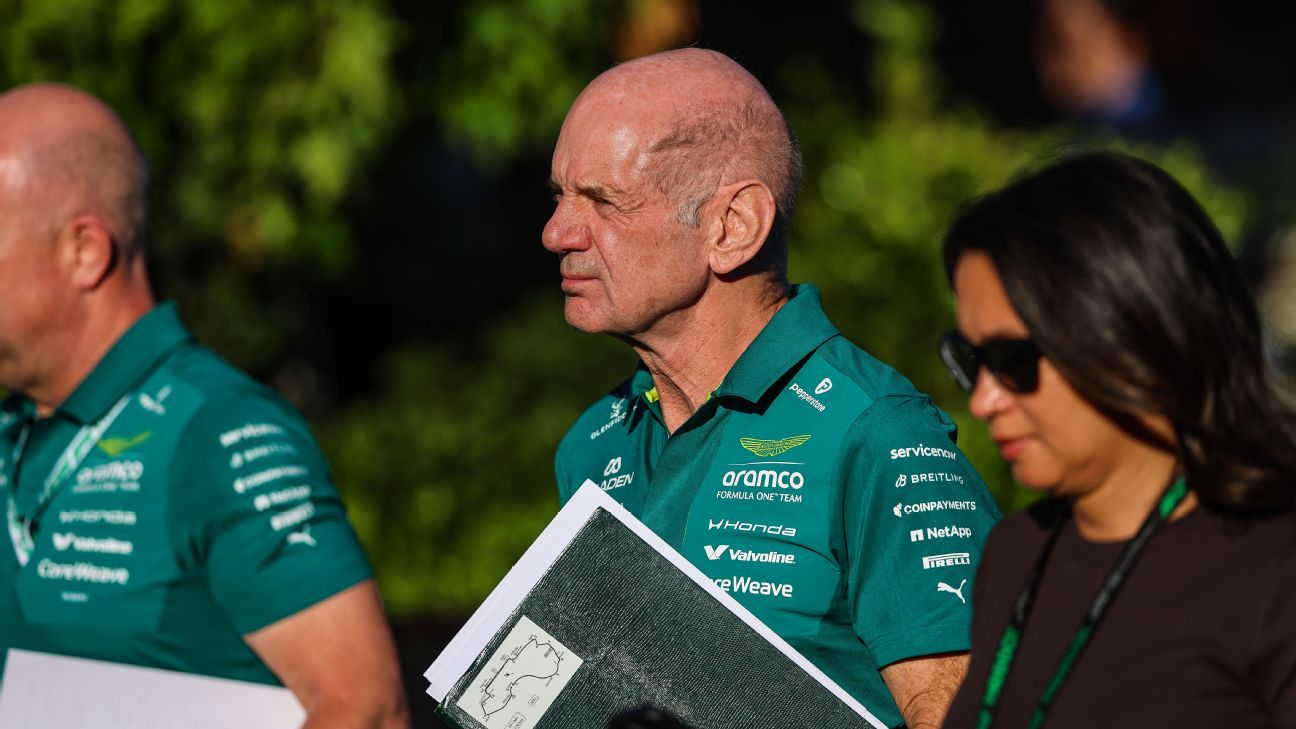
Aston Martin’s partnership with engine supplier Honda is not even a race old and it is already in crisis. After just one day of practice at the first round of the new season in Australia, the team is facing the very real prospect that neither of its cars will take part in Sunday’s 58-lap grand prix.
And if Aston Martin does make it that far, there’s the terrifying prospect that its two drivers, Fernando Alonso and Lance Stroll, will suffer permanent nerve damage as a result of extreme vibrations being transmitted from Honda’s power unit to the chassis. Countermeasures have been put in place to help the car hit the car rack up precious mileage, but any prospect of racing competitively this weekend now seems hopelessly remote.
It raises the question of how Aston Martin, one of the best funded teams on the grid with legendary designer Adrian Newey at its helm, and Honda, among the most successful engine manufacturers of recent years, ended up in this situation.
– Bold predictions for F1 in 2026: Ferrari will end its title drought
– Australian Grand Prix 2026: Race start time, how to watch, full schedule
– Does winning first race of F1’s new era guarantee title?
– The craziest F1 start ever? Why Melbourne might see chaos from the off
Why might the cars miss the race?
As of Friday, the team was down to its last two working batteries for Honda’s hybrid power unit, and it currently has no spares. It means that one more battery failure in final practice, qualifying or the race would result in that car being unable to take part in the remainder of the Australian Grand Prix weekend. Team boss Newey has also ruled out hope of fresh supplies arriving from Honda’s factory in Japan because, right now, there aren’t any spare batteries in existence.
Despite having a vice-like hold over Aston Martin’s race weekend, the battery itself is not the biggest problem. Instead, it is how susceptible it is to the significant vibrations emanating from other parts of the power unit, which have the potential to render it useless.
The vibration and its impact on the battery was evident in preseason testing, significantly restricting the team’s mileage in Barcelona and Bahrain. With no obvious solution to the source of the vibration in sight, full focus shifted to protecting the battery so that the car could at least attempt to complete a race distance in Australia.
Honda engineered a countermeasure on its dynamometer in Japan, but an attempt to run it in first practice in Australia was scuppered by a separate issue.
“So we’ve had a fresh problem, if you like, [with] communication internally with the battery to its management system,” Newey explained between practice sessions. “But the much more underlying problem is the vibration issues that we continue to struggle with.”
The “fresh” problem meant two further batteries had to be discarded, leaving Aston Martin with just one per car for the remainder of the weekend. Fortunately, second practice proved more productive and Honda was at least able to confirm the countermeasure is working as hoped.
“With Lance and Fernando completing a combined 31 laps, we were able to gather the necessary data to determine that the items we implemented first on the dyno at HRC Sakura are working at the track,” Honda’s chief trackside engineer Shintaro Orihara said.
“As a result, there are less battery vibrations occurring according to our analysis gathered during the session.”
It may seem mind-blowing that an organization of Honda’s strength and size would turn up to Australia with just four batteries — two of which were out of use within the first hour of running. But when you consider F1’s sporting regulations limit each car to two batteries per season for cost saving purposes, it puts into context how serious it is to be chewing through them at such a rate.
Add to that the complexity of the technology and the limitations on spending imposed by the power unit cost cap, and it’s perhaps more understandable why Honda doesn’t have a truckload of spares to call on.
Can the vibration issue be solved?
Despite a huge amount of effort going into protecting the batteries, the vibrations remain the core issue. It’s still not clear exactly what the issue is or how long it will take to solve, but the alarming implications for the drivers were highlighted by Newey during a press conference on Thursday.
“What is important to remember is, effectively, the PU, the combination of the ICE and possibly the MGU as well, is the source of the vibration,” he said. “It’s the amplifier and the chassis is, in that scenario, the receiver.
“A carbon chassis is a naturally stiff structure with very little damping, so the transmission of that vibration into the chassis, we haven’t made any progress on that. So that vibration into the chassis is causing a few reliability problems, mirrors falling off, tail lights falling off, all that sort of thing, which we are having to address.
“But the much more significant problem is that that vibration is transmitted ultimately into the driver’s fingers. So, Fernando is of the feeling that he can’t do more than 25 laps consecutively before he will risk permanent nerve damage to his hands. Lance is of the opinion that he can’t do more than 15 laps before that threshold.”
If the countermeasure to protect the battery works successfully over the course of the Australia weekend, full focus can switch to the source of the vibration. Every lap of on-track running will help provide additional data for engineers to analyse, although on Thursday Honda racing president Koji Watanabe and Newey both ruled out a quick fix.
“I think there’s a very clear action on Honda to try to reduce the vibration which is emanating from the PU,” Newey said. “They are working on that.
“It’s not going to be a quick fix because this involves fundamental balancing and damping projects that they will need to conduct. I can’t comment how quickly they can achieve that, but that has to be the main drive.
“At the moment this vibration issue is sucking all energy in every area. I mean, as I said, emotionally, I mean our mechanics were up until four o’clock this morning. So of course they’re on their knees. The factory has been offering a lot of support, so it’s something we really need to try to get on top of as quickly as possible.”
Although it’s very much of secondary importance to the wellbeing of the drivers and mechanics, the vibration issue is also preventing the team from exploring the car’s performance. Until it can be resolved, there’s no way of knowing what the potential of Newey’s first Aston Martin chassis will be, especially when it’s running in qualifying specification on low fuel.
“I kind of feel a bit powerless because, clearly, we’ve got a very significant PU problem, and our lack of running then also means at the same time we’re not finding out about the car,” he added. “So, our information on the car itself is very limited because we’ve done so little running, and particularly running at low fuel, because fuel acts as a damper to the battery.
“Honda have limited us very much to how much low fuel running we can do and it just becomes a self-feeding problem.
“And of course it’s using a lot of energy, in the human sense as opposed to the kilowatt sense, on our part to try to work with Honda and to produce the best overall solution, because we can turn around and say, ‘Well, it’s not our problem,’ but it is our problem because ultimately the car is the combination of chassis and PU.”
How did Honda end up in this position?
Honda arguably had the best power unit on the grid at the end of the last regulation cycle, and it was put to great use by Red Bull to claim four drivers’ championships and two constructors’ championships between 2021 and 2024. Such a recent run of success makes the current situation even harder to comprehend, especially as Aston Martin paired with Honda precisely because it wanted its own works engine to help it fight for titles.
But the team that designed Honda’s V6 turbo-hybrid under the last set of regulations is not the same as the team working in Honda’s power unit department today. That’s because many of the engineers responsible for the development of Honda’s last power unit left its racing department when the Japanese company decided to pull out of F1 at the end of 2021.
As part of that decision, Honda agreed to continue to supply Red Bull with engines until the end of 2025 but only under an FIA-mandated freeze on development for all manufacturers. With no commitment to F1 beyond 2025, Honda’s power unit team disbanded to work in other parts of the company or, if they so wished, other industries.
It was only towards the end of 2022 that Honda decided to make a U-turn on its exit plan after being convinced to stay in the sport by a combination of F1’s 2026 regulations and its recent title success with Max Verstappen and Red Bull. By that point, the new regulations were already published and the established power unit manufacturers, as well as newcomers Audi and Red Bull, had already started work.
“A bit of history is important there,” Newey said. “Honda pulled out at the end of 2021, they then re-entered the sport, kind of, at the end of 2022, so over roughly a year, a year and a bit, out of competition.
“When they reformed, a lot of the original group had, it now transpires, disbanded and gone to work on solar panels or whatever, and so a lot of the group that reformed are actually fresh to Formula 1. They didn’t bring the experience that they had had previously.
“Plus, when they came back in 2023, that was the first year of the budget cap introduction for engines, so all their rivals had been developing away through ’21, ’22 with continuity, their existing team, and free of budget cap.
“They re-entered with, let’s say, only, I’m guessing, 30% of their original team, and now in a budget cap era, so they started very much on the back foot and unfortunately, they’ve struggled to catch back up.”
An explanation for Honda’s shortcomings, perhaps, but one that was followed by a far more shocking claim. Asked if Aston Martin was aware of the extent of Honda’s brain drain between 2021 and 2023, Newey added: “No, we weren’t.
“We only really became aware of it in November of last year when Lawrence [Stroll, team owner], Andy Cowell [former team principal and now chief strategy officer] and myself went to Tokyo to discuss rumours starting to suggest that their original target power they wouldn’t achieve for race one.
“Out of that came the fact that many of the original workforce had not returned when they restarted. So, no is the answer.”
It’s clear the relationship between Aston Martin and Honda is already under significant strain. Newey has consistently laid the blame at Honda’s door over the first two days in Australia, leaving little doubt over who he holds responsible for the near-daily embarrassments under his watch.
A detailed version of events is unlikely to ever emerge from Honda’s side due to the way the company conducts its business, leaving the Aston Martin perspective as the dominant narrative. Whether that’s entirely accurate may never be known, but one message is clear from both sides: the only way forward is to work together.
“We are closely working together to find what is the root cause, and also we are discussing, and also doing many dyno testing,” Watanabe said on Thursday. “Then we’ll choose some options, what kind of countermeasure is necessary, together with Adrian. So, we always working closely together.”
Newey added: “We are where we are with Honda. Obviously, our focus now is to work with Honda to get to the best possible place. Being realistic, this season is first of all, as I mentioned, getting on top of this vibration problem so we can run reliably, and from there to see how much performance they can add to the combustion engine in particular.
“Then at the same time, of course, Honda needs to start working on the ’27 engine because it’s clear that a very large step in combustion engine power is needed for ’27, and that has to be their sole focus.”