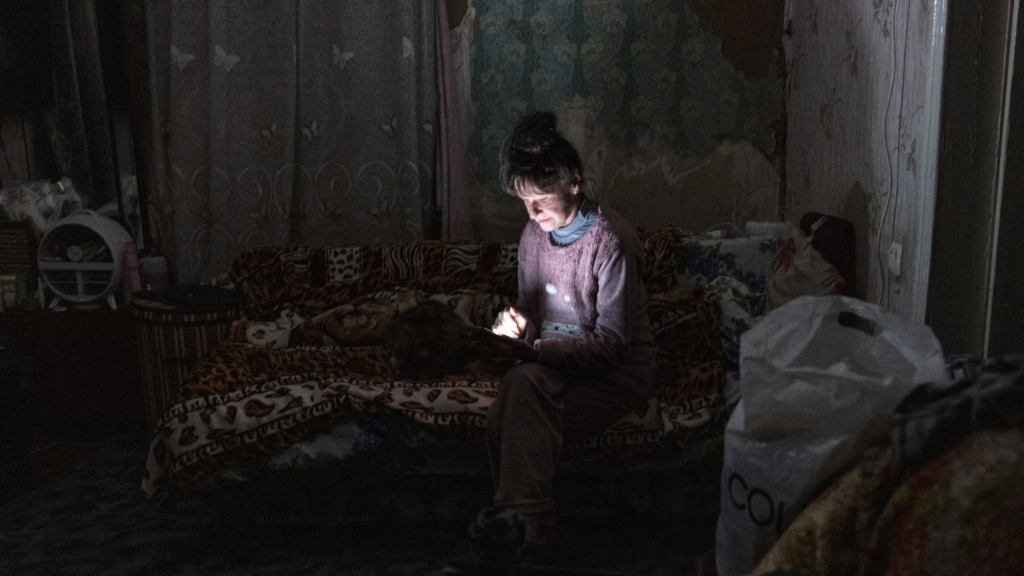
Memorial chairman Yan Rachinsky condemned Russian President Vladimir Putin and the war in Ukraine in his acceptance speech on behalf of the organization Memorial in Oslo, Norway on Saturday.
Rodrigo Freitas/NTB/AFP via Getty Images
hide caption
toggle caption
Rodrigo Freitas/NTB/AFP via Getty Images

Memorial chairman Yan Rachinsky condemned Russian President Vladimir Putin and the war in Ukraine in his acceptance speech on behalf of the organization Memorial in Oslo, Norway on Saturday.
Rodrigo Freitas/NTB/AFP via Getty Images
A Russian Nobel Peace Prize co-laureate denounced President Vladimir Putin and the ongoing war with Ukraine in an acceptance speech on Saturday.
Yan Rachinsky, who accepted the prize on behalf of his organization, Memorial, one of Russia’s oldest civil rights groups, lamented actions that continued to “sow death and destruction on Ukrainian soil,” adding that the war was an “insane and criminal war of aggression against Ukraine.”
With millions displaced and tens of thousands killed since February, there is no indication that the war will end anytime soon. Rachinsky’s speech occurred just days after Putin publicly vowed he would “consistently fight for our interests” in continuing the conflict.

The Russian authorities, which shut down Rachinsky’s organization last year, reportedly warned him not to accept the award, as he confirmed to the BBC. In the interview, Rachinsky said he decided to ignore the advice, despite threats to his safety.
“In today’s Russia, no one’s personal safety can be guaranteed,” Rachinsky told the BBC. “Yes, many have been killed. But we know what impunity of the state leads to. … We need to get out of this pit somehow.”


Rachinsky and the other co-laureates received the prize for “an outstanding effort to document war crimes, human right abuses and the abuse of power,” according to the committee. In his speech, Rachinsky acknowledged the civil rights milestones his organization achieved, while also lamenting that it didn’t stop Russia’s invasion of Ukraine.
“But did our work prevent the catastrophe of 24 February?” he said on Saturday, referring to the date of Russia’s full-scale invasion. “The monstrous burden that fell on our shoulders that day became heavier after we received the news that the prize had been awarded to us.”

Natalia Pinchuk, left, on behalf of her husband, the jailed Belarusian activist Ales Bialiatski; Yan Rachinsky center, on behalf of the group Memorial; and head of the Ukrainian Center for Civil Liberties Oleksandra Matviichuk pose with their Nobel Peace Prizes in Oslo, Norway, on Saturday.
Javad Parsa/NTB/AFP via Getty Images
hide caption
toggle caption
Javad Parsa/NTB/AFP via Getty Images
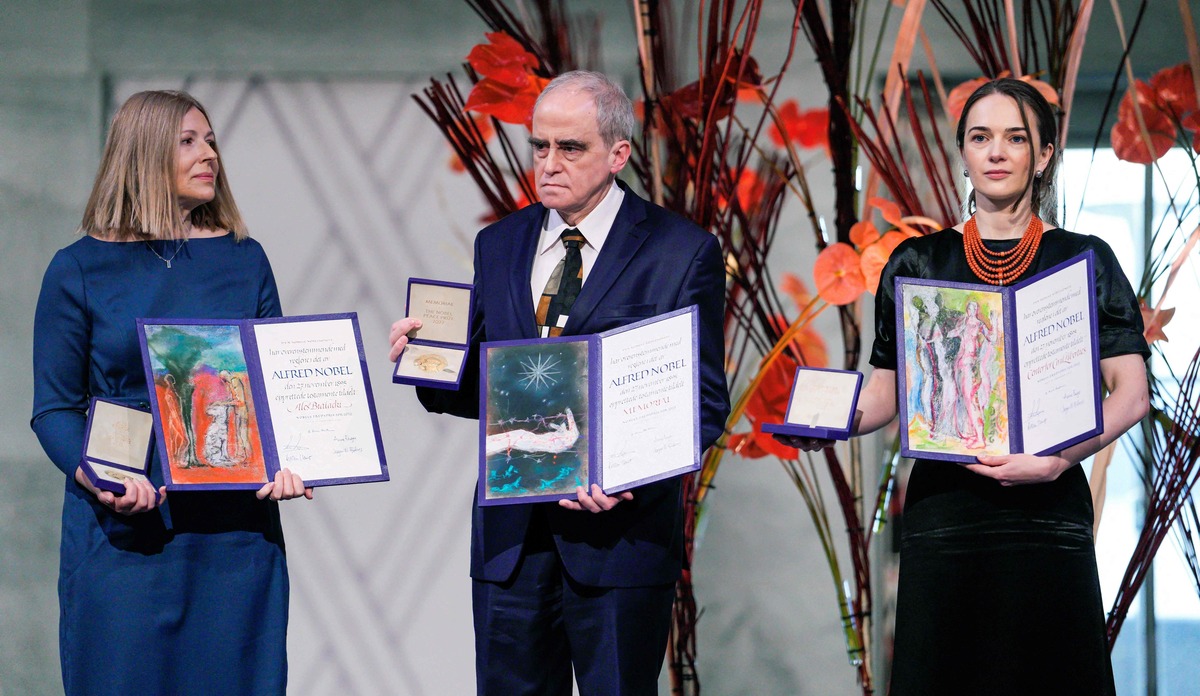
Natalia Pinchuk, left, on behalf of her husband, the jailed Belarusian activist Ales Bialiatski; Yan Rachinsky center, on behalf of the group Memorial; and head of the Ukrainian Center for Civil Liberties Oleksandra Matviichuk pose with their Nobel Peace Prizes in Oslo, Norway, on Saturday.
Javad Parsa/NTB/AFP via Getty Images
Memorial shared this year’s prize with the Center for Civil Liberties in Ukraine and Belarusian advocate Ales Bialiatski. In its press release, the Nobel Committee reflected on its decision to jointly award three recipients from neighboring countries.
“Through their consistent efforts in favour of humanist values, anti-militarism and principles of law, this year’s laureates have revitalised and honoured Alfred Nobel’s vision of peace and fraternity between nations — a vision most needed in the world today,” the committee said.