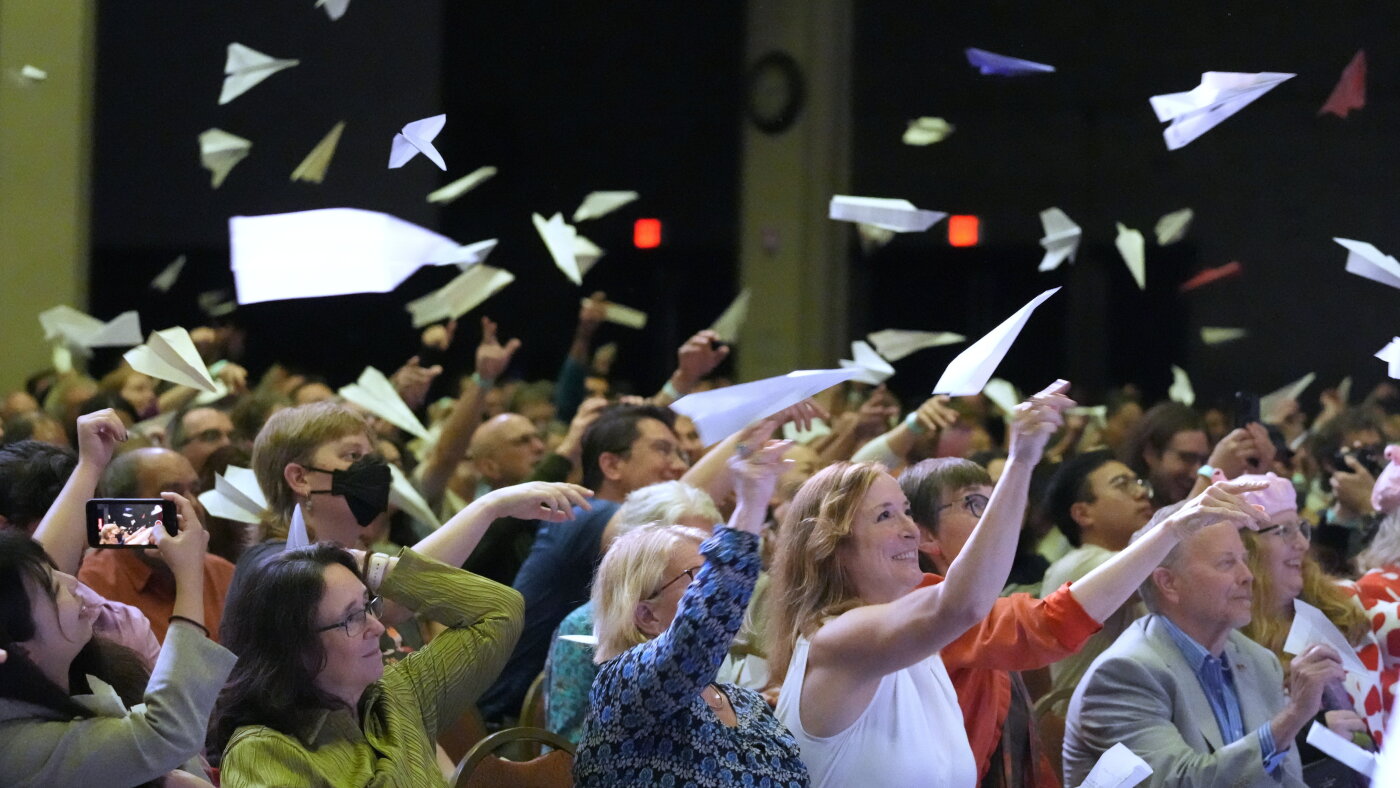
Audience members toss paper airplanes during the 2025 Ig Nobel Prize award ceremony in Boston, Mass.
Robert F. Bukaty/AP
hide caption
toggle caption
Robert F. Bukaty/AP
This year’s Ig Nobel Prizes — which are awarded for humorous, yet thought-provoking research — have been announced, but not on their home turf.
For the first time in the ceremony’s 35-year history, officials are holding the Ig Nobel ceremony outside of the United States — in Zurich, Switzerland.
The reasons, they say, have to do with the increasingly hostile climate in the U.S. toward science and foreigners.

“Before last year, almost every winner would find a way to travel to the ceremony from around the world,” says Marc Abrahams, who founded the Ig Nobels in 1991. “Last year, of the 10 winners, we ended up with only six of them at the ceremony.”
Four did not want to travel to the U.S., citing safety concerns related to unpredictable immigration and visa protocols.

“They’d been seeing news reports of people being possibly sent right home when they arrived here, people being badgered about their personal lives in great detail, of people potentially being grabbed and put in prison or stuck on an airplane and sent to some other country, or who knows what else,” explains Abrahams.

In 2025, the Physics Ig Nobel Prize went to a group of European researchers who studied the behavior of cacio e pepe pasta sauce.
Improbable Research
hide caption
toggle caption
Improbable Research
Abrahams says that, in part, he sees this change as an opportunity.
“When you’ve been doing something for 35 years, what’s the chance you’re ever going to get to start it all over again afresh?” says Abrahams.
Still, he and others involved say it’s bittersweet to host the awards abroad.
“It’s a sad decision to move from where it all started, but it’s also opening new horizons for us and new audiences,” says Kees Moeliker, retired director of the Natural History Museum Rotterdam and a former Ig Nobel winner. “It’s a very positive thing for all our fans we have in Europe.”

“Unfortunately, the decision that they’re making to hold their ceremony outside the U.S. is quite rational,” says Holden Thorp. He’s the editor-in-chief of the Science family of journals and doesn’t play a role in the Ig Nobels.
Thorp says the move reflects a broader trend where international scientists are now less enthusiastic to come to the U.S. for study, work and awards.
“A principle by which the United States built its scientific excellence,” says Thorp, “which is that we welcome the best scientific talent from all over the world — that is no longer the case.”
Urination optimization
After opting to host the Ig Nobel ceremony overseas, Abrahams has remained focused on the unwavering goal of the initiative — “to get people interested in things that otherwise they might never ever let themselves become interested in,” he says.
That includes fluid mechanics. This year’s physics prize was awarded to a research group that built the theory around — and then prototyped — a splash-free urinal.
“I don’t know if you’ve ever been in a urinal and wore sandals, you sometimes feel those droplets,” says Tadd Truscott, a fluid dynamicist at the King Abdullah University of Science and Technology in Saudi Arabia and a member of the winning team. “They could be yours, they might be your neighbor’s. Well, the idea was to stop that completely.”
Truscott helped determine the optimal stream angle to minimize splashback, which is less than 30 degrees. His colleagues then took it a step further.
“They were able to redesign a urinal so that any direction that you urinate into it,” he says, “it maintains this minimum angle so that you always have no splash.”
When Truscott got the news of the Ig Nobel, he was beyond thrilled. “I almost passed out, I was so excited,” he says, laughing. “They didn’t ask me if I was sitting down. And I think that would have been good!”
All winners received a statuette (this year, a slab of blue cheese topped by a foot erupting with toadstools in honor of this year’s broader theme of “fungi”) and 10 trillion Zimbabwean dollars. But that currency cratered years ago, so it isn’t actually worth anything.
A rather long kiss
This year’s economics prize went to a group that found that those in higher social classes were more likely to take from a children’s candy stash.
A late researcher who examined the aerodynamics of nose blowing received the medicine award.
And the biomechanics prize was given to a team for developing a more rigorous definition of kissing — “a non-agonistic interaction involving directed, intraspecific, oral-oral contact with some movement of the lips/mouthparts and no food transfer.”
This definition allowed the researchers to study the long history of kissing behavior in humans and beyond.
“To understand how a trait has evolved, you can’t just look at it in one species,” says Matilda Brindle, an evolutionary biologist at the University of Oxford and part of the winning team. “You’ve got to look across different species.”
She and her colleagues found that kissing occurs in most living large apes and likely, they believe, in Neanderthals. In fact, they argue that early humans and Neanderthals may have even kissed one another. “That’s really exciting,” Brindle says, “cause it just puts such a romantic spin on human-Neanderthal relationships.”
“Next time you kiss someone,” she says, “you can think, ‘This is a 21.5 million-year-old tradition that I’m honoring here. It’s not just a modern human behavior. It’s really ancestral.’ And to us, that suggests that it probably has quite a useful evolutionary function.”
That function may be to facilitate mate choice or exchange beneficial oral microbes.
Despite the change in location, the Ig Nobel laureates were honored as they are every year: They were showered with the traditional volley of paper airplanes — a celebration still filled with splash and affection, if on a new continent.