In a city that was built on oil and remains home to over 2,000 active wells, zoning officials are considering a first: shutting down an oil production site.
Residents of the Jefferson Park neighborhood just south of the 10 Freeway have been fighting for more than decade to close the 32 closely-packed oil and gas wells at the Murphy drill site, run by Bakersfield-based E&B Natural Resources. It has a history of air pollution violations running from before the current operator took over to this year.
The city’s zoning administrator is now weighing whether to revoke the operator’s permit. Momentum has been building toward phasing out oil in Los Angeles for years, but the city has never rescinded a permit before.
The Rev. Eddie Anderson used to live with his wife near the Murphy drill site. His wife suffered two miscarriages, their dog died of cancer and his asthma got worse.
“This is our opportunity. We have a small window,” said the Rev. Eddie Anderson, senior pastor at the McCarty Memorial Christian Church nearby. He has firsthand experience, he says, with the health consequences of living next to an oil production site.
In 2020, he moved to Jefferson Park following the advice of his mentor, civil rights leader the Rev. James Lawson, to live closer to his congregation in the historically Black neighborhood, now majority Black and Latino.
But soon “things started to get weird,” he said. His asthma, which had been mild, became acute. His dog developed cancer. His wife suffered a miscarriage. Then his neighbor, a deacon in his church, told him about a previous roommate who had died of cancer, and how he had recently been diagnosed himself.
After a second miscarriage, the couple started looking into the Murphy drill site, which they knew was two blocks away, and learned about the violations. They learned the oil extraction process often involves chemicals that can harm fertility or fetal health.

Warning signs at the main gate of the Murphy drill site.
“My wife asked, ‘Were we poisoned?’” said Anderson. They left the neighborhood in 2024 for Mid City. “I don’t know, but as I’m talking to others, I’m finding more and more women who are telling the same story … To me, this is not just an environmental justice issue. This is a civil rights issue.”
The Murphy drill site land is owned by the Roman Catholic Archdiocese. The family of prominent railroad and oil tycoon Daniel Murphy donated it after his death and the Church leased it to oil developers beginning in the 1960s.
In its heyday in the 1970s, the site produced about 1,600 barrels of oil per day. As of this summer, that’s down to about 240 barrels per day, according to E&B Natural Resources. At current prices, that’s about $24,000 worth per day. E&B said oil is an important resource for the region.
“It provides local energy for Angelenos, produced under some of the strictest environmental rules in the world, instead of oil shipped in from overseas,” spokesperson Ted Cordova said. The site employs local contractors and businesses and pays royalties to over 3,000 people who own mineral rights, he said.

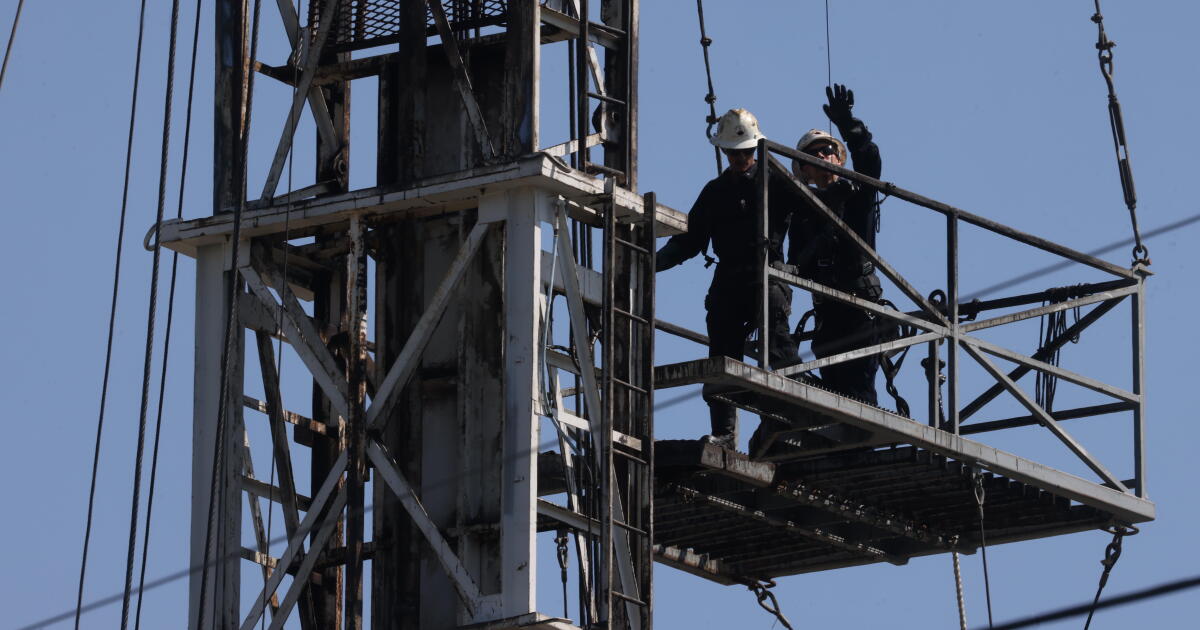
A laborer works at the base of the Murphy drill site, a site with multiple oil wells on West Adams Boulevard in South Los Angeles.
E&B took over the lease from Sentinel Peak Resources in 2019. Since then, Redeemer Community Partnership, a neighborhood nonprofit, has tracked 54 violation notices and 19 other types of notices at the site from the South Coast Air Quality Management District, the state labor board, the state oil regulator, and the Los Angeles Fire Department. These were reviewed by the L.A. Times. Several were referenced in a recent city staff report.
They include gas leaks, spraying substances to cover the smell of fumes and failing to properly maintain idle wells, among others.
In November 2025, regulators issued violations to contractors there for using equipment during a pipeline pressure test that is prohibited within 1,000 feet of a school, of which there are three in the immediate vicinity. In January 2025, they found methane gushing from the valve on a well. The air district said it has visited the site 30 times in 5 years.
Residents say the notices represent just a fraction of what occurs at the site, including noxious odors and noisy truck deliveries when people are trying to sleep. Some they observe by peering over the low wall from the neighboring AIDS Healthcare Foundation clinic. (E&B is almost a year delayed in complying with orders to enclose its operations behind a 30-foot structure.)
Inspectors rarely arrive in time to witness residents’ complaints, so “it’s difficult for them to get a good picture of what’s going on,” said neighbor Silvia Esparza, standing a block from the site while workers inside climbed a tower and the smell of oil wafted through the air.

Silvia Esparza and her daughter, Jordi, 10, right, walk home in the West Adams District in Los Angeles. The Esparza family lives close to the Murphy production site.
Other next-door neighbors include a convent, a multi-building affordable-housing complex and a preschool for children with hearing loss.
The oil company says it’s following the rules, and the air quality notices represent routine oversight and “do not rise to the level of nuisance,” which is the legal name for what the city zoning administrator is investigating.
As part of that process, the city held a four-hour public hearing in July.
Cordova said via email that the hearing was also to determine if the Murphy drill site is jeopardizing public health or safety. “E&B believes the administrative record does not support such findings.”
The company disputes that 27 odor complaints since 2024 and 67 videos of work being done outside permitted hours referenced in a city staff report represent actual violations of the city’s noise, odor and operating hour rules.
Cordova also shared an independent report the company commissioned from consulting firm Roux Associates, which he said “found no evidence in the administrative record … demonstrating that the site adversely affects public health.”
Yet research from University of Southern California in 2021 found neighbors closer to the Murphy wells or directly downwind had significantly lower lung function than those living further away. A 2022 paper also identified higher levels of toxic metals associated with crude oil in the nail clippings of people living near the site.
Jill Johnston, who led both USC studies, said the published data could make a difference for the community.
“We’ve consistently seen that the voices and experience of communities is rarely sufficient to move towards more health protective policies,” Johnston said. “Oftentimes having independent scientific data can help.”

The Murphy drill site is an active urban oil extraction facility on West Adams Boulevard in South Los Angeles.
Los Angeles, like L.A. County, is in its second attempt to ban new drilling and phase out existing wells over the next 20 years after a 2022 vote was struck down by an L.A. County Superior Court judge.
Culver City secured an agreement with the operator of the Inglewood Oil Field to shut down the part that lies within its borders by 2029. Other notable closures include the Allenco multiple well site, near the Murphy drill site, which chose to stop operations in 2013 in the face of local protests and was later forced by the state to fully decommission. The nearby Jefferson drill site, which Redeemer Community Partnership also organized against, elected to shut down in 2018 after the city ordered it to implement stronger health protections.
A handful of other sites have closed under community pressure, tighter regulations or through negotiated agreements. Currently, the city is considering directly revoking only one other oil permit, for the Broadway drill site downtown, where residents have waited nearly 3 years for a decision.
Councilmember Heather Hutt, who represents Jefferson Park, said times have changed as she called for the Murphy drill site’s permit to be revoked. As the city moves to ban wells and new state laws require buffer zones and plugging idle wells, “the relationship between residential communities and oil drilling operators has been reset,” she wrote.
The public comment deadline for individuals closed Sept. 25. Neighborhood councils have until Oct. 5 to comment. E&B has until Oct. 19 to respond, and then the ball is in the city’s court with the decision that could take months.