
A 26-year-old pregnant woman named Talibe Gezginci cleans her tent in a makeshift camp for displaced people in Gaziantep.
Erin O’Brien for NPR
hide caption
toggle caption
Erin O’Brien for NPR

A 26-year-old pregnant woman named Talibe Gezginci cleans her tent in a makeshift camp for displaced people in Gaziantep.
Erin O’Brien for NPR
GAZIANTEP, Turkey — At a camp for displaced people inside the municipal stadium in downtown Gaziantep, in southeast Turkey, families devastated by this week’s magnitude 7.8 earthquake say they are struggling to survive. In a camp set up by Turkey’s disaster relief arm, and in makeshift settlements in the fields around it, survivors of the quake say they do not have enough food, water, heating or basic amenities to keep themselves alive.

“There’s nothing for us here to eat,” says a soldier in his mid-20s named Faris, who fled from the hard-hit city of Antakya. “There’s no gas, no heating system, no electricity. We don’t have money or any of our cards.”
He asks to be identified only by his first name because he is still an active member of the Turkish military and risks punishment if he criticizes the government.
The regions affected by Monday’s earthquake are home to an estimated 13.5 million people, including as many as 2 million refugees, primarily from Syria. The earthquake has killed more than 23,000 in Turkey and Syria, according to The Associated Press, and tens of thousands have been injured.
Tens of thousands of buildings have been destroyed. Many residents of the hardest-hit areas, including Antakya and the satellite villages around Gaziantep, have fled to areas like Gaziantep’s city center that remain comparatively unscathed.
Five days after the earthquake, Turkey’s government under President Recep Tayyip Erdogan has been widely criticized for a scrambled and ineffective response. While an estimated 200,000 people remain trapped under rubble, many of those who have survived are struggling to meet their basic needs.

A mother, Zehra Cati, with her young child at a makeshift camp for people displaced by the earthquake.
Erin O’Brien for NPR
hide caption
toggle caption
Erin O’Brien for NPR

A mother, Zehra Cati, with her young child at a makeshift camp for people displaced by the earthquake.
Erin O’Brien for NPR

A view of the makeshift camp inhabited by Kurdish migrant workers.
Erin O’Brien for NPR
hide caption
toggle caption
Erin O’Brien for NPR
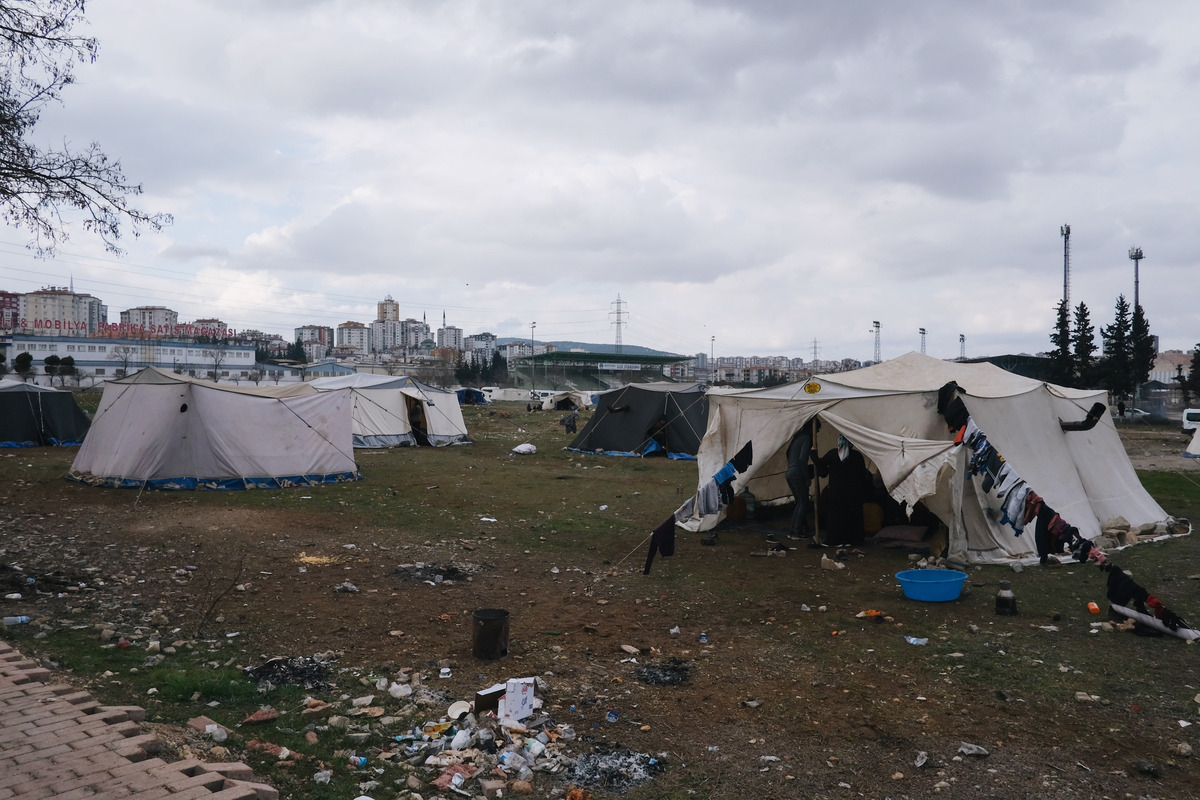
A view of the makeshift camp inhabited by Kurdish migrant workers.
Erin O’Brien for NPR
Many hundreds of people in these camps are from villages surrounding the cities of Gaziantep and Hatay. In villages such as Nurdagi, Islahiye and Pazarcik, small satellite districts, entire streets and neighborhoods have collapsed into rubble.
Late Thursday night in Nurdagi, a rescue worker named Ozgur says his team no longer expects to find anyone alive under the rubble. He works in construction for a large holding company and asks to only be identified by his first name for fear of reprisal for providing assistance without direct government approval.

“There are 30 to 40 people under there,” he says, pointing to a collapsed six-story building in front of him. “But none of them are going to come out alive.”
In the camps, people are facing a different sort of danger.
Crowded into white tents set up by Turkey’s disaster and emergency relief arm, known by the acronym AFAD, families of eight or more are sleeping on foam mattresses on the ground. Wrapped in the clothes they were wearing at the time of the quake, and in donated, colorful blankets, mothers, daughters, brothers and fathers huddle to keep warm.
Faris, who has been in the camp since Wednesday, says he hasn’t eaten since then.
“We wait in line all morning and by lunch there is no food left,” he says.
AFAD has said it has deployed dozens of food trucks and hundreds of thousands of meals, but opposition politicians and members of the public have widely condemned the organization’s response.
Faris says his family can barely even access the bathrooms for the lines, because there are not enough facilities in the municipal stadium for the hundreds of people temporarily staying there.

A 64-year old grandmother and her grandson in her daughter-in-law’s tent at the makeshift migrant camp.
Erin O’Brien for NPR
hide caption
toggle caption
Erin O’Brien for NPR

A 64-year old grandmother and her grandson in her daughter-in-law’s tent at the makeshift migrant camp.
Erin O’Brien for NPR

The entrance to the AFAD camp for displaced people in the center of Gaziantep.
Erin O’Brien for NPR
hide caption
toggle caption
Erin O’Brien for NPR

The entrance to the AFAD camp for displaced people in the center of Gaziantep.
Erin O’Brien for NPR
He and his mother, three sisters, brother and brother-in-law all have deep purple circles under their eyes and are covered in wounds from falling rubble. Their hands are covered in deep gashes from where they dug each other out from their collapsed home, their feet cut from when they finally made it out and had to find their way through the rubble in the cold without shoes.
They stopped counting how many people had died.
They traded off shifts sleeping in a car and on the street in Antakya for three days before driving to the Gaziantep camp, some 100 miles away.
They were told by police in Antakya that they had to evacuate, and that they could find shelter and food in Gaziantep. Now, Faris says he regrets the decision to come.
In Gaziantep, he explains, they have no food, no money, no credit cards, no form of identification and no way of making a plan. He says the day before he walked to the gas station next to the camp with a plastic cup to see if they would give him something to eat or drink. He came back with an empty cup.
“We don’t know why we’re here. We have nothing. We don’t know what we came here for,” he says.
In a makeshift camp set up in a sports field outside the Gaziantep stadium, the situation is also dire.

The AFAD-built camp in the central Gaziantep stadium.
Erin O’Brien for NPR
hide caption
toggle caption
Erin O’Brien for NPR

The AFAD-built camp in the central Gaziantep stadium.
Erin O’Brien for NPR
There, several Kurdish migrant families have set up the tents they usually use during the planting season. Genco Demir, who organized his community’s move to this field, says he and other farmers have been abandoned by the government. In their impoverished neighborhood of Sekiz Subat, less than 2 miles away, they say no one has come to inspect or repair their homes, damaged by the earthquake.
“We don’t have coal, we don’t have food, we don’t have anything,” he says. “We have to feed the children. Help us.”
Hayat Gezer, a 45-year-old woman with a traditional Kurdish tattoo on her chin and a black headscarf, says the group is grappling with the additional stress of legal problems. Many members of their community, she says, have been imprisoned for crimes ranging from theft to aiding and abetting terrorism.
Southeastern Turkey is a heavily Kurdish region, and the Turkish government has been involved in a four-decade-long conflict there with the armed separatist group, the Kurdistan Workers’ Party (PKK). This has led to persecution of many Kurds for alleged links to the group.
Gezer’s daughter was imprisoned in Islahiye, an area heavily damaged in the quake. Gezer doesn’t know if she is alive.
The desperation in this camp is clear. At one point, a young man tries to take bread from his neighbor’s tent; a violent fight ensues. Demir has to hold the young man back.
Hunger and cold have helped make those in the AFAD camp highly critical of the Turkish government. Faris says he voted previously for Erdogan, who is up for reelection this year, but the soldier vows he never will again.
When camp officials try to pull back another older man, the man shouts, “Let them hear what we’re going through.”
“I’m yelling at the president,” he says. “Shame on the president. No one is helping us.”

