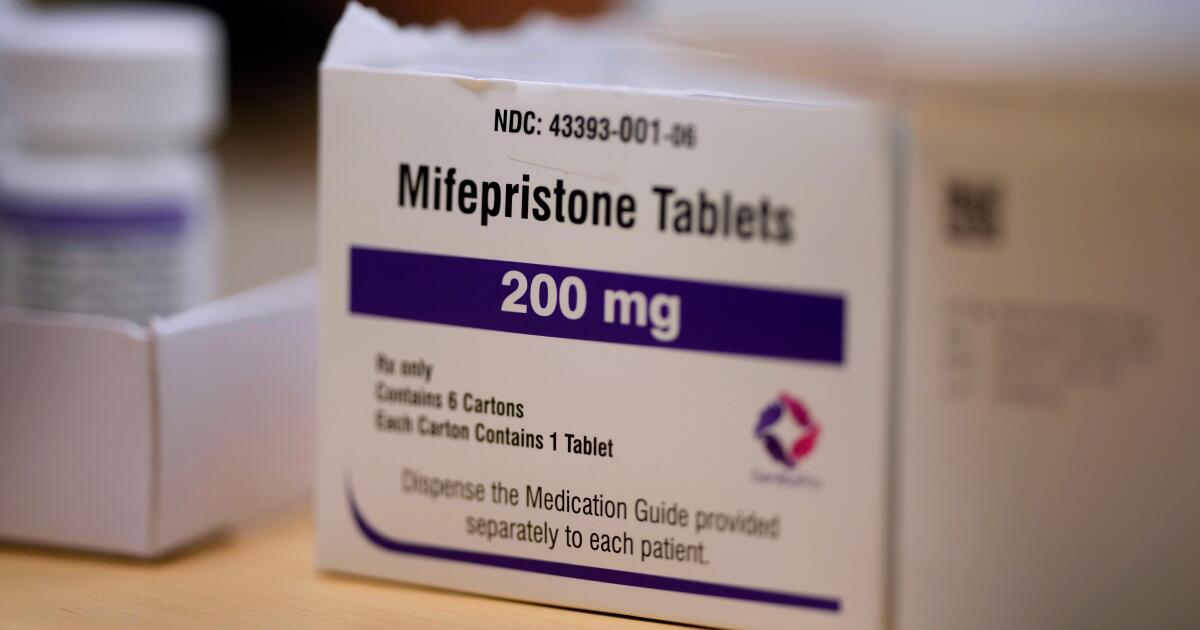
In the biggest jolt to abortion policy in the U.S. since the overturning of Roe vs. Wade, a federal appeals court has restricted access to one of the most common ways to end early pregnancies by blocking the mailing of mifepristone prescriptions.
The unanimous ruling Friday from the New Orleans-based 5th U.S. Circuit Court of Appeals marks a substantial victory for abortion opponents seeking to stem the flow of abortion pills prescribed online that they view as subverting state bans on the procedure.
It will apply in all states, including those without abortion restrictions. In California, where abortion remains legal, residents, especially in the rural northern reaches of the state and the Central Valley, rely on telemedicine to access abortion care.
“California will continue to stand for a woman’s right to choose — and fight like hell against those who seek to reach across our border and tear that fundamental right away,” Gov. Gavin Newsom said in a statement.
The ruling, which drugmakers are expected to appeal to the U.S. Supreme Court, requires that mifepristone be distributed only in person and at clinics, overruling regulations set by the federal Food and Drug Administration.
Friday’s ruling is in effect while the case works its way through the courts, but a mifepristone manufacturer has asked the appellate court to put its ruling on hold until the Supreme Court weighs in.
Nationwide impact
Frustrated with a lack of federal action against medicated abortions, Louisiana Atty. Gen. Liz Murrill sued the FDA last month, saying its regulations undermined the state’s ban on abortions at all stages of pregnancy.
“The regulation creates an effective way for an out-of-state prescriber to place the drug in the hands of Louisianans in defiance of Louisiana law,” Judge Kyle Duncan, who was appointed by President Trump, wrote in the ruling.
FDA officials have said the agency is conducting a new review of mifepristone’s safety, but the appeals court noted that there was no timeline for its completion.
In California, many prefer the convenience of mailed abortion pills, which allow people to circumvent the presence of protesters at clinics and have their procedures at home, said Mary Ziegler, an expert on the law, history and politics of reproductive healthcare at UC Davis. But the ruling will fall heaviest in areas of the state where healthcare access is limited.
“More than 90% of California’s [abortion] clinics are in urban areas, and a lot of the gaps are in rural areas, particularly in Central California and places like Kern County and Stanislaus County,” Ziegler said.
The two majority-Latino counties have some of the highest poverty rates in the state. The three northernmost counties in the state also don’t have a single clinic between them, Ziegler added.
“California is a large state geographically, so not being able to get an abortion in your county is a big deal,” she said.
In 2022, over a third of California’s 58 counties had no abortion clinics, and more have closed in the years since, following federal funding cuts to Planned Parenthood and a growing preference for telehealth that has led to less income for brick-and-mortar clinics.
There is little precedent for a federal court overruling the scientific regulations of the FDA, and it remains to be seen how the decision could affect how the drug is dispensed in the long term.
Murrill, a Republican, celebrated the ruling as a “victory for life,” while other antiabortion advocates cheered the reversal of rules finalized under President Biden that ended a long-standing requirement that the pills be obtained in person at a doctor’s visit.
Representatives for the FDA and the U.S. Department of Justice did not immediately respond to requests for comment.
Long record as safe and effective
Danco Laboratories, a mifepristone manufacturer and defendant in the lawsuit, has asked the appeals court to put its order on hold for one week to give the company time to seek relief from the Supreme Court.
Mifepristone was approved in 2000 as a safe and effective way to end early pregnancies. It is typically used in combination with a second drug, misoprostol, which is not affected by the ruling but is less effective on its own. Ziegler said providers may pivot to mailing out misoprostol alone as an abortion drug if the ruling holds.
Surveys have found that the majority of abortions in the U.S. are administered using pills and that about 1 in 4 abortions nationally are prescribed via telehealth. Providers have suggested that its availability through telehealth is a reason why the number of abortions in the U.S. has not fallen since the Supreme Court overturned Roe in 2022.
Telehealth accounts for 11% of all California abortions, which is lower than the national rate of 27%.
“That’s for a few reasons, but the main one is probably that there are so many clinics in the state, and access is pretty available, especially in urban areas,” said Ushma Upadhyay, a professor and public health scientist at the UC San Francisco.
Abortion pills and those who prescribe them out of state have become key targets of abortion opponents.
Some Democratic-led states have adopted laws that aim to protect providers who prescribe via telehealth and mail the pills to states with bans. Those so-called shield laws are being tested through civil and criminal cases in Louisiana and Texas.
California doctors who send prescriptions out of state have been operating under a shield law, as has Culver City-based Honeybee Health, the leading national distributor of mifepristone.
“California was a huge part of the legal scheme that allowed abortion access to continue in banned states,” Ziegler said. “But that all operated under the assumption that telehealth was an option.”
One telehealth provider in a state with a shield law, Dr. Angel Foster, was working with legal experts to understand how the ruling would affect her organization, the Massachusetts Medication Abortion Project.
“We will do everything in our power to continue providing care to people in all 50 states,” she said.
Ziegler noted that one group most likely to be affected is minors, who often seek telehealth abortions to avoid the involvement of parents and other adults.
Undocumented people may also feel disproportionately affected, because even though clinics don’t usually require information that would expose immigration status, “travel could increase the risk if there’s a [U.S. Immigration and Customs Enforcement] presence in the community,” Ziegler said.
Midterm politics
The case could make abortion a key issue in this fall’s midterm elections as Democrats aim to take back control of the U.S. House and Senate and Republicans fight to hold on to their narrow majorities.
Recent electoral results suggest that voters seeking to maintain abortion access have the political momentum. Since Roe was overturned, abortion has been on the ballot directly in 17 states. Voters have sided with the abortion rights side in 14 of those results.
Abortion rights supporter Fatima Goss Graves, president and chief executive of the National Women’s Law Center, slammed Friday’s ruling as “deeply out of step with both the public and fact-based science.”
Trump received criticism after the ruling from some antiabortion advocates who expressed frustration that he did not take action himself to block distribution of the pill.
The FDA under Trump approved another generic version of mifepristone last year, which peeved some allies of the president.
“It’s shameful that the Trump administration’s inaction has forced pro-life states to take their battle to the federal courts,” said Marjorie Dannenfelser, president of Susan B. Anthony Pro-Life America, who also applauded the ruling.
The Trump administration itself could appeal the ruling, but it’s unclear whether that will happen.
As to what comes next, Ziegler said that “in theory we could see a ruling from the Supreme Court on the emergency docket sooner or we could see the Supreme Court try to kick the can down the road until after the election.”
“The wild card is,” she said, “is this going to be the permanent new normal for Californians, or is this just going to be a temporary thing?”
The Associated Press contributed to this report.