In the first salvo of what could become a prolonged court battle over Colorado River water, the state of Nevada has sued the Trump administration over its plan to impose major water cutbacks on Las Vegas.
The state filed the lawsuit three days after the Trump administration released the plan requiring Nevada, Arizona and California to cut water use by about 20% for the next two years. The plan allows for much larger mandatory cuts over the next decade if necessary to prevent the river’s drought-depleted reservoirs from reaching critically low levels.
“Southern Nevada could lose more than 70 percent of its already meager Colorado River allocation,” while four other states — Colorado, Utah, New Mexico and Wyoming — “are not required to contribute a drop,” Nevada Gov. Joe Lombardo, a Republican, said as he announced the lawsuit Monday.
“This isn’t about political posturing,” Lombardo said. “This is a matter of survival for a community that represents about two-thirds of our state’s citizens and the lion’s share of its economy.”
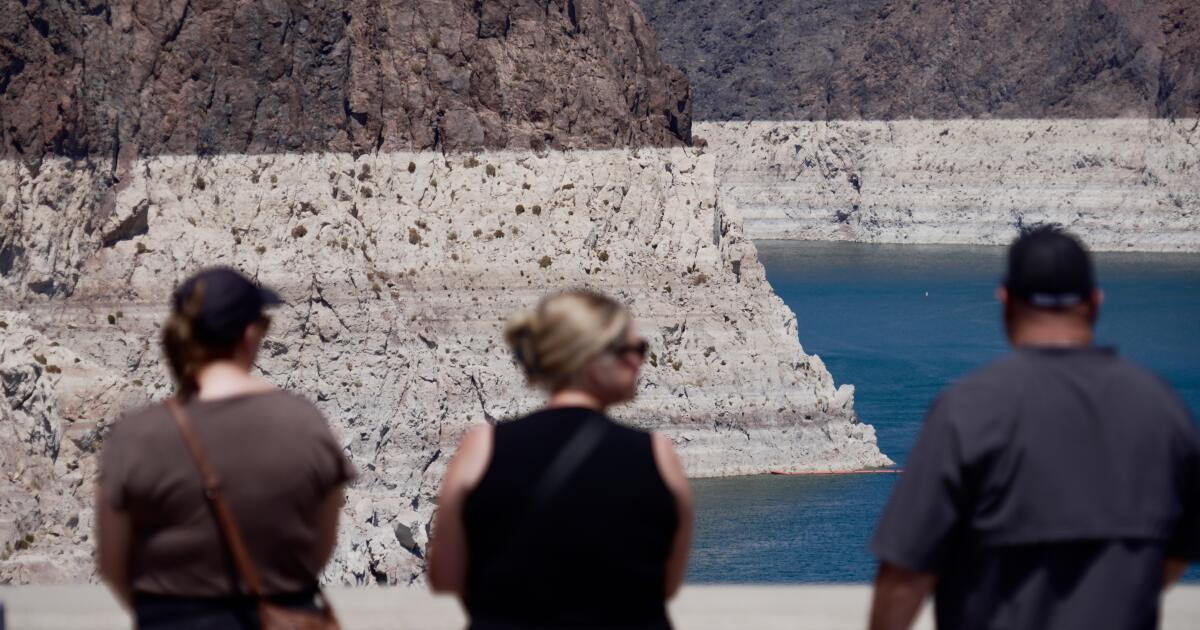
Colorado River reservoirs have dropped dramatically over the last 26 years as global warming has worsened severe drought. The largest, Lake Mead and Lake Powell, have never been lower.
Glen Canyon Dam stands beside Lake Powell near Page, Ariz. Lake Powell, the second largest reservoir in the nation, has reached its lowest water level in history.
(David McNew / Getty Images)
Nevada leaders said that under the plan, the state’s annual allotment of 300,000 acre-feet could be slashed to as little as 86,500, which they said would devastate Las Vegas and surrounding cities.
“That’s simply not a reduction that a major metropolitan area can adjust to,” said John Entsminger, Nevada’s lead negotiator and general manager of the Southern Nevada Water Authority. “It would have catastrophic effects on our ability to provide a safe, reliable water supply.”
The Las Vegas area gets about 90% of its water from the river. It has already reduced its use by about 40% over the last 25 years by eliminating thirsty grass in many areas and outlawing front-yard lawns for new subdivisions.
“We have clearly demonstrated our ability to adapt and do more with less,” Entsminger said. “However, conservation has its limits, and there is just no way to meet even the basic needs of this community with the volume of water Interior has proposed.”

The Colorado River provides water for about 35 million people in cities from Denver to San Diego, as well as 30 Native tribes and 5 million acres of farmland. About three-fourths of the water taken from it flows to farms via canals, producing alfalfa for cattle as well as lettuce, broccoli and other crops.
This year, the Rocky Mountains had the least snow on record, and the lack of snowmelt is sinking reservoir levels lower.

Rancher Bill Fales checks an irrigation line at one of his family’s pastures near Carbondale, Colo., in June. The Colorado River provides water for about 5 million acres of farmland.
(Robert Gauthier / Los Angeles Times)
Over the last three years, negotiators repeatedly held talks to try to reach a seven-state agreement, but the three downstream states, California, Arizona and Nevada, deadlocked with the four upstream states.
As part of its plan, the Trump administration accepted an offer by California, Arizona and Nevada to reduce the water they take by 3.2 million acre-feet between now and the end of 2028.
California will cut its Colorado River water use by about 12%, while Arizona will take about 31% less and Nevada 28% less.
The Trump administration is not requiring water cuts for Colorado, Utah, New Mexico and Wyoming.
Andrea Travnicek, the Interior Department’s assistant secretary for water and science, said that’s because the federal government has different “responsibilities and authorities” in the upstream and downstream states.
In previous agreements, however, all seven states have contributed, Entsminger said, and the federal plan represents a sharp break with that collaborative approach.
“Everybody that uses water from the Colorado River has a stake in using that water more efficiently, so that we can all get by with less,” Entsminger said. “A plan that focuses on a minority of states ultimately has no chance of success.”
Even as the state goes to court, Entsminger stressed that Nevada is open to negotiating.
In the lawsuit, Nevada argues that the Trump administration’s plan violates the National Environmental Policy Act, the Administrative Procedure Act and the “Law of the River,” and asks the court to halt its implementation. It also alleges the Interior Department failed to account for the severe damage drastic water cuts would inflict on southern Nevada’s $180-billion economy.
Arizona’s leaders have raised similar concerns, saying the most draconian cuts under the plan would severely harm their state.
Tom Buschatzke, Arizona’s lead negotiator, said last week that the state is “reserving our right to potentially take legal action.”

Canals from the Central Arizona Project bring water to Phoenix. Much or all of the water Arizona gets via the canal could be cut off under the Trump administration plan.
(Ronaldo Bolaños / Los Angeles Times)
Arizona faces especially large water cutbacks because the Central Arizona Project, the series of canals that run to the Phoenix and Tucson areas, isn’t nearly as old as other aqueducts, giving it low-priority water rights and putting it among the first in line for reductions. Much or all of the water Arizona gets via the canal could be cut off under the Trump administration plan.
Brenda Burman, general manager of the Central Arizona Project, called the federal plan “flawed” and said “every state that relies on the river should be part of the solution.”
Her agency said in a written statement that after 2028, the federal plan would allow for “disproportionate, unlawful, and intolerable cuts on Arizona.”
Nevada’s case is likely to end up before the U.S. Supreme Court, and the state makes strong claims, though the outcome is hard to predict, said Rhett Larson, a water law professor at Arizona State University.
“The litigation over the Colorado River isn’t just about who gets how much water, but about what the U.S. Constitution says about who does or should have the power to make that decision,” Larson said in an email.
The case will probably take years, he said, and if a court blocks the plan, the states could have to figure out what to do in the meantime.
“Litigation is far from an ideal outcome, and carries a lot of costs, risks, and uncertainties that everyone wants to avoid,” Larson said. “But it has its benefits. When parties are not communicating very well … it’s time for litigation.”
The last time the Supreme Court got involved in a major Colorado River dispute was its landmark 1963 decision in Arizona vs. California.
California uses more Colorado River water than any other state. None of California’s water officials have indicated the state is considering suing.

