This story is part of Image’s May Momentum issue, which looks at art as a sport and sport as an art.
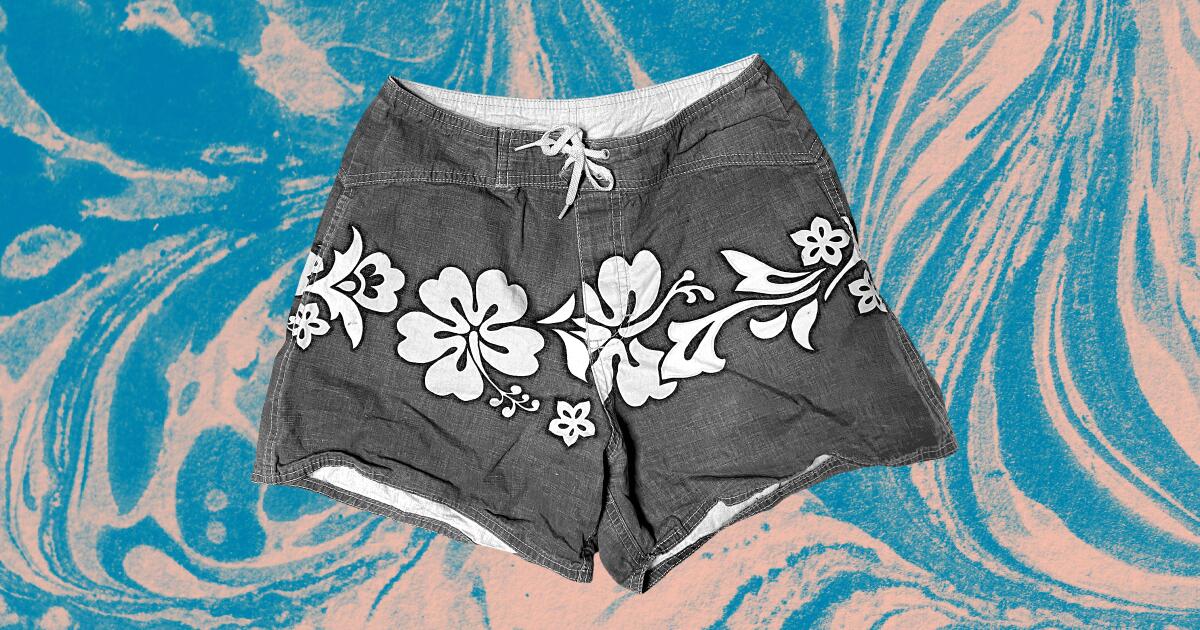
I’m haunted by the perfection of Roxy board shorts from the early aughts. As a teen surfer girl in El Porto, they were my holy grail. In those years, all the cool surf brands made cute surf clothing, but the emphasis was decidedly more on the aesthetic than the function, which was a bummer when it came to, you know, surfing. Roxy board shorts changed that, especially the particular style I’m thinking of: slightly longer to actually prevent thigh chafe from the board, they sat perfectly on my hips and stayed on with their Velcro and lace-up fly. Unlike when I tried to borrow from the boys section, the board shorts weren’t comically long or baggy or cut straight across the waist. These were made for girls who actually surfed. I bought them in every (very cute) color I could find and surfed them until I couldn’t any longer.
Sonia Kasparian, the original designer of Roxy’s board shorts back in the mid-’90s, smiles in our recent conversation when I recount my astonishment at their discovery. She’s grinning because of course they fit — that was the ethos behind her design. “I wanted [the board shorts] to be totally functional, exactly to the same standards that the men’s were, but designed for women. There was a completely different fit for women than men.” And true to Roxy’s style bona fides, the board shorts looked good enough to pair with a T-shirt. “Everything was designed with the idea of being something that women would not only want to wear in the water, but just wear out walking around in everyday life,” Kasparian explains. “But if you were to go out in the water, those shorts would stay put. They would be comfortable — and they would be completely authentically built.” The brand was testing prototypes in the surf, eventually with pros like longtime Roxy team rider Lisa Andersen, but initially with Kasparian and her fellow Roxy and Quiksilver colleagues Lissa Zwahlen, Melissa Martinez and Amy Grace Patrick, among others. They’d paddle out in the board shorts in the morning to try out their designs before heading into the office, their noses dripping saltwater later in the day as they bent over fabric bins and sales reports.

Some of the first pairs of Roxy board shorts from designer Sonia Kasparian’s personal archive.
(Sonia Kasparian)
The functional ethos was always part of Quiksilver too. For the uninitiated, Roxy is the women’s brand of Quiksilver, the legendary Australian company that began in 1969 and made board shorts that performed as well as they looked. Their innovative, stylish design quickly became a nonnegotiable for the best and coolest surfers, and when Angeleno Bob McKnight discovered the board shorts on a surf trip in the early ’70s, he knew they’d become ubiquitous among surfers in California too. But when McKnight brought the brand to the U.S., he was met with skepticism. As McKnight tells it during our conversation at Quiksilver HQ, when he first approached Walter Hoffman, the renowned California maker of Hawaiian print fabric and eventual supplier and mentor, Hoffman exclaimed that board shorts were “the worst idea I’ve ever heard in my life.” The apparel business, according to him, was an impossible one to succeed in. McKnight protested to Hoffman, though: “We’re not in the apparel business. We’re making equipment for surfers.” The distinction paid off with pros and wannabes alike, and by the time Quiksilver launched Roxy with Kasparian in 1990, they were a cultural juggernaut. PacSun, anyone?
When I ask Kasparian about being a part of my personal archives, about being part of the historical surfwear archives, she’s “just so happy.” Despite Roxy’s eventual runaway success — it’s responsible for about 30% of Quiksilver’s sales — it was hard work to convince others in the industry that there was absolutely a need and a desire for fashionable, functional surfwear for girls. “I mean, you would go into the surf shops and you’d see all this men’s product, and you’d see a poster of the Reef girl with her butt in your face, wearing a thong,” Kasparian recounts. It’s not an exaggeration to say that Kasparian and her team made history, not just for teenage me but for countless other girls who wanted to look and feel confident in and out of the surf. “[Roxy board shorts] changed the dynamic of where women fit in the surf industry. They weren’t just the girls that sat on the sideline with the thong and watched their boys out in the water. They were the ones out in the water. And that was huge.”
I haven’t had any luck in finding the grown-up surfer girl version of Roxy board shorts. I still comb thrift racks and bulk bins for something close enough, even trying on the odd pair of early aughts Quiksilver men’s board shorts, as if, just by wanting it enough, I can somehow manifest the completely different fit that Kasparian was so intentional about designing. But board shorts for women these days just don’t hit the same way, especially the longer ones. They read midlife modesty, not stoke; they’re lacking in the joyous, playful audacity that Kasparian and her team infused into their groundbreaking designs. Maybe the board shorts I’m seeing aren’t the vibe because, well, they’re made for women, not girls, and despite my best efforts to never grow up (see: still surfing), I am in fact an adult woman and no longer a girl. And maybe, most of all, when I say I long for those Roxy board shorts from long ago, what I really mean is that I’m nostalgic for a younger version of myself: a surfer girl who was just discovering clothes that made her feel more like herself, with all the evolutions of that person still ahead of her.

