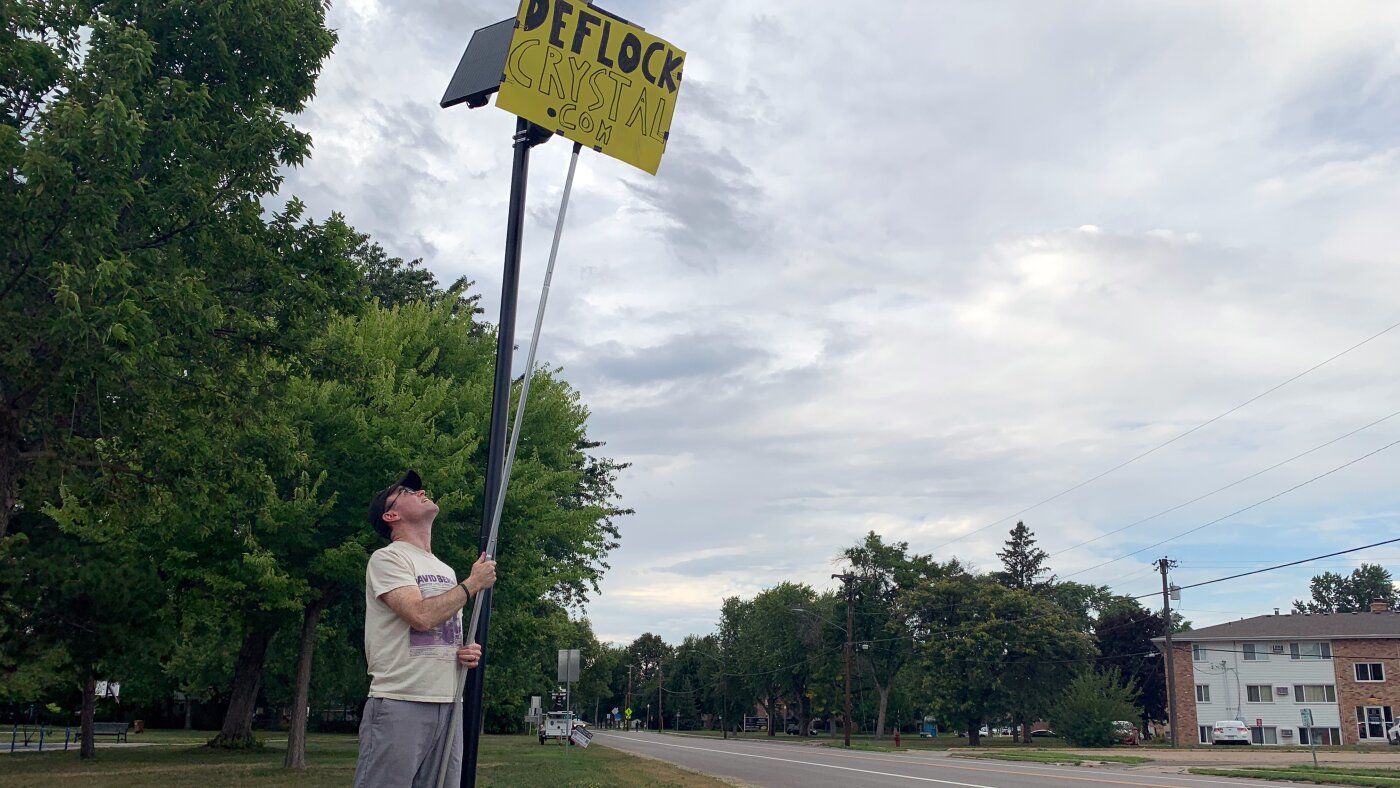
Brady O’Rourke in Crystal, Minn., holds a sign he made to block the view of a Flock camera, which tracks vehicles driving along the road. It’s one of several actions Americans are taking to oppose this police surveillance technology.
Meg Anderson/NPR
hide caption
toggle caption
Meg Anderson/NPR
A few times a week, Brady O’Rourke walks to the busiest street near his house in Crystal, Minn., carrying a long metal pole with a bright yellow sign taped to the end.
It’s a roof rake, normally used to scrape snow off a house, but O’Rourke has different plans for this one. At the intersection, he stops at a Flock camera, an automated license plate reader that police use to track vehicles.
Normally, this camera records everyone who drives down this street. But not right now: O’Rourke lifts his rake into the air and blocks the camera with his sign. He waves at passing cars. Some drivers smile and wave back. A few people honk their horns.
“I don’t want to pay to be surveilled,” O’Rourke says. “My tax dollars are funding cameras at the end of my block. I don’t want to live like that. I don’t think anybody should have to live like that.”
O’Rourke, inspired by a man in Florida who used a pool skimmer to do the same thing, is part of a growing movement against automated license plate readers like Flock.
What Flock cameras do
This week, Flock Safety, the Atlanta-based maker of the cameras, held its annual conference amid intense backlash.
According to the company, more than 5,000 law enforcement agencies use its technology. More broadly, there are more than 130,000 AI-powered automated license plate readers on American streets, according to DeFlock, an advocacy group that tracks the cameras.

A Flock license plate reader is seen along a public road last year in Houston.
David Goldman/AP
hide caption
toggle caption
David Goldman/AP
Every month, those cameras capture billions of license plates and other details about cars, including makes, models, colors and any alterations. That allows police to see where drivers have been over time.
“They monitor, quite simply, when we go to and from work, where we go to the doctor, where we drop our kid off at daycare. What we’ve enabled in practical reality is law enforcement to go back and look at where any of us was at any given point in time,” says Clare Garvie, deputy director of technology law and policy at New York University’s Policing Project.

Police leaders say Flock cameras help them locate stolen vehicles and missing people, and a recent preliminary study suggests that Flock cameras can deter car theft.
“There’s no question that license plate readers can be very helpful tools for law enforcement,” says Jeff Potts, executive director of the Minnesota Chiefs of Police Association.
But the expansion of the technology — combined with advancements in AI and the centralization of data in cloud networks — has increased the risk of abuse, says Jay Stanley, senior policy analyst with the Speech, Privacy and Technology Project at the ACLU.
And the technology has been misused: Some police officers, for instance, have used it to stalk ex-partners, or accessed the data for immigration enforcement purposes without a local government’s consent. A sheriff’s office in Texas used it to track a woman who may have had an abortion.
“The potential for police fishing expeditions is unlimited,” says Stanley. “What a lot of these AI, big data techniques do is they try to boil the ocean, to reduce huge amounts of data down to various people who they think could be involved. The problem with that, of course, is it sweeps up potentially enormous numbers of innocent people.”

And sometimes, the data is wrong: A 2024 analysis by a police department in California found Flock misread license plates in 71% of the alerts it sent to police.
The indiscriminate nature of the data collection, Garvie says, also raises concerns that the cameras violate the Fourth Amendment, which protects people from being searched unreasonably.
“We did not set up a system of governance in this country that says, ‘Just don’t do anything wrong and you won’t have anything to worry about.’ What we said is, ‘No, actually, law enforcement is affirmatively restricted against getting up in our business as we go about our daily lives,'” she says.
Garvie says she wants to see more oversight of the technology from lawmakers.
Last week, Flock changed some of its features to help prevent abuse, including shortening how long it recommends data be stored and cutting off access to officers who appear to be misusing the tool.
“We are so transparent about the business. We don’t own this data. We don’t sell this data. Cities have control over how long it’s stored. And who it’s shared with,” Garrett Langley, the CEO of Flock, told NPR.

Flock camera vandalism across dozens of states
An increasing number of people are combating the technology in both legal and illegal ways. According to an NPR review of local news reports, Flock cameras have been vandalized in at least 36 states.
People have stolen the cameras, sawed them down, crashed into them with cars, covered them in paint and stickers, and shot at them.

Someone vandalized this Flock camera near Washington Avenue and Westcott in Houston.
Raquel Natalicchio/Houston Chronicle via Getty Images
hide caption
toggle caption
Raquel Natalicchio/Houston Chronicle via Getty Images
Social media is filled with tongue-in-cheek how-to videos, instructing viewers on things like how to discreetly saw through a metal pole.
The comments on Facebook posts from local news stations about the vandalism are rife with snark: “Not all heroes wear capes,” one commenter wrote.
“These are people being amped up to go do something. And I don’t think they’re being given the level of information they should that they’re also committing a felony,” Langley says.
Langley says if people have concerns with his company’s technology, they should take it up with their city council.
And many people have. According to DeFlock, at least 100 cities have deactivated the cameras or canceled contracts with Flock or similar companies.
Stanley, of the ACLU, says there’s a deep well of dislike in the U.S. for the notion of being surveilled by the government.
“We’re seeing opposition from the left. We’re seeing opposition from MAGA Republicans. We’re seeing opposition from mainstream Republicans, from centrists. And so it really is a nonpartisan issue,” he says. “This grassroots uprising is just really remarkable. At the end of the day, it’s not like anything I’ve seen in my 20-plus years as a privacy advocate.”
Organizers with DeFlock are holding a National Week of Action through Saturday. They say more than 25,000 people are registered for events around the country — things like protests and education sessions — that offer people a legal way to use their voice.