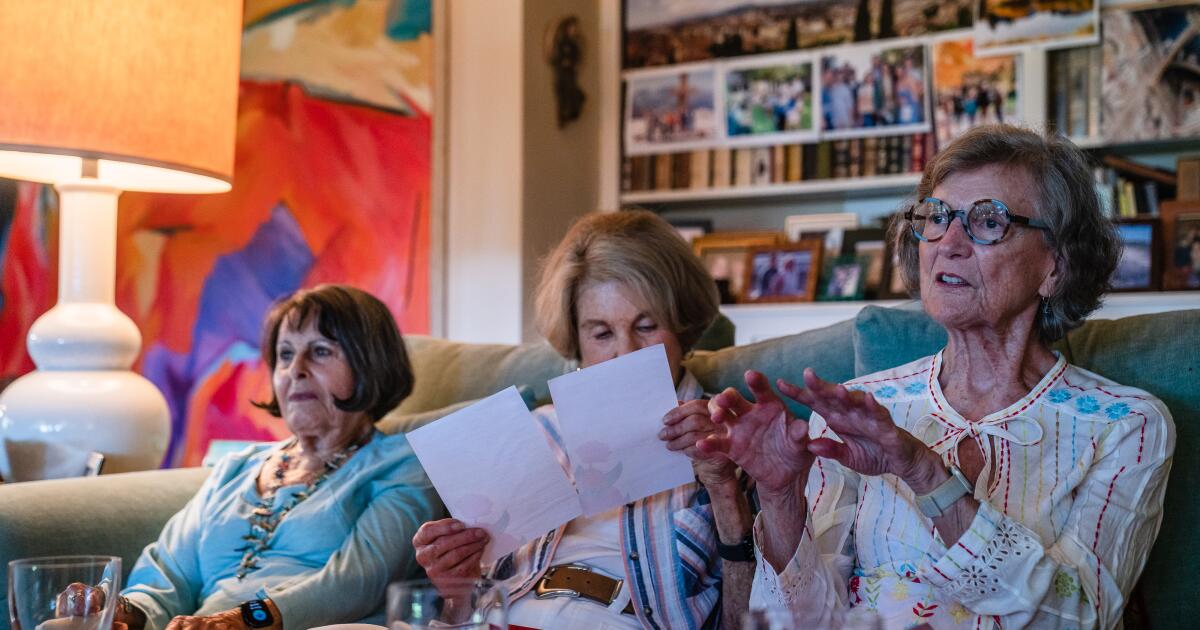
The members of Becky’s Book Club in Pacific Palisades couldn’t stand “Play It as It Lays.” Snakes, freeways, difficult men and Didion’s quiet brutality hang in the air like the oppressive heat of this unusually warm spring day. At their feet, a regal Airedale terrier named Phoebe lounges, looking as though she belongs in an oil painting.
“If I had read this book before coming to Los Angeles, I would have never come,” says Raymee Olin Weiman, one of the members of the book club. She’s a spirited talker who eventually concedes a compliment to Didion. “I did not like it, but I was compelled to read it, because the writing is so brilliant.”
Becky Nedelman, an 85-year-old who organizes the book club, agrees. “To me, Maria is when you drive by an accident, and you don’t want to look, but you do,” she says of Didion’s aimless and troubled protagonist.
Amy Silverberg, the book club facilitator (who is also a Times contributor and friend of this reporter) had warned the group the month prior that they might shudder at the unnerving novel. When she walked in the door, they confirmed Silverberg’s fears, immediately airing their displeasure. “You are to blame,” she tells them with a smile. “I want to reiterate that.”
For all their grievances with Didion’s fiction, the women’s lives bear a striking resemblance to Didion’s own. Some of the women in the book club are older than the late author Joan Didion, who would have been 91. A few of them are in their 90s, save for Gail Heltzer — “the baby of the group,” as she’s called — who is 83.
The book club comprises old friends who have been meeting to discuss literature for over 25 years. Long-standing book clubs in Los Angeles are a rarity — many flame out due to dwindling interest, scheduling conflicts and waning enthusiasm. That hasn’t been the case for Becky’s Book Club, which still sparks lively debate at every meeting.
The gathering, which takes place in the women’s homes, has endured through each phase of their lives — marriages, motherhood, even illness.
Nancy de Brier and Barbara Smith share a laugh during their book club meeting.
(Ariana Drehsler / For The Times)
“The only way we’ve lost members, unfortunately, has been by passing away or moving away,” says Becky Nedelman.
Today, they meet at Emily Lawrence’s home, where she has prepared peanut butter cookies and an elaborate cheese board for the occasion.
With each passing year, the sentimental value only swells.
“The longer it goes on, the more important we become to one another. We’re the age where we occasionally lose friends; we lose husbands — lots of us have. So, this is very important,” says Nancy deBrier, one of the members. The group credits the book club’s enduring success to its organizer, Becky Nedelman.
Nedelman has assembled the book club over the decades, inviting women from different parts of her life, including investment clubs and Planned Parenthood organizing along with high school classmates. In the end, she chose members who were serious about books.

Host Emily Lawrence with her copy of Joan Didion’s “Play It as It Lays.”
(Ariana Drehsler / For The Times)
“We wanted to be with a group of women who were really readers. We didn’t come to talk about recipes or kids and grandkids, but we really wanted to focus on the book,” says Nedelman.
Since June 2001, the group has read 252 books together, maintaining a detailed record of every book. The group mostly reads contemporary literature, but once a year, they tackle a classic — or “a downer,” as they’ve come to call them.
“Apeirogon” by Colum McCann and “The Correspondent” by Virginia Evans stand out to them as particularly engaging. They read “Anna Karenina” and “Crime and Punishment,” an experience they agree was challenging but rewarding. Their commentary is astute and heartfelt, even when it’s critical. “Are any of the classics fun?” asks Harriet Eilber.
What makes a book club run so smoothly for over two decades? Gail Heltzer attributes it to the group’s open-mindedness and inherent chemistry. “Everybody is willing to read a wide variety of books on different subjects. We don’t reject any ideas,” says Heltzer. “Everybody has opinions and is extremely respectful, and everyone leaves smarter.”
The book club has encouraged the women to reconnect with reading later in life. DeBrier, who has a master’s degree and practiced law, explains that reading has been a gift throughout her life. “My reading life post-college was so much more interesting in many ways,” she says. “You’ll find that that’s the good thing about life, right? It’s very enriching to keep reading.”
“Their open-mindedness at their age is really inspiring to me,” says Silverberg. “I hope to have that open-mindedness in my 80s and 90s. What is a better path for open-mindedness than to read?”
To ensure the book club runs efficiently with riveting discussions, the women have enlisted the help of Literary Affairs — an L.A.-based company that offers facilitators at over 50 book clubs in L.A. The facilitators often have exceptional literary resumes; many are novelists and hold PhDs in literature. Silverberg, the facilitator of Becky’s Book Club, is also a novelist and comedian and has worked for Literary Affairs for five years. Last year, her debut novel, “First Time, Long Time,” was released — and the book club attended her book launch at Skylight Books in Los Feliz to offer support.
“Whether they like the book or not, they’re always willing to turn the page,” says Silverberg of the group. She enjoys the hour and a half she spends discussing literature with them. “They make me think about a book differently, and I appreciate that. They let me argue with them. I’m always on the side of the book.”

The book club has been meeting together for over 25 years and has read more than 250 books.
(Ariana Drehsler / For The Times)
During today’s discussion, Silverberg bravely makes a case for “Play It as It Lays.” The women stare back at her with sullen but intrigued faces. Silverberg reads a passage of the novel to the group. Her voice is light but insistent. “She’s so at the mercy of the men in her life,” says Silverberg.
“That was the ‘60s,” retorts Weiman. In spite of their initial resistance, Didion’s writing pulls buried recollections to the surface. At times, the novels stir up memories from the women’s lives, prompting poignant, often vulnerable discussions. DeBrier reflects on her own experience of motherhood in the 1960s. “I was having a baby — I didn’t know what existential meant,” she remarks.
Later, the women share memories on the 1960s sociopolitical issues of birth control, homosexuality and the Vietnam War. They maintain that they had a hopefulness that contrasts with Didion’s protagonist.
“Despite how bad things were in the middle of the war, I did not consider everything bleak,” says Heltzer. “I knew that we were going to keep trying and the people were going to help move the nation.”
The conversation shifts into a broader reflection on womanhood.
“I always had a free mindset about what I wanted to do. Until my 20s, when I got married, I didn’t realize I had choices in my marriage,” reflects Weiman. She feels Didion’s novel urges women to reconnect with themselves, using protagonist Maria as a cautionary tale. “What she did then was a gift to all women — in writing this novel.”
At the end of the book club, the women break into convivial chatter. They hover around the cheeseboard and cookies. Emily Lawrence showcases her collection of first-edition William Carlos Williams poetry. She has a growing collection of books that she would like to donate to the Palisades branch library, which was destroyed in the 2025 fires. With Lawrence’s donations, her aim is for the Palisades to begin to enjoy new stories, new characters and new beginnings in the wake of disaster. Perhaps evoking an oft-quoted Didion quote: “We tell ourselves stories in order to live. We live entirely by the impression of a narrative line upon disparate images, the shifting phantasmagoria, which is our actual experience.”
Connors is a writer living in Los Angeles. She hosts the literary reading event Unreliable Narrators at Nico’s Wines in Atwater Village every month.