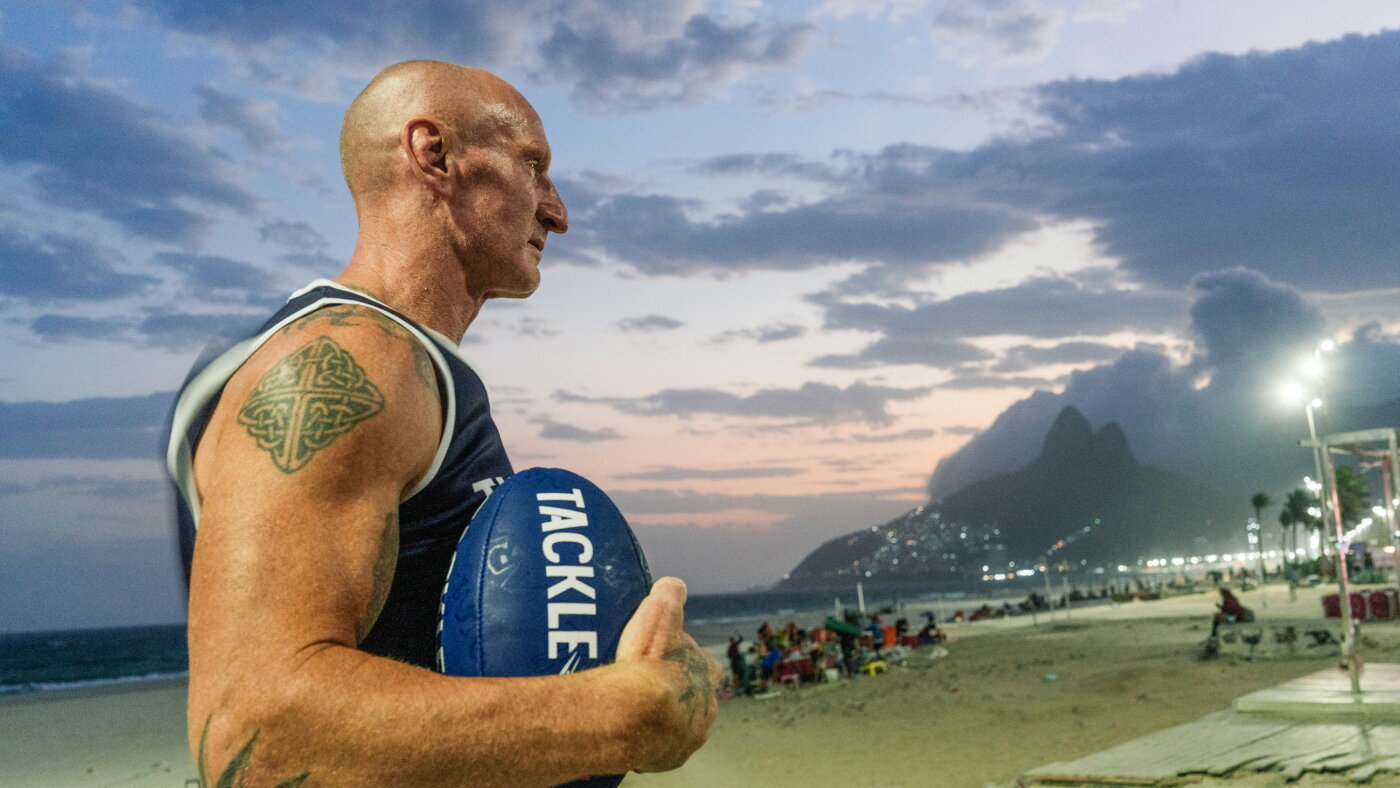
Retired rugby star Gareth Thomas, who is HIV positive, came to Rio de Janeiro’s famed Ipanema Beach to participate in a campaign called “Tackle HIV.”
Ian Cheibub for NPR
hide caption
toggle caption
Ian Cheibub for NPR
RIO DE JANEIRO — “People are still afraid of those three letters,” says Gareth Thomas, a former Welsh rugby star.
He’s talking about HIV. Thomas became a global champion for people living with HIV when he announced that he was HIV positive in 2019.
Since then, he has been a strong advocate for sharing knowledge about the virus –- and what it’s like to live with it.
This summer, he came to Rio de Janeiro to participate in the International AIDS Conference and to spread his message as part of the Tackle HIV campaign.
“I thought I was gonna die”
That message resonates with another advocate: Welton Gabriel, a 36-year-old event organizer from Sao Paolo.
Sitting in a bar overlooking the world-famous Ipanema beach, Welton Gabriel recalled the night 12 years earlier when he learned he had tested positive for HIV.

When Welton Gabriel told close friends that he was HIV positive, many cut contact. “They did not want to talk with me,” recalls Gabriel, who is now an activist combating the stigma of HIV. He was photographed during the AIDS Conference in Rio de Janeiro, Brazil, this summer.
Ian Cheibub for NPR
hide caption
toggle caption
Ian Cheibub for NPR
“I thought I was gonna die,” he remembers.
For a while, his life did hang in the balance. Gabriel had contracted a treatment-resistant strain of HIV — he believes that the sexual partner who infected him had been taking medication but decided to stop, allowing the virus to mutate. It took seven months before doctors were able to get the infection under control.
“The amount of virus in my body was really high,” he says. “I was initially started on a medicine that gave me a lot of problems with my liver, and my eyes became yellow. But then I was changed to the treatment that I am still on, which is working.”
Despite the trauma he’d endured, and the fact that his condition was under control, when Gabriel chose to tell close friends that he was HIV positive, many cut contact. “They did not want to talk with me,” recalls Gabriel, who lives in São Paulo.
Such discrimination remains one of the biggest hurdles to ending AIDS as a public-health threat in Brazil, a country of about 214 million which has the greatest number of people living with HIV in Latin America — nearly 1.1 million.
While Brazil’s public healthcare system provides free access to medications that can suppress HIV and prevent transmission, allowing people to live normally, many still face a lifetime of stigma. Research from UNAIDS Brazil, a nonprofit that works closely with government agencies in the country, suggests that more than half of all HIV positive individuals in the country have experienced some form of discrimination. Gabriel lost friends, and others have been excluded by their own family or denied opportunities at work after disclosing their HIV status.
Today, Gabriel works as an activist with Barong, an organization that supports vulnerable communities across Brazil by offering mobile testing, education and information about HIV protection. He has come to realize that much of the discrimination stems from a place of fear.
Despite advances in HIV science — highlighted at this summer’s AIDS 2026 conference in Rio, where researchers discussed developments from a monthly pill that can block HIV transmission to new strategies aimed at long-term remission — Gabriel says perceptions of HIV in Brazil have changed little since 1990, when the iconic Brazilian singer Cazuza died of AIDS at age 32.
Charismatic and talented, Cazuza went from school dropout to wealthy superstar during the 1980s and captivated the Brazilian public. His struggle with the debilitating effects of AIDS turned HIV into a household discussion topic within the country. However, Gabriel says that many people are unaware of the extent to which medical science has changed the prognosis of HIV over the past three and a half decades. As a result, he says that HIV is still commonly viewed as a death sentence.
“For a lot of Brazilians of that generation, that’s still the symbol of HIV,” says Gabriel. “When I learned I was HIV positive, I looked on Google, and the first thing I saw was the story of Cazuza.”
‘You can live a normal, happy, healthy life”
Gabriel had come to Ipanema Beach to speak with teenagers from disadvantaged communities as part of a Tackle HIV event organized in partnership with Thomas, Viiv Healthcare and AIDS-related charities. The effort aims to shift public attitudes by bringing accurate information to young people who are often left out of mainstream health outreach.
Speaking at the event, Thomas suggested that people still ostracize those living with HIV because of a lack of knowledge about the virus. He says it’s common for people to be unaware of the modern medications that can prevent and control HIV.

“The stereotype of someone with HIV is they are weak, fragile, frail,” says former rugby star Gareth Thomas of Wales. “I am none of those things.” He was photographed at Rio de Janeiro’s Ipanema Beach.
Ian Cheibub for NPR
hide caption
toggle caption
Ian Cheibub for NPR
“”Many people don’t know that you can live a normal, happy, healthy life if you start medication straight away, and so people avoid getting tested, avoid the result or avoid the medicine taking,” says Thomas.
The consequence is preventable deaths. In Brazil, national health data shows that 27% of HIV positive people are only diagnosed and treated once their condition has progressed to a late stage, known as advanced AIDS. By that point, their immune system is severely weakened, leaving them highly vulnerable to life-threatening infections. In 2024, the most recent year for which data is available, more than 9,000 people in Brazil died from AIDS.
“We’re losing ground every year”
Beatriz Grinsztejn, a Brazilian infectious-diseases specialist and former president of the International AIDS Society, describes this as tragic, given the availability of free tests and treatments. “People don’t access what is available, and this is really painful,” she says.
Even when timely diagnoses are made, convincing people to keep taking their medication is another challenge, even if that treatment is keeping them alive. Government figures show that 82% of HIV-positive individuals in Brazil are taking HIV-suppressing antiretroviral drugs — a seemingly impressive number yet well short of the U.N.’s target of 95%.
Gustavo Passos, equality and rights officer at UNAIDS Brazil, says this gap undermines the country’s push to eliminate AIDS as a public-health threat. “On the treatment part, we’re losing ground each year,” he says. “The data we have implies that it’s related to how people connect with health services.”
Passos says that many people living with HIV feel stigmatized even by healthcare professionals, fearing that their status will be illegally disclosed without their consent, which causes them to lose trust in the system meant to support them.
Gabriel sees this dynamic play out in daily life. “It’s about being judged if you’re seen taking your treatment each day, and the pressure that puts on people,” he says. “If someone feels judged, a lot of times they will stop the treatment.”
“A lot of homophobia and transphobia”
While Brazil is commonly depicted to outsiders as a place of uninhibited sexuality — on social media, it’s popularly described as one of the most promiscuous countries in the world — the reality is quite different.
Since 2014, lawmakers at federal, state and municipal levels in Brazil have proposed more than 200 pieces of legislation to ban all discussions of sex and gender education in schools. The legislative trend has continued to surface elsewhere: Two years ago, protests broke out in major cities over a proposal to equate abortion with homicide.
As Grinsztejn points out, Brazil has very high rates of violence against sexual minorities, citing Rio as a notable example. “The best gay destination in the country has a lot of homophobia and transphobia,” she says. “The number of murders of trans people is one of the worst on the planet.” Most victims are young: While general life expectancy in Brazil is 76, the transgender population’s life expectancy is 30-35, which Grinsztejn says has been attributed to high rates of violence.
She says that this feeds into wider perceptions of HIV as a disease of immorality and deviance, driving discrimination.
Her fiancé never spoke to her again
Fabiana de Oliveira, a 57-year-old activist with the National Network of Women Living with HIV, an organization formed by women living with HIV and AIDS, says HIV discrimination in Brazil is also heavily gender-skewed.

Fabiana de Oliveira (in the white top) is an activist with the National Network of Women Living with HIV, “women in Brazil are … are expected to take care of everything,” she says. After an HIV diagnosis, “you end up asking yourself, ‘Was this my responsibility?’ and it places a lot of burden on your mental and emotional health.”
Ian Cheibub for NPR
hide caption
toggle caption
Ian Cheibub for NPR
She recalled her own experience of being diagnosed with HIV at 26. Her fiancé and partner of eight years, whom she suspected of giving her the virus, never spoke to her again. “I never saw him after that day,” she says. “His family came to the hospital to check if I had HIV, and told me that I was no longer welcome in their house.”
Living in Catanduva, a municipality in the state of Sao Paulo with just 100,000 people, she grew accustomed to feeling the judgment of others and even herself. “Women in Brazil are never the ones who are being cared for,” says de Oliveira. “We are expected to take care of everything, the husband, the children, so it’s hard to equate HIV as being part of your identity. You end up asking yourself, ‘Was this my responsibility?’ and it places a lot of burden on your mental and emotional health. Many women living with HIV in Brazil end up isolating themselves.”
When it comes to the persistently damaging effects of stigma, the irony is that Brazil has also played a major role in innovations which have the potential to ultimately end the HIV epidemic. Lenacapavir, a twice-yearly injectable drug which can block HIV with virtually 100% effectiveness, was recently approved by regulators after reviewing global clinical trial data, including research carried out in Brazil. The country is now leading a large real-world study of lenacapavir across multiple cities to understand how the drug can be effectively implemented in public-health settings.
But de Oliveira is skeptical about whether such innovations can have the necessary impact without wider education campaigns and more openness in discussing HIV.
“People are more afraid of how society is going to perceive them than they are of the virus,” she says.
Yet Gabriel has also seen firsthand how mindsets can change when people learn more about HIV. In the months and years after he disclosed his status, he was able to explain to his family and friends that he wasn’t going to die, and correct misconceptions about how the virus could be transmitted.
“When I was able to explain more, some of my friends did eventually come back,” he says. “Even if I originally felt discriminated against, it later allowed everyone to be more present and more aware.”
David Cox is a freelance health journalist who has written for publications around the world including NPR, The New York Times, Wired and The Guardian. He has a Ph.D. in neuroscience.
For stories about life in our changing world, subscribe to NPR’s Global Health newsletter.